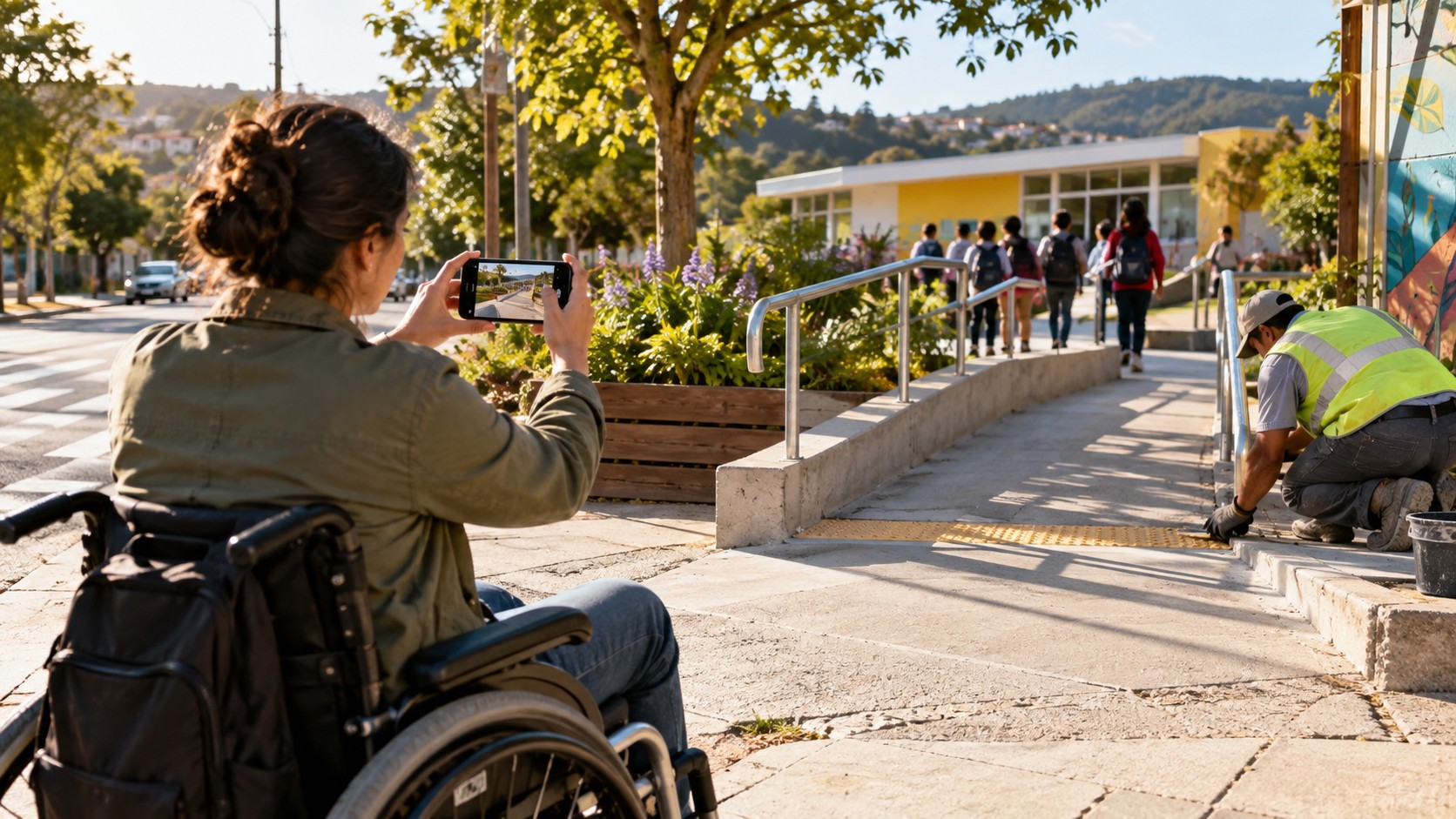
In an imagined scene, a mother has saved three replies about the stretch of pavement leading to school. The school knows about the difficulty, a neighbourhood association has offered support, and an office has suggested another contact. People are willing to help, but nobody knows who will pick up the next question. Each conversation starts again from the beginning. A local network becomes useful when it connects these offers without turning the person affected into a permanent messenger between institutions, neighbours and professionals.
An offer needs somewhere to go#
The damaged surface beside the trees is familiar to people who take that route. What would be new is separating the tasks that have become tangled together. Describing the interruption, receiving a report, assessing an intervention and keeping the community informed involve different kinds of work. Somebody may contribute to one without having the capacity for the others. Recognising that distinction prevents a friendly offer from sounding like a promise of repair, or a conversation without an answer from being mistaken for a lack of interest.
The damaged surface beside the trees is familiar to people who take that route. What would be new is separating the tasks that have become tangled together.
In this example, the school could acknowledge the observation and explain what it can pass on. The association could help organise the information if the family wanted that assistance. The organisation responsible for the location would need to clarify its involvement and the channel it uses. These are possible arrangements, rather than a description of services available in every neighbourhood. Before relying on an offer, the people involved would need to check its actual scope, availability and method of receiving requests.
A lengthy telephone list does not guarantee a connection. It may leave the person seeking help with more decisions than before: whom to call, what to repeat and who responds when nobody answers. A workable network often starts with something much more specific. Somebody agrees to receive a particular description and explains what happens next. That first connection does not repair the pavement, but it reduces uncertainty about the journey of the request and leaves more energy for other parts of everyday life.
Supporting a request without taking it over#
The family in the example might welcome help drafting a message while preferring to send it themselves. They might also want company at a meeting without asking anyone to speak on their behalf. Collaboration depends on the task; its terms cannot be inferred from difficulty travelling along a pavement. The person offering support can describe what they are willing to do and ask which actions would be helpful. Declining a particular offer neither cancels the relationship nor proves that offering assistance was pointless.
A shared draft makes that boundary visible. The person familiar with the route checks whether the description captures what happens there; someone helping with the writing can arrange dates or separate questions. If disagreement emerges, the document should not be sent as though consensus already exists. One person might want to describe only the turn beside the tree, while another favours a broader review. Both ideas can be recorded, but their authorship and the extent of agreement matter when they reach an outside recipient.
The same care applies to contact details. Knowing that somebody belongs to an association does not establish permission to circulate their number or add them to a messaging group. They may prefer an organisational email address or a conversation at a particular time. When coordination uses channels that people know and accept, each participant retains room to set limits on their response. Living nearby does not remove the need to ask, and personal availability does not automatically become an ongoing public service.
Sharing tasks while keeping a point of contact#
Suppose four people want to contribute. One can mark the location on a plan, another can gather observations already written down, a third can check the reporting channel, and a fourth can read the reply when it arrives. They need not all attend every discussion. This division helps when the tasks are manageable, understandable and accepted, and when their connections are clear. Otherwise, distributing work can produce four versions of the same request and multiply the calls that the arrangement was meant to save.
A simple record could hold the point on the route, the unanswered question, the channel used and the person who has agreed to keep contact for a defined period. Personal detail is not necessary to make that record useful. The documentation explains what needs attention, while individual preferences remain with those who expressed them. If a response requires additional information, it can be discussed before being supplied. Coordination then avoids collecting family histories that nobody needs in order to locate an uneven patch of pavement.
Being the contact person does not mean becoming the other participants' manager. The role may consist only of gathering updates and preventing duplicate messages. At a handover, the next person receives the necessary facts and open questions, rather than an unlimited obligation. Even a brief changeover deserves confirmation: somebody must know that responsibility for a task has passed to different hands. Silence in a group does not demonstrate that another participant has accepted follow-up, however many people have seen the most recent message.
Availability belongs inside the arrangement#
Neighbourly support may be unavailable on some days because people work, provide care, rest or have other commitments. Designing a network around continuous presence eventually concentrates work on whoever usually answers first. For the pavement issue, an agreed occasional enquiry would be more realistic than a promise of daily monitoring. The frequency can change if circumstances do. A worthwhile task is not necessarily compatible with every schedule. Acknowledging this helps people make commitments whose extent is understood, instead of quietly accumulating expectations.
Temporary accompaniment and environmental improvement also need to remain distinct. Company on a journey may be useful to someone who accepts it, but it does not show that access difficulties have disappeared. The network can hold both matters in view: responding to an immediate request and keeping the issue about the physical space open. Support retains its value when its limits are visible. A person might welcome company on one occasion and choose a different option the following day without having to justify that change.
There may be a part of the problem that none of the organisations contacted can address. Recognising the gap is more useful than continuing to pass the family's name between uncertain contacts. Whoever receives the enquiry can explain what they know, identify what remains unclear and check whether an appropriate recipient exists. If no recipient is found, the absence remains an unresolved question. The network does not need to appear comprehensive. It needs to avoid presenting a referral as though an effective answer has already been delivered.
A connection is tested when information returns#
The quality of coordination becomes apparent when a response comes back. A message reaching only the original sender may exclude the people who use the route and those who supplied observations. Sharing an agreed summary through a channel they can access completes part of that circuit. This does not mean automatically forwarding every exchange. The useful distinction is between what has been confirmed, what has been requested again and what still lacks a date or an adequate explanation from the organisation handling the matter.
A response might announce a visit to the location. Those interested could then agree how their experience will be conveyed without everyone having to attend. If somebody chooses to participate, their contribution should not be presented as the opinion of the whole neighbourhood. A broad network includes disagreements and needs that have yet to surface. Preserving that modesty leaves room for a new observation, even when it requires a proposal that seemed widely supported to be reconsidered or described more carefully.
For someone who recognises a similar situation, one possible step is to revisit a single unfinished conversation and identify where the connection was lost: who received the information, what they could do and who expected a reply. That small map can support a precise request to the relevant organisation. The mother in the opening scene does not need to assemble the entire neighbourhood before starting. It may be enough for the next contact to accept a defined task and make clear how she can reach them again.