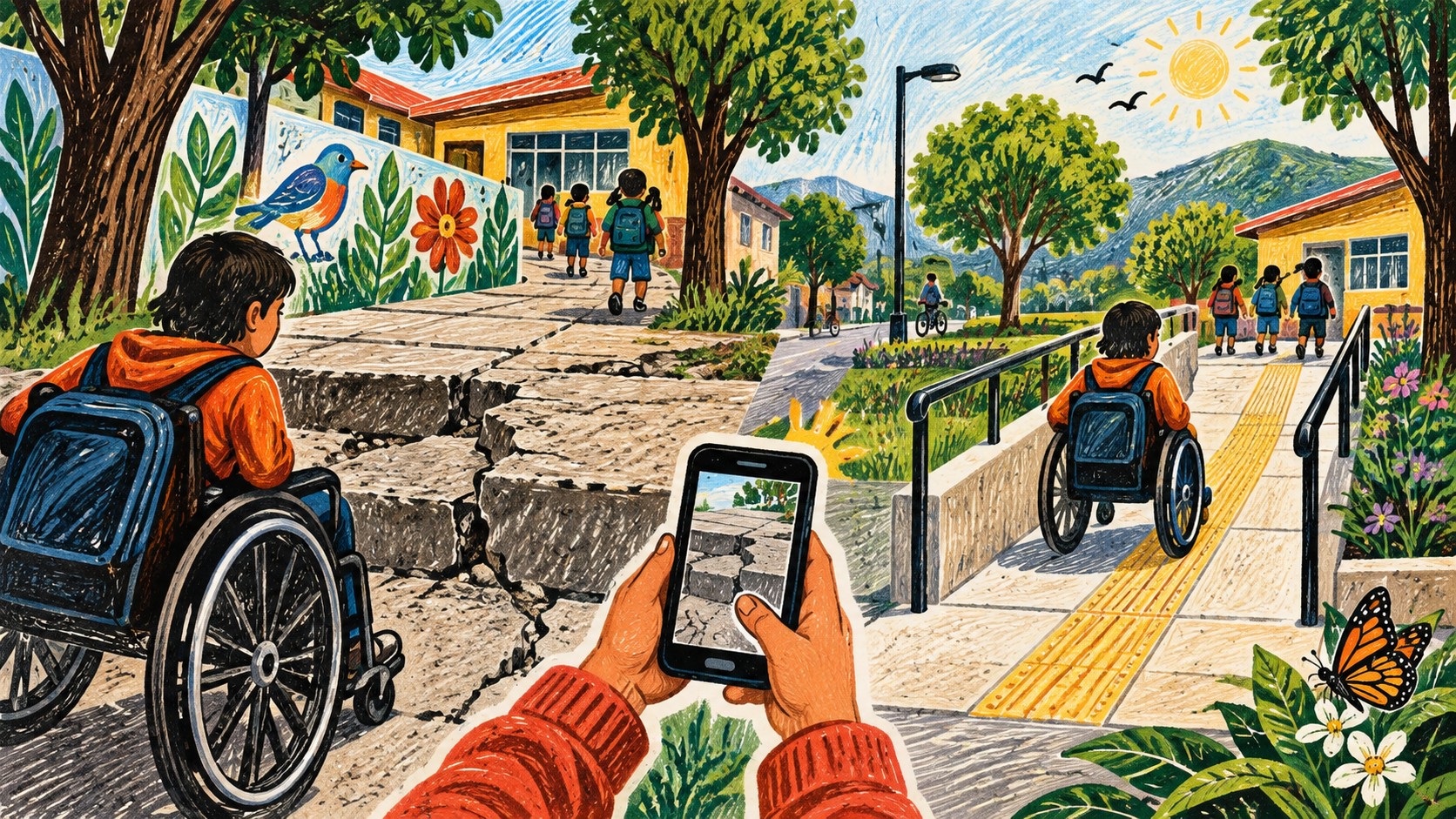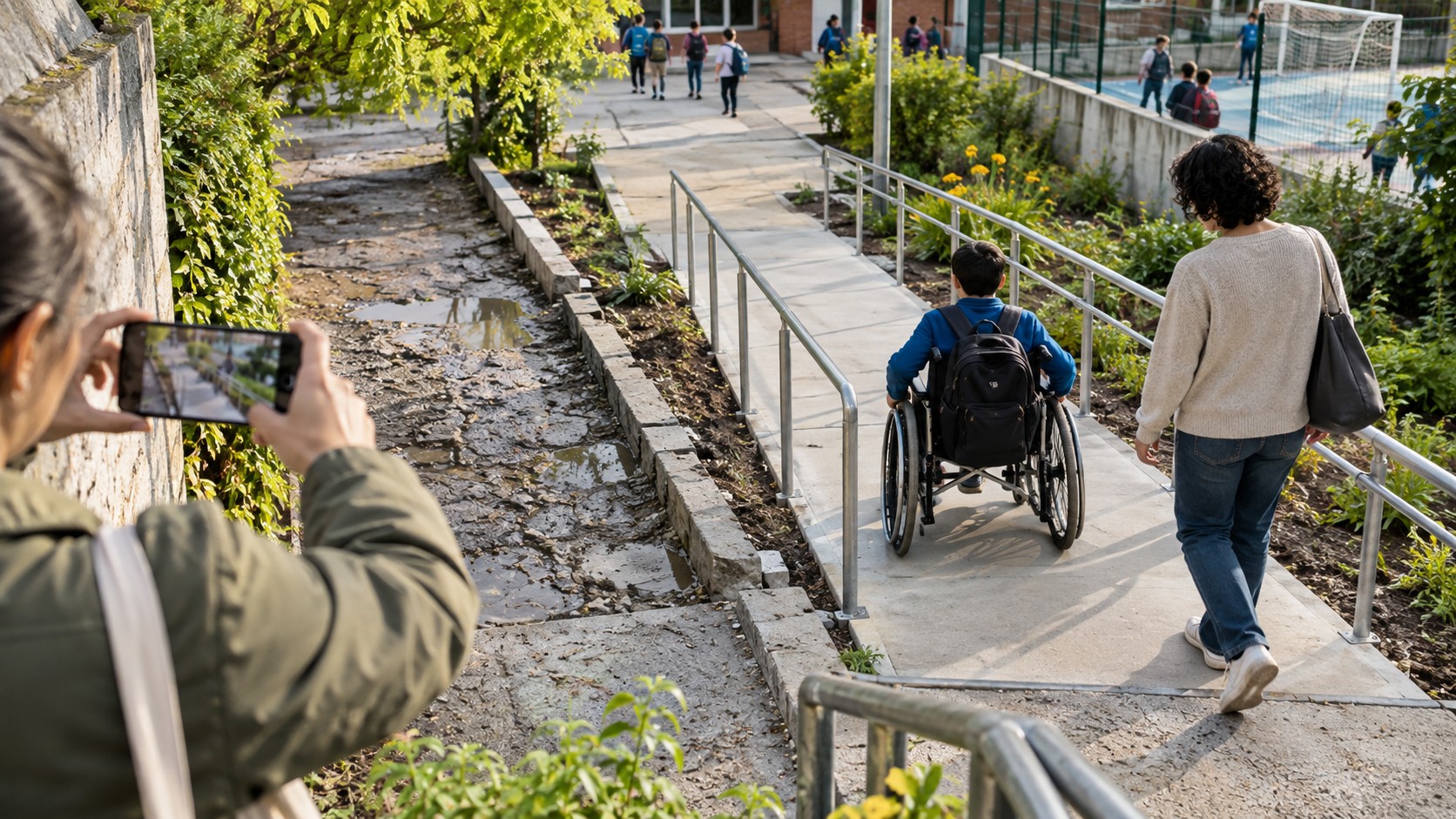
The phrase “difficult users” appears in a draft report. The scene is fictional: beside a school, some people stop where two paths meet, while others request a review of the signs. The message attributes the interruption to those passing through before describing what they encounter. Reading the phrase without knowing the location would be enough to imagine troublesome behaviour. Yet the report has not explained that two arrows on the same post point towards different destinations. Its wording has already selected someone to blame before it has located the actual problem in the surrounding space.
What a sentence makes it possible to investigate#
A differently written report might explain that, when approaching from the garden, it is unclear which path leads to the open entrance. This description does not establish the signs as the only cause or claim that everyone experiences the same difficulty. It does offer a checkable question: the relationship between directions, approach and access. Changing the language changes the work the message makes possible. The organisation receives a question about a place, rather than an assessment of people it could hardly know from a couple of lines describing a brief encounter beside a school.
A differently written report might explain that, when approaching from the garden, it is unclear which path leads to the open entrance.
Precision begins with identifying who observed what. One person might have seen several pauses without knowing the reason for any of them. Another might explain that they were looking for a particular entrance and did not understand the direction. Those accounts have different limits. A careful record preserves the distinction between observation and communicated experience. It does not turn a gesture into a conclusion about orientation, memory, independence or intention. This boundary strengthens the account by preventing an assumption travelling as a fact when a report moves from an email into a meeting or a maintenance note.
Concrete verbs generally contribute more to describing the site than adjectives applied to people. An arrow points, a door stays closed, a branch covers part of an instruction. By contrast, calling somebody distracted or clumsy defines them through an interpretation that does not explain how to improve the route. Language can concentrate on observed actions without denying the difficulty: stopping, returning, requesting information. An explanation of why those actions occurred remains open when it is unknown. A useful sentence does not need to supply every possible cause before it can help its recipient examine the location.
Describing a barrier without making it an identity#
In the school example, a family might report having to retrace their steps at the turn beside the garden because the advertised entrance was closed. The sentence describes a situation and an effect. It neither presents somebody as dependent nor makes the episode a permanent characteristic. On another day, with different information, the journey might be experienced differently. Keeping conditions central makes possible changes easier to consider. A personal label, however, can imply that the difficulty belongs to the person walking and therefore lies beyond the scope of any improvement to the surrounding environment.
A wish to avoid labels does not require hiding words that people choose for themselves. Someone may consider a disability or a particular need relevant and describe it in their own terms. The problem arises when others infer an identity, simplify it or circulate it unnecessarily. Documenting a barrier does not demand classification of those encountering it. A deliberately shared experience can be included where it adds context, with a clear distinction between the account belonging to its author and a general description of the path that the organisation is being asked to examine.
Even an apparently complimentary expression can shift attention away from the issue. Calling somebody admirable for completing the route turns an everyday activity into a story of exceptional achievement. The report stops asking why a direction is missing and starts celebrating that someone arrived despite its absence. A communication intended to improve a place benefits from retaining the ordinary task: reaching school, finding an entrance, following a path. Personal recognition cannot replace a description capable of identifying which condition might be obstructing that activity, or explain what the responsible organisation could usefully investigate next.
Somebody's voice is not freely available material#
A spontaneous conversation beside the signpost is not an agreement to reproduce it in a public document. If a phrase helps explain the incident, the writer can ask whether it may be included and for what purpose, or simply describe the spatial condition without personal attribution. Names, ages and recognisable faces are unnecessary to show that two directions are difficult to relate. A detail's relevance depends on what it helps establish about the problem. Biographical information does not automatically become valuable because it makes a message feel more emotional or gives the account a more personal tone.
The eventual destination of the text matters as well. A maintenance note and an open social media post have different audiences. The first recipient might need an exact location and a contact for clarification; the public post could reveal arrival routines that nobody expected to share. Before reusing the report, its author can reconsider what information remains necessary and whether those mentioned agreed to that additional use. Copying a paragraph is easy, but ease does not expand the permission under which its content was obtained or transform a casual comment into a public testimonial.
Photographs call for a separate decision. A frame showing signs and paths without identifiable people may be enough to illustrate confusion at the junction. An image in which somebody appears hesitant can encourage interpretations the text is trying to avoid. It cannot establish, by itself, which information was missing or how an arrow was understood. An editorial or illustrative picture accompanies the subject; it does not verify a hypothetical episode. Preserving that distinction protects both the people represented and the clarity of the evidence, particularly when an image circulates separately from the explanation originally placed beside it.
Courtesy should not erase the difficulty#
Careful language can remain firm. Saying that somebody might feel slightly uncertain is less precise than stating that the indicated entrance was not open during the advertised period. Softening every word can remove the very condition requiring a response. Avoiding blame means not assigning unsupported intentions; it does not mean denying a closed door or a contradictory notice. A message gains strength by describing facts, limiting inferences and making a concrete request. Its respect comes from accuracy, rather than from making the event appear unimportant or suggesting that asking for a review is an inconvenience.
At a meeting, someone might explain that they have always arrived through that route without difficulty. A reply need not dispute their experience. It can acknowledge that the route is clear to them and add that the directions seen from the garden present another situation. Different experiences can then coexist without ranking who understands the space better. Disagreement becomes manageable when it concerns a condition that can be reviewed. Framing the discussion around capable or inattentive people risks turning it into an informal assessment of those who requested an improvement in the first place.
The final request could ask for a review of the relationship between arrows, available entrances and the communicated timetable. It need not demand a particular technical solution or promise that changing one sign will resolve every difficulty. Those responsible for the site can assess the appropriate intervention. The community message contributes the viewpoint from which the barrier was encountered and its practical consequence. That is enough to initiate a check. The account does not have to imitate an expert report before the organisation can regard it as information deserving attention and a considered response.
Reading the draft before it travels#
A brief editorial reading can look for three common shifts. The first turns an observation into an assumed motive: someone stops because they are not paying attention. The second allows an episode to define an identity: that person cannot find their way. The third makes one individual's experience stand for an entire group. In each case, revision returns to what is known, attributes communicated information carefully and removes unsupported additions. This is more than replacing a list of forbidden expressions with a list of approved ones. The essential change concerns what the writer claims to know.
The revised version can retain inconvenient but necessary qualifications: the report records one experience, access was not checked from the opposite end, or responsibility for updating the sign remains unclear. These boundaries help the recipient choose what to verify. If further information arrives, the wording can be corrected without presenting the correction as a defeat. The record supports learning about the site. Its purpose is not to freeze an initial interpretation and defend it against every subsequent detail that might change the understanding of what happened beside the junction on that particular occasion.
Here the next action could be as concrete as replacing the first draft with a report about two arrows, an approach from the garden and an entrance that did not match the announcement. The person ceases to be what the document assesses; the route becomes what it examines. Such a communication can request improvement without requiring anybody to carry a label in order to justify it. Precision gives the recipient something they can review and gives people using the place an account in which they do not have to defend their character before their difficulty is heard.