From the pavement, the entrance looks clear. Yet in a hypothetical scene, a neighbour stops before reaching the community centre door and eventually takes a detour. Someone else assumes she has missed the side entrance. Before pointing it out, they could ask which part of the route is making passage difficult. The answer might reveal a heavy door, an object positioned at the turn or a sign readable only from a different height. A route cannot be understood solely by looking at it from outside.
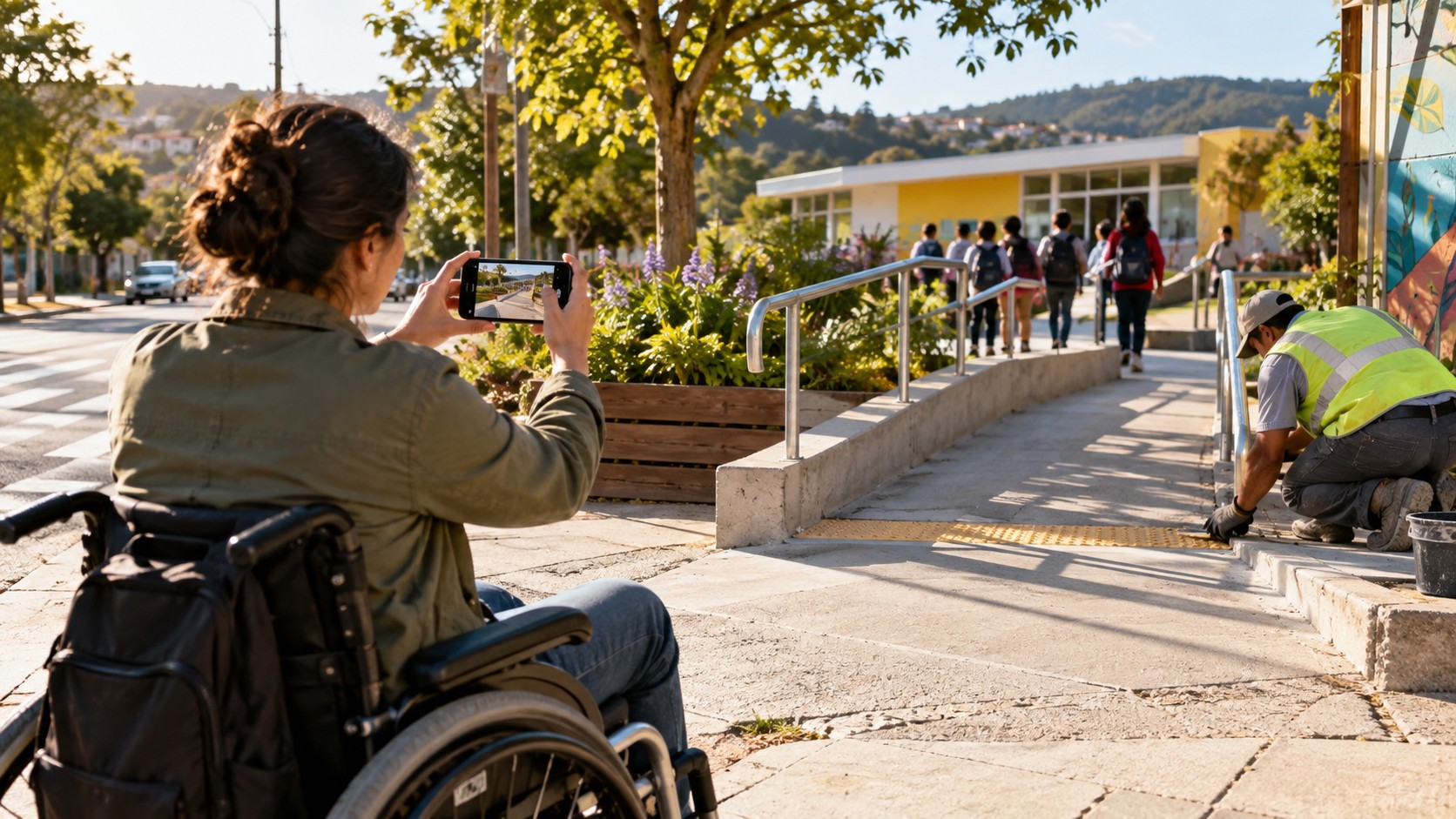
A detour supplies a question rather than an explanation#
Noticing somebody take another path reveals a difference, not automatically its cause. They might be avoiding an uncomfortable surface, seeking shade, accompanying someone or choosing another destination. Treating the detour as proof of inability would assign a story they have not told. The useful question in this scenario concerns the route and permits an unexpected answer. It also allows the neighbour to decline an explanation while she is trying to reach an activity that is about to begin. Her journey need not become an impromptu public lesson.
Noticing somebody take another path reveals a difference, not automatically its cause.
The approach matters because even a question can interrupt. Offering a brief conversation without blocking passage or touching another person's belongings leaves room to accept or decline. There is no need to demand a complete account of their body, age or circumstances. If they wish to identify a particular difficulty, that information is enough to start with. Neighbourly interest can focus on an environmental barrier without turning the person encountering it into an object of public attention or requiring them to explain their entire experience to strangers.
A straightforward answer might locate the problem in a planter that narrows the turn beside the door. Someone walking straight ahead barely notices it; someone needing to change direction has less space available. Stating that other people have managed to enter does not resolve that difference. It describes different conditions of use. Listening alters what the observer sees: the planter ceases to be merely decoration and becomes an object affecting an ordinary movement. Its attractive appearance and its inconvenient position can both be acknowledged without contradiction.
Following the whole route#
Mentally removing the planter does not establish that access is resolved. The route begins earlier and continues afterwards: arrival from the pavement, approach, turning, opening the door and entering the interior. A visible ramp in this example might lead to a closed door with a bell that is hard to locate. Asking about the precise point of difficulty helps prevent isolated fixes. The person using the route contributes knowledge about its continuity; a photograph of the most noticeable feature might leave out the detail that actually determines passage.
A usual condition also needs to be distinguished from a temporary circumstance. Perhaps the planter normally stands further away and was moved during a delivery. Perhaps a noticeboard obstructs the entrance every afternoon. Frequency changes what would need reviewing. Recording when an obstruction is observed makes a specific account possible without claiming that it happens constantly. A temporary explanation does not remove the effect either: if passage is blocked during an activity, the problem deserves attention even if it disappears after the building closes for the evening.
Experiences can differ without invalidating one another. One visitor finds the turn difficult, another needs somewhere to rest and a third cannot distinguish the entrance sign. A single conversation cannot establish a universal need. Voluntary observations may reveal several aspects of the route and different priorities. The centre's task would be to understand them with those responsible for the premises, rather than selecting the most convenient testimony as evidence that the entrance already works for everyone. A varied account provides more useful questions than a competition between visitors.
Recording an obstruction without exposing its user#
A useful note can describe the location, time and action that proved difficult: turning beside the door while the planter occupies that spot. This is more precise than claiming the centre is inaccessible in every respect, which the observation does not establish. Nor does the description need the neighbour's name. An account of the environment can keep the issue understandable to its reviewer without retaining personal details that add nothing to a decision about where an object should stand. Precision and discretion can support the same practical purpose.
If an image appears necessary, its framing can concentrate on the obstruction and its relationship to the passage. Faces, registration plates, children or identifiable details of people's routines are not essential to showing the planter's position. The person who explained the difficulty retains a choice about appearing in the account. Asking her to repeat the movement for a more convincing photograph would impose additional work and might place her back in the uncomfortable situation the observation is intended to address. The image should serve the issue, not demand a performance.
A measurement or drawing may explain a layout, but neither alone constitutes a technical accessibility assessment. Where specific criteria are needed, suitable sources and professionals should be consulted for the particular premises and proposed intervention. The neighbour's record serves a different function: making a difficulty locatable that might otherwise disappear into a general complaint. It can include what remains unknown. Acknowledging that limit helps the responsible organisation determine which checks are required before making a decision, rather than mistaking an initial observation for a completed professional evaluation.
Reaching someone able to act#
The conversation gains continuity when the observation reaches the centre or organisation managing that entrance. Identifying an available channel and stating the request gives the communication a purpose: review the turn, examine the object's position or clarify how the entrance operates. A complete construction proposal is unnecessary. A definite request allows a definite response and prevents a photograph from circulating indefinitely among neighbours without reaching anyone who can inspect the site or authorise a change. Sharing an image widely is not the same as directing a report effectively.
The recipient may need to distinguish an immediate correction from an intervention requiring further assessment. Moving objects in a shared space without agreement could create another obstruction or interfere with their function. Neighbourly initiative need not therefore mean physically rearranging the entrance. It can mean reporting, describing and asking what action will follow. If the situation appears dangerous at that moment, the appropriate attention channel should receive the information. Recording evidence should not become a reason to remain exposed to a hazard or invite someone else to repeat a risky movement.
The response needs to retain its actual status. A receipt acknowledgement is not yet a repair; an announced visit does not show that the problem has disappeared. Nevertheless, it can represent identifiable progress within a process. Recording what the organisation replied and when it expects to inspect the location enables understandable follow-up. The neighbour need not be made responsible for chasing every administrative step. Nor does the incident need to become a contest over who cares most about the area or whose concern is most deserving of attention.
Asking again after a change#
If the planter is repositioned, the useful check concerns the route that previously caused difficulty. The entrance may look better without providing enough turning space, or the obstruction may simply move somewhere else. A review involving users who choose to participate supplies information different from a photograph of completed work. Nobody should be required to demonstrate publicly that a repair succeeds. The check can centre on the environment and the conditions intended to change, giving participants room to report limitations without being treated as ungrateful for the effort.
A change may resolve this problem while leaving others outstanding. Describing the result accurately recognises progress without declaring the centre's entire accessibility settled. It also preserves what was learned: the issue was not a neighbour needing directions to a door, but a layout making a particular journey difficult. That understanding can become part of opening routines, decisions about noticeboards or arrangements for materials during deliveries. A one-off observation becomes more useful when it informs ordinary practice rather than surviving only as the memory of a complaint.
Someone noticing a similar difficulty could next prepare a brief account of the location, ask whether the affected person wishes to add anything and pass it to the responsible organisation. The scene ends better when its initial question produces a change that can be checked, rather than when somebody wins an argument about the intentions behind the planter's placement. Caring for a shared place starts by accepting that a route appearing obvious from one position may require another reading through the experience of the person who actually travels it.