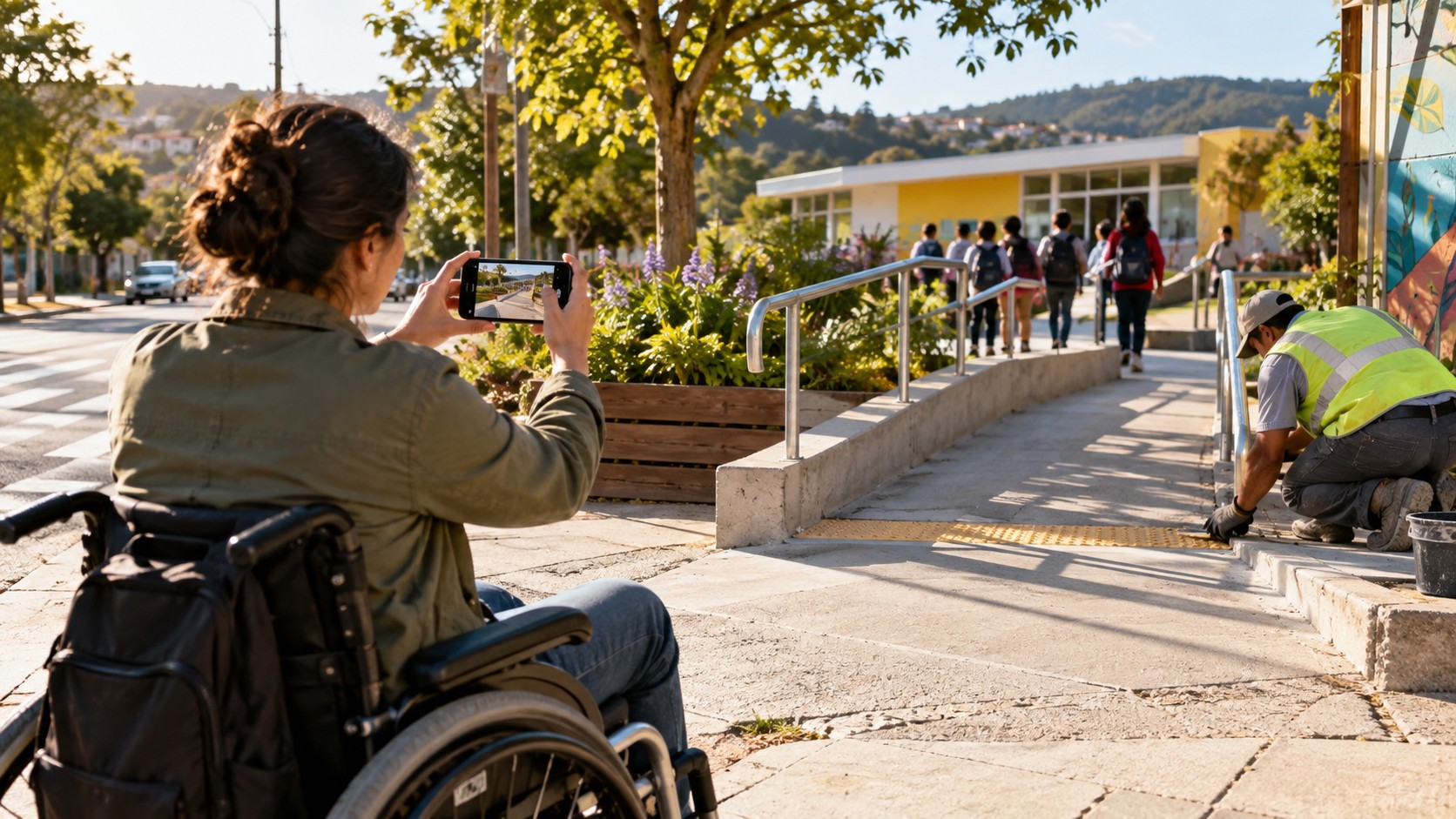
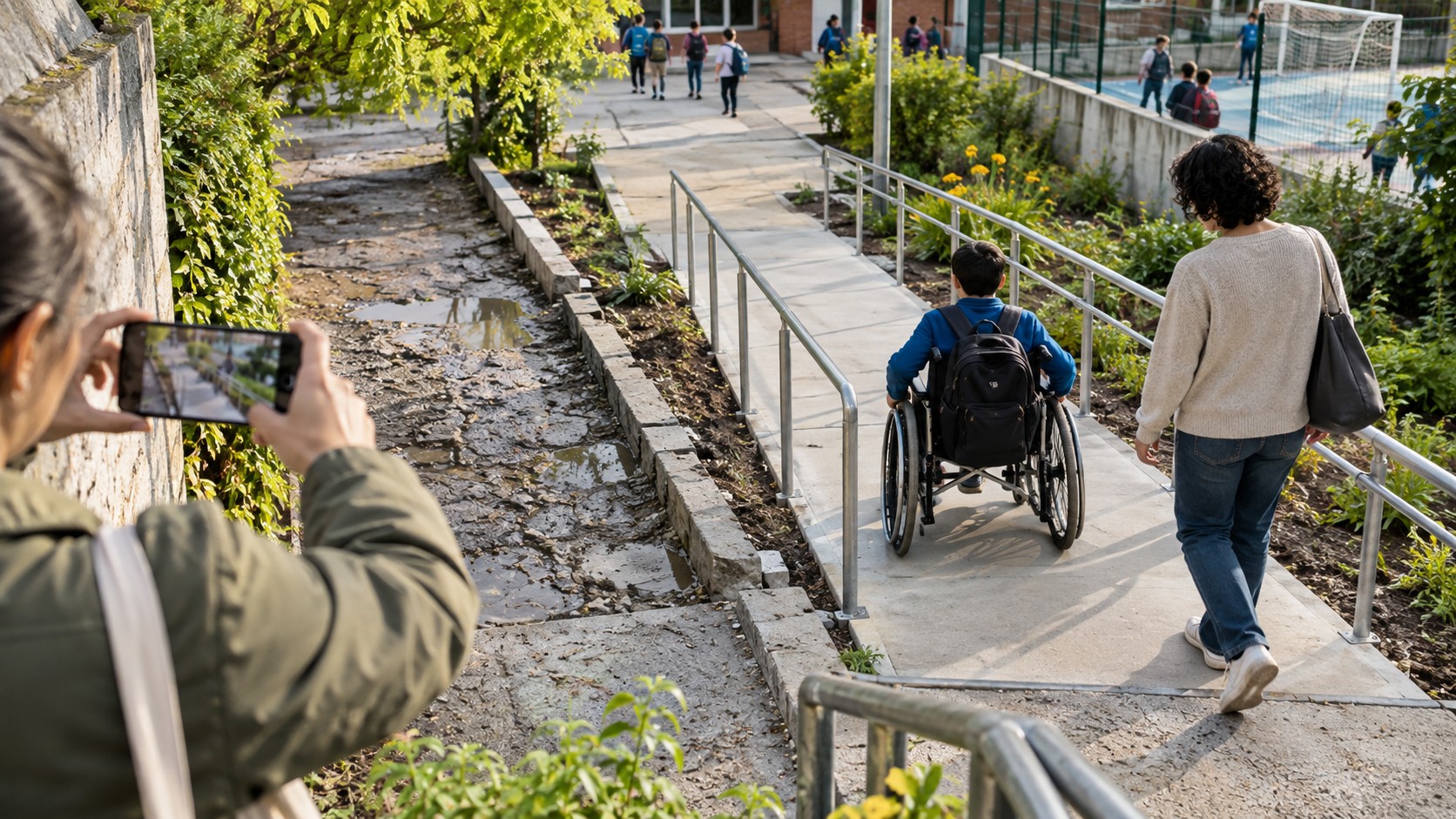
At nine, the passage beside the little garden is clear. Half an hour earlier, in an imagined scene, two waste containers await collection there, making people go around the far end of the square. The difference seems unimportant to someone visiting later. For a person heading to school with little time to spare, that half hour falls exactly within their journey. A recurring difficulty can remain invisible because the people encountering it and the people checking the space arrive at different times.
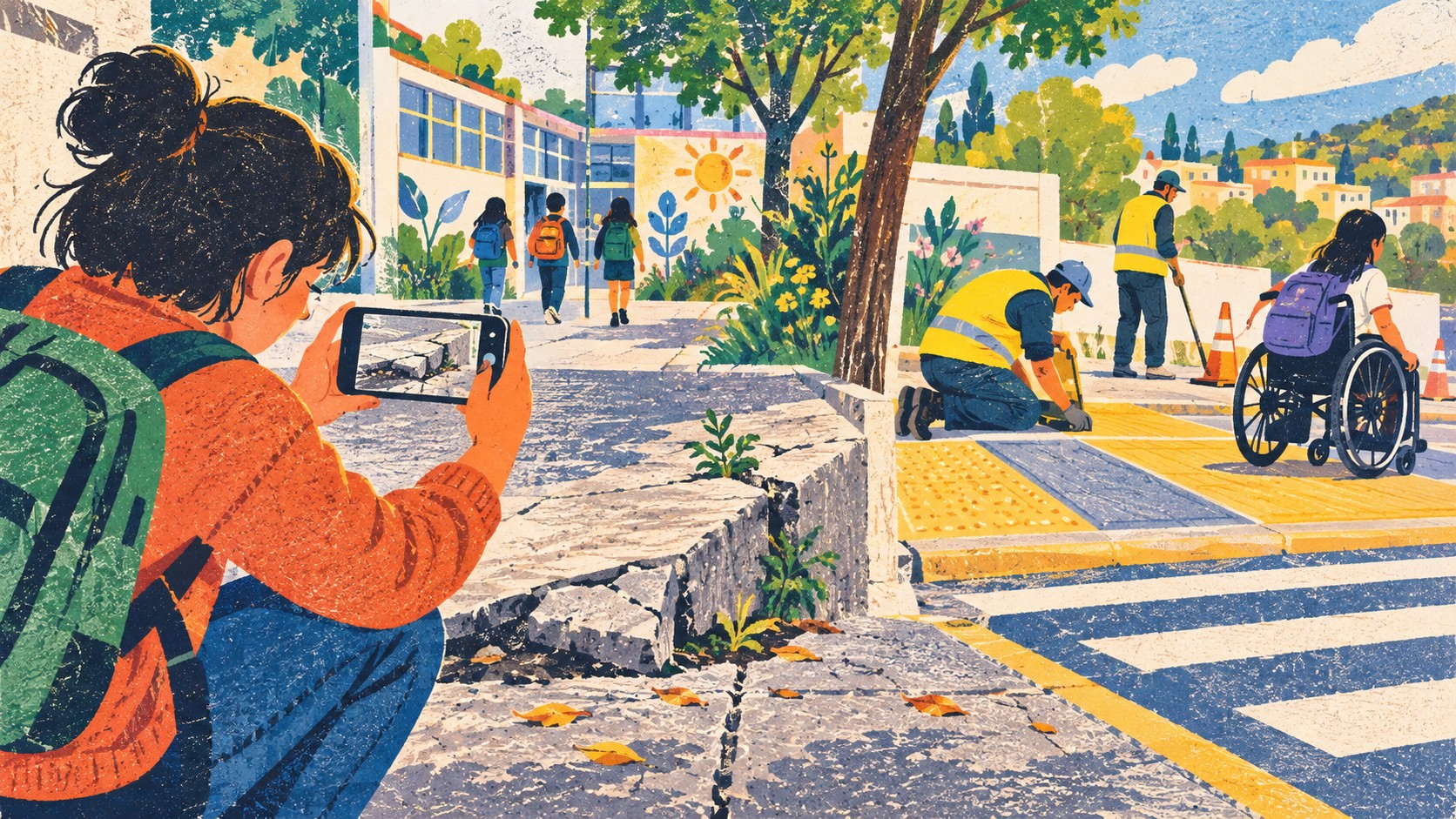
The clock belongs in the picture#
This example allows a barrier to be considered without assuming that anyone is careless. The collection needs organising, school starts at a particular time, and the garden occupies land that cannot simply become a storage area. Each activity works in isolation. The problem arises when they overlap. A photograph of the empty square accurately describes one moment, but cannot account for the entire morning. Understanding a shared place involves noticing what happens between two pictures that are both truthful.
This example allows a barrier to be considered without assuming that anyone is careless.
The person walking around the containers might never make a complaint. Arriving on time may feel more urgent; perhaps somebody else has already reported it, or explaining a minor inconvenience seems likely to involve too much effort. Their silence does not establish that the route works. Neither does it authorise anyone else to tell their personal story. The observable point is narrower: while collection is being prepared, one section stops providing the route available for the remainder of the day.
Locating that condition changes the discussion. Instead of arguing about whether the square is satisfactory overall, people can ask what happens during a specific period. An initial disagreement may reflect different schedules rather than inaccurate accounts. Someone opening a shop at ten never encounters the containers; someone passing before school sees them regularly. Bringing both perspectives together helps describe a sequence without making one person's routine the universal measure of how the neighbourhood operates each morning.
A small observation with clear boundaries#
A short note could identify the section, date and approximate time, along with the arrangement observed. It can also explain the limits of the observation: the passage was occupied when somebody crossed the square, but they did not remain to establish how long it stayed that way. This precision avoids turning an impression into a claim about the whole day. A brief record becomes more credible when it distinguishes what was seen from what still needs checking.
There would be no need to follow collection staff, identify vehicles or film children arriving at school. The purpose is to understand how a place is occupied, rather than compile a record of the people working or travelling there. A sketch of the corner and a description of the objects might provide enough information to begin. If an image is included, it can focus on the passage and exclude people. A growing collection of photographs does not necessarily clarify a question that fits into several sentences.
On another morning, the containers might stand farther away. That difference deserves a place in the note, even if it appears to weaken the complaint. It might reveal an alternative already used on some occasions, or result from an unusual circumstance that remains unknown. Keeping the variation visible supports a useful enquiry: what determines where the containers wait, and could that arrangement prevent the passage being interrupted during the period when people are arriving for the school day?
An inconvenience does not need an audience#
A neighbourhood conversation may begin with an irritated remark about something always being in the way. Repetition can understandably wear people down, but that remark gives the recipient no defined task. Describing the overlap between collection and school arrival offers a more precise starting point. It does not require minimising the detour or proving that everyone experiences it equally. A real difficulty can be acknowledged without turning the report into an accusation about the intentions of a service.
A local messaging group might help identify the appropriate contact. However, forwarding pictures every morning can also generate comments about workers, families or shops. Useful information disappears when the discussion becomes a search for someone to blame. A summary can contain the observed sequence and the outstanding question, leaving out names and personal interpretations. Keeping attention on the organisation of the passage makes the conversation more likely to lead to a concrete check by someone able to follow it through.
Participation does not have to be measured by the number of signatures either. One well located observation can provide a reason to review how a place works. Others may add experiences voluntarily, without exposing private circumstances. Nobody should have to describe a health condition or family situation to draw attention to a visible interruption. Understanding the section of path is a legitimate task before anybody starts classifying the people who use it or comparing whose inconvenience deserves greater consideration.
A question that can receive a usable reply#
The organisation managing the space can receive a straightforward message: the precise location, the period when it was found occupied and the effect on the route. The request might ask for the waiting position during collection to be reviewed. It need not assume that changing a schedule or moving a container is simple. Several responsibilities may be involved. That is exactly why the report needs to reach a channel capable of identifying how this particular use is organised.
An initial reply might establish that the location belongs to another service. That clarification is valuable if it provides a recognisable way forward. When a message simply moves between contacts without anyone acknowledging responsibility for receiving it, the person reporting becomes a permanent intermediary. A reference or a specific indication of who will examine the issue reduces that burden. The aim is not an instant remedy, but to prevent every enquiry starting as though the previous conversation had never happened.
A constraint not visible in the scene may also emerge: the alternative position interferes with another task. Learning this does not cancel the difficulty on the path. It adds a condition that needs to be considered when looking for a better arrangement. People using the square can explain when it is busiest, while those organising collection can describe operational needs. Improvement depends on connecting that information rather than deciding in advance which of the two activities deserves to matter more.
Checking at the time that made the difference#
If a different position is tried, the most relevant check takes place while the containers are still waiting. Returning at ten would produce the same clear view that concealed the original problem. The question is whether the route remains usable during the overlap, and whether the change has created a difficulty elsewhere. An agreed review can examine that condition without asking anyone to repeat a detour or become the subject of a public demonstration for the neighbourhood.
The result might be modest but specific. A new arrangement may work on ordinary days and fail when the amount awaiting collection increases. That identifies what remains unresolved, rather than forcing a verdict of complete success or total failure. The record can keep one sentence about the change and another about the circumstance still requiring attention. Proportionate follow up needs enough information to support learning; it does not need to become daily surveillance of everyone moving around the square.
For somebody recognising a similar situation, a possible beginning would be to note when an obstruction appears and which journey it interrupts, after attending to their own travel. That small difference in timing may give the responsible organisation the clue a general photograph cannot offer. Care for the place becomes concrete when the review reaches the hour at which somebody needs it, and when an improvement no longer depends on that person finding a private way around the same obstacle every morning.