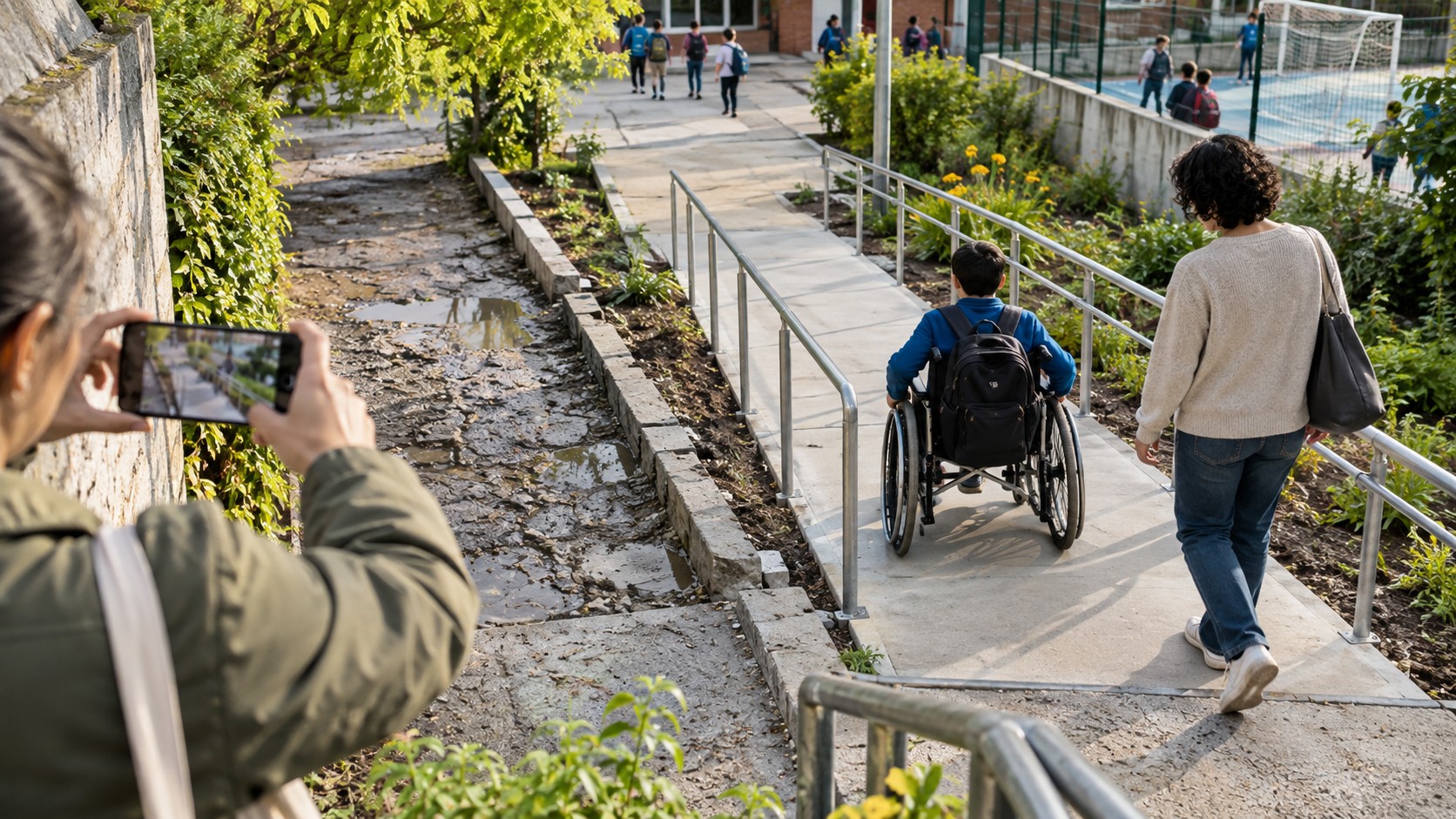
The folding table reappears beside the ramp every Friday. In this hypothetical example, a centre opens its courtyard for a book exchange, and the first team puts boxes there because the door is close by. Another group arrives later and continues setting up where the materials are already standing. Nobody remembers choosing that spot for storage; there is no instruction explaining where anything belongs. The discussion about the passage returns every week because the arrangement depends on somebody remembering to make the same request.

A useful agreement starts with a limited task#
In this scene, a general request for greater consideration would probably meet with agreement. Yet the following Friday the boxes would need a destination again. A useful arrangement addresses that outstanding decision: where preparation begins, which space remains available and who guides people bringing materials. Clarifying this prevents care becoming a matter of correcting behaviour after the event. It also allows preparation to stop depending on newcomers guessing what previous participants already happen to know about the courtyard.
In this scene, a general request for greater consideration would probably meet with agreement.
The people organising the exchange have a legitimate need to unload and sort books. Those crossing the courtyard need a usable route while that happens. These purposes do not have to compete, nor does one need to be presented as a concession granted by the other. An agreement can seek a way to prepare the event alongside the building's ordinary use. If the available space cannot accommodate both, that limitation belongs with centre management rather than disappearing beneath an encouraging promise.
Defining the task also stops a small meeting becoming an attempt to regulate every aspect of courtyard life. The example does not require decisions about how each visitor will behave, how long they may stand around or which conversations they can have. It requires a location for materials during preparation. Keeping that scope makes an agreement easier to understand, try and revise. A rule attempting to explain everything eventually becomes harder to remember than the difficulty that prompted it.
People affected by the change have knowledge to contribute#
The staff opening the building may know an available corner, while those carrying boxes understand how unloading works. People using the entrance can point out whether the proposal occupies another necessary part of their route. These contributions are different, but they complement one another. A short conversation can bring them together without requiring everyone interested to attend an assembly. Equally, somebody's absence should not be interpreted as agreement with whatever distribution the group would find most convenient for itself.
Participation can take several forms: an observation after the event, a message to the centre or a response to a simple drawing of the proposal. This reduces dependence on a single meeting held at a particular time. Somebody unable to attend keeps a way to identify an effect the team overlooked. The purpose is not to collect opinions endlessly, but to let needs directly connected with preparation enter the decision before an arrangement becomes established through repeated use.
In the example, the suggested corner turns out to hold cleaning equipment temporarily. Using it without consultation would transfer the conflict to another, less visible task. Discovering this does not mean abandoning the book exchange. It means considering work already happening there. A thoughtful agreement may require a different option from the one that seemed easiest during the first discussion, or coordination with the person responsible for allocating space among the activities carried out in the building.
An instruction that survives a change of team#
Once a workable position is agreed, the group could prepare a short note for the start of each session. It would indicate the authorised place for boxes, the route being kept available and whom to consult if a difficulty arises. It would not need to name the person who originally raised the issue. The arrangement protects a shared use of the courtyard, rather than representing an exceptional favour applied only after checking whether a particular individual is present.
The way this information is delivered matters. Text buried in an old conversation may never reach somebody joining for the first time. An instruction accompanying the preparation materials, or a brief explanation when the key is handed over, places the agreement where the decision is made. The centre can choose an appropriate format. What matters is that organising the event no longer depends on remembering exactly who attended the discussion or knows which participant to ask for an explanation.
The agreement also benefits from distinguishing practical guidance from permission to alter the building. Choosing a waiting position for boxes does not authorise painting floors, installing objects or changing entrances. Such interventions would require the appropriate assessment if they became necessary. A note can explain the agreed use without improvising physical alterations. That preserves its everyday usefulness while keeping visible the boundary around what the organising team can decide within its own role and what requires someone else's responsibility.
An incident offers information rather than a culprit#
On the first trial Friday, a larger than usual delivery might arrive. If the boxes do not fit, the response need not begin by identifying somebody who broke the agreement. The situation reveals a variation the arrangement needs to accommodate. Whoever coordinates preparation can consult the centre about an alternative position. Having a recognised route for that question prevents each participant solving it independently, with good intentions but without knowing the requirements of other activities happening nearby.
A reminder can refer directly to the object and its location: there is an agreed waiting place for that material. It does not require a public reprimand, a photograph of whoever placed it or a list of offences. The agreement would lose its purpose if keeping the route available meant monitoring the participants. Attention can instead focus on whether instructions arrived, whether they were understandable and whether the layout worked with the actual materials. Those questions provide ways to improve the arrangement.
Sometimes a person knows the agreement and still challenges it. The disagreement can be taken to the centre's coordination, without turning the person who needs to pass into the event's referee. Their journey should not be suspended while they persuade every participant. An identifiable responsible person can receive the discussion and review whatever needs attention. Allocating those tasks protects both access and volunteers, who may be helping enthusiastically without having authority to resolve every dispute about use of the building.
Reviewing the arrangement without grading its users#
After several sessions, a review could concentrate on three observations: whether materials found a place, whether the route stayed available and whether the incoming team received the information. There would be no need to score groups or count which person received most reminders. Those figures reveal little about the arrangement's quality. Discovering that the note remains inside a box arriving at the end of unloading, however, explains why a perfectly clear instruction appears too late to help.
The review may lead to a simple adjustment: include guidance in advance preparation, reduce the quantity delivered at once or discuss another layout. None of these options automatically suits every courtyard. Their value comes from connecting the adjustment to what was observed. An untested suggestion can remain labelled as a suggestion. Mistaking the existence of a written agreement for a working arrangement would allow everyday experience to disappear behind the document that was supposed to make participation easier.
A group facing a similar problem could begin by gathering the minimum information about its next session and writing an agreement that a newcomer can use without knowing the conflict's history. The test lies in that handover: finding a place for boxes, keeping the route available and knowing where questions belong. The arrangement protects people when preparation involves fewer interruptions, and when the same individual no longer has to return every Friday to explain that they also need to cross the courtyard.