There are moments when continuing to produce does not clarify a decision; it merely adds noise. A meaningful pause does not abandon creativity. It gives a fragile intuition enough room to show what it needs.
On a desk there may be an open notebook, a list of ideas, and a screen crowded with tabs. From the outside, the problem can look like a lack of drive. Often the person has already gathered material, tested an opening, and noticed a possible direction. What is missing is not another instruction, but time for that first mark to stop competing with every alternative. When every minute must prove its usefulness, attention begins to monitor itself and the process narrows.
Stopping is part of the work#
A helpful pause is not leaving a task for forgetfulness to solve. It has a clear edge: execution stops so the underlying question can be noticed. It might last for a short walk, the time needed to put materials away, or an afternoon without opening the file. Its value is a change in the relationship to the outcome. Instead of demanding that an idea become a product immediately, it allows a person to ask whether the chosen form, pace, and expectation still serve the original intention.
A helpful pause is not leaving a task for forgetfulness to solve. It has a clear edge: execution stops so the underlying question can be noticed.
Many creative decisions wear down through accumulated tiredness rather than a shortage of ability. Someone who is tired may revise a sentence ten times when it already contains what matters, switch tools without a reason, or seek opinions before hearing their own judgment. A pause introduces distance. It cannot promise a brilliant answer, but it makes it less likely that urgency will be mistaken for importance. Returning after breathing helps separate a difficulty worth working on from a pressure that simply demands compliance.
A notebook that owes nobody a result#
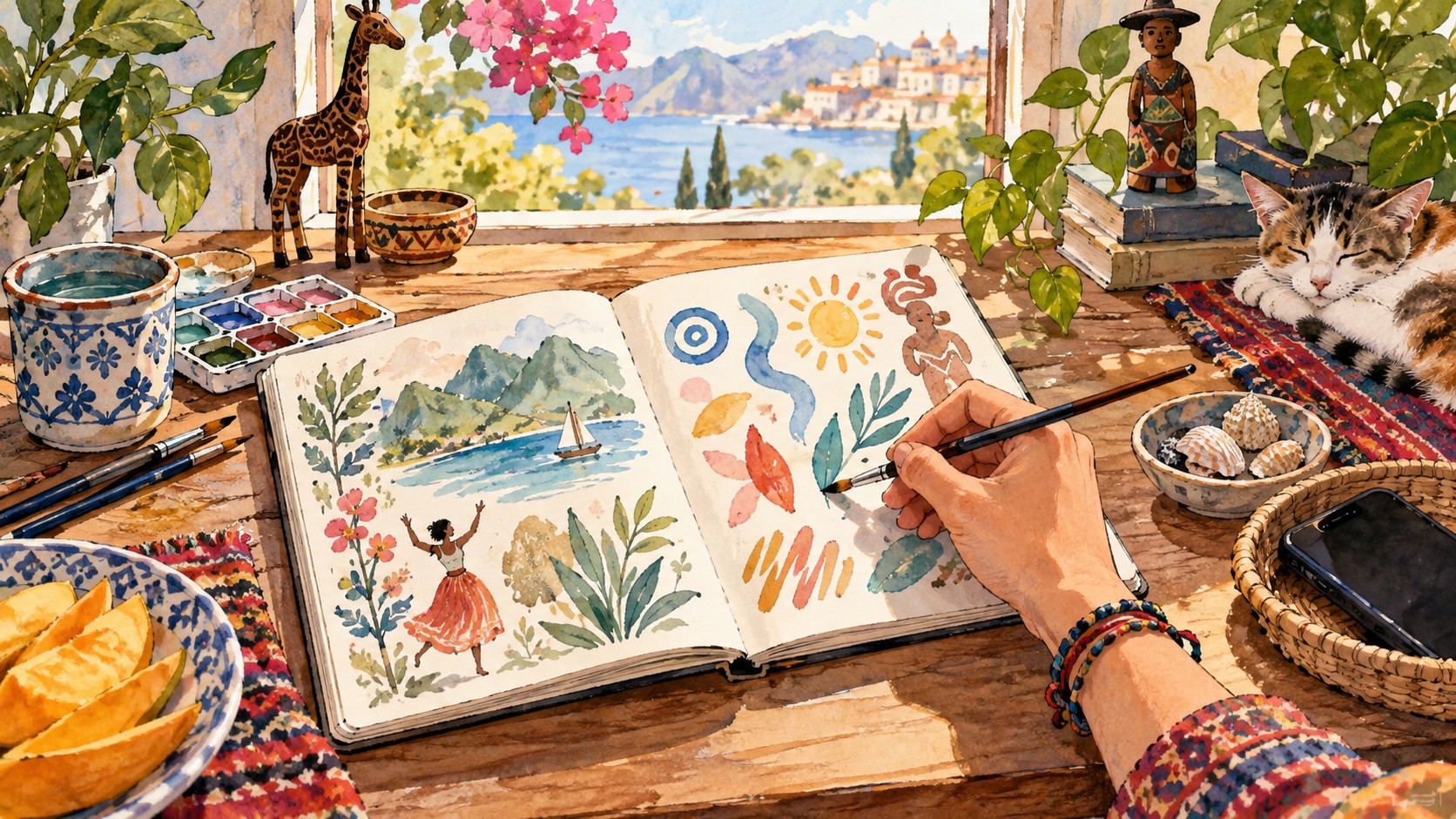
A notebook becomes especially valuable when it is not required to prove talent. It can hold crossed-out lines, unfinished drawings, words without a destination, and questions with no shape yet. That freedom is neither childish nor unproductive. It preserves information that early evaluation would discard: unusual associations, memories, shifts in tone, and uncertainty about how something should be told. The notebook protects the right not to know before making a choice.
When a process is crossed by constant comparison, even this private space can fill with imaginary metrics. A person may wonder whether a page is original enough, fast enough, or shareable enough. A meaningful pause suggests another measure: did this session help someone see more clearly? Sometimes the answer is yes because a piece was made; sometimes it is yes because it became clear that the piece was not needed. Both conclusions can guide the next step without turning creativity into a silent contest.
Noticing the body without diagnosing it#
Fatigue, irritation, or distraction do not by themselves explain what is happening to anyone. An editorial text should not interpret a person's health or history. It can acknowledge that long periods without a change of rhythm may make choosing, revising, or collaborating harder. If discomfort persists, becomes stronger, or causes concern, it is respectful to consult a suitable health professional or trusted person. Seeking guidance does not contradict creative autonomy; it supports it.
In ordinary life, a pause may be simple: drink water, look through a window, clear a surface, or say aloud what the work was trying to resolve. These are not universal prescriptions. They are small transitions that can prevent one rushed decision from being followed by another. The point is not to use rest as a technique for extracting more output, but as an opportunity to regain presence. Creativity needs material and relational conditions, not individual willpower alone.
Return with a small question#
Coming back feels lighter when it does not require solving the whole project. A small question can open the door: which part of the draft still has energy, what information is needed to choose between two paths, or who could hear the idea without being asked to approve it? Bounded questions make one possible action visible. They also prevent a pause from becoming a fantasy of starting over whenever discomfort appears.
It helps to leave a marker before stepping away. It may be a two-sentence note: “I am deciding between these options” and “when I return, I will look at this first.” The marker reduces the burden of resuming because it preserves context without requiring someone to hold it in memory. This is not a productivity list. It is a bridge of care between two periods of attention. Work regains continuity, not through pressure, but because a kind return has been prepared.
Pausing inside shared work#
In a team, stopping can seem risky because there are schedules, expectations, and other people waiting. That is exactly why it helps to name the pause rather than disappear behind it. Saying, “I need to review the approach before closing this version,” offers more useful information than sending something premature to demonstrate speed. It also makes room to agree on which decision belongs today and which can mature. Clear boundaries protect both trust and shared time.
A culture that only celebrates immediate delivery learns to hide uncertainty. Later, expensive corrections, resentment, or work that nobody recognizes as their own can appear. A meaningful pause does not remove those tensions, but it allows them to be addressed before they become larger. It may include a short conversation about the purpose, a review of scope, or a decision to remove a demand that adds no value. Collective creativity grows when people may adjust the path rather than only accelerate along it.
A workable gesture for today#
The next time a creative task feels blocked, a person can reserve a short interval without judging performance: fifteen minutes to write, draw, sort references, or simply look at the material without correcting it. At the end, it is enough to record one concrete observation rather than a verdict: an image that matters, a question that persists, or a boundary that has become visible. That record lets the pause leave a trace without turning it into a test.
Then one proportionate return action can be chosen: move a sentence, ask for clarification, prepare a reference, or close the notebook until tomorrow. A decision does not have to be final in order to matter. Supporting creativity without pressure means accepting that some answers form better when they are not chased. The pause is not an empty space between tasks. It is part of the work of caring for a perspective that can remain one's own and still be shared.
It also matters to examine which conditions make a pause possible. Not everyone has the same time, quiet, or permission to step away from a task. Rest should therefore not become a moral obligation or a test of perfect self-care. Sometimes it is enough to change the order of a meeting, defer a non-urgent reply, or ask for an expectation to be written down. Naming these conditions challenges an unfair assumption: that every creative difficulty must be solved alone. Organizations, families, schools, and teams can support more breathable processes when they protect reasonable intervals, clear criteria, and conversations where uncertainty is not treated as a failure.
A pause becomes more substantial when it leaves a question for the setting as well as a question for the maker. Which part of this request truly needs speed, who set the deadline, and what would be lost if a less polished but more honest version were offered? Such questions do not suspend work forever; they help direct energy. A responsible answer may be to share a provisional decision now and identify what needs later review. In that way, pace is not imposed as fate. It becomes something people can discuss, adjust, and carry together with greater care.