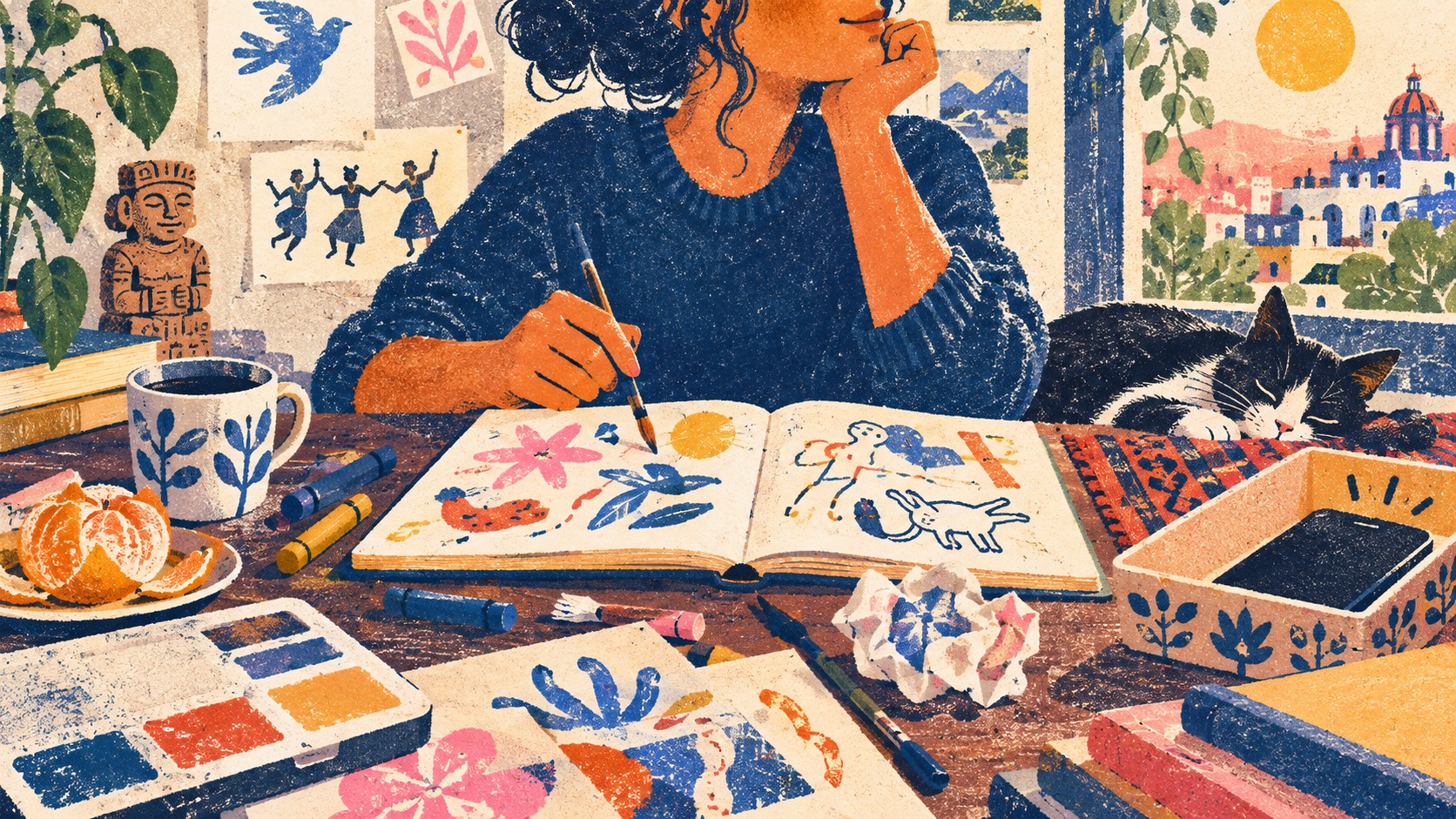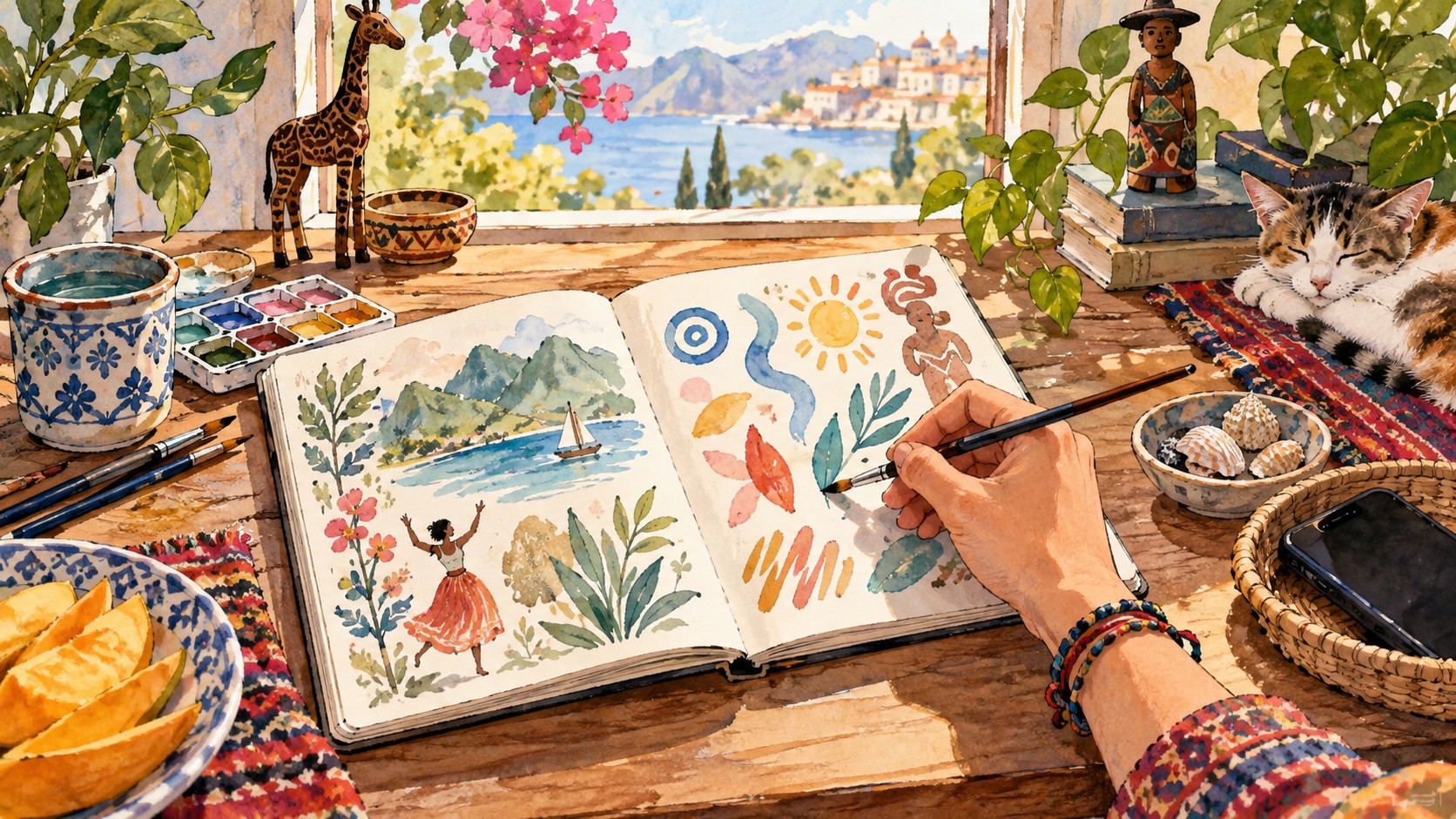
An open notebook can attract many questions: whether it looks good, whether it will be useful, whether it deserves to be shown. It can also be free from those questions for a while. That freedom makes room for a gentler practice: trying a word, shape, or colour without turning the attempt into a definition of the person making it. Supporting creativity without pressure begins by protecting that margin.
Describe before you label#
A creative situation quickly fills with words that carry too much weight. “Clumsy”, “brilliant”, “messy”, or “untalented” may sound like explanations, yet they turn one particular moment into an identity. A drawing with an uncertain line does not prove incapacity; a text that has not found its rhythm does not settle anybody's worth. Precise description offers another route. Someone can say that the page contains many crossings-out, that a scene has changed three times, or that an idea seems to have paused. These are observable facts. From there, it is easier to ask what the process needs without deciding who the person must be.
A creative situation quickly fills with words that carry too much weight. “Clumsy”, “brilliant”, “messy”, or “untalented” may sound like explanations, yet they turn one particular moment into an identity.
Descriptive language is not a cold formula. It leaves room for experience. “I can see that you tried two materials” can acknowledge attention without demanding success. “This part seems to have taken time” can open a conversation without interpreting a mood. Even silence can be respectful when somebody does not want to explain their work. Creativity breathes more easily when it does not have to defend itself against every look. A companion does not need to pretend enthusiasm about everything; it is enough to prevent a rushed opinion from closing a search that has only just begun.
A notebook that does not have to perform#
The image of a notebook without a planned outcome is useful because it is concrete. Its pages may hold unfinished lists, sketches that go nowhere, strange combinations, and questions that remain unresolved. None of that is waste by itself. A notebook keeps evidence of attention: a texture noticed on a street, a sentence overheard in conversation, a way of arranging a worry. When every page must be presentable, that attention becomes thinner. Fear of getting something wrong arrives before experimentation has started. When a page may stay private, error regains its place as working material.
Protecting that place does not require expensive supplies or a perfect desk. It may mean having a notebook nearby, a digital folder without an audience, or a temporary corner where concentration is not interrupted. It also needs simple agreements: do not inspect without permission, do not compare with previous work, do not demand an instant explanation. Privacy in a process does not mean compulsory isolation. It means a person retains the right to decide when to share and what kind of response would be useful. That decision matters especially where productivity creates constant expectations.
Play as a way of learning#
Creative play is not a detour from learning; it is one of its doors. A construction that collapses can teach something about balance. A melody repeated with changes can make differences audible. An absurd story can uncover a voice that a correct exercise could not find. Play permits repetition, rule changes, and leaving an idea behind without making departure into failure. That is why it can matter at every age. Childhood does not own the possibility of trying. An adult can also draw without a plan, cook an unfamiliar combination, or write a scene that nobody will read.
Pressure often arrives disguised as motivation. “Use your time well”, “do it properly”, and “show it when you finish” are ordinary sentences that can shrink curiosity when they arrive too early. A more useful form of support makes a small margin practical: twenty minutes without assessment, a box of basic materials, a modest prompt, or permission to leave something unfinished. It does not force inspiration to appear. It provides conditions in which a person can discover whether they want to return. Autonomy is not producing alone under watch; it is being able to choose, test, and change direction without receiving punishment for it.
When error stops being a verdict#
A process may fail for many different reasons: information is missing, haste is excessive, a tool is unsuitable, tiredness takes up too much room, or an idea needs another structure. Placing every reason beneath the sentence “I am not good at this” removes useful distinctions. Naming the obstacle makes action possible. A person may rest, consult a technique, reduce the scale, save a version for another day, or ask someone to notice one detail. None of these options requires claiming that a person can do everything. They simply recognise that one difficulty is not a complete portrait of anyone.
A companion can help by avoiding empty promises and informal diagnoses. Saying “this has not turned out as you expected” may be more honest than imposing optimism. Asking “would you like company, an opinion, or space?” returns control. If distress becomes intense, lasts, or affects other parts of life, a conversation about making should not become a clinical assessment. It is respectful to encourage contact with a healthcare professional or another qualified source of support, depending on the context. Seeking support does not erase the ability to decide; it can offer tools for caring for the process more effectively.
Sharing without making another person a tribunal#
Making always enters into dialogue with other people. We learn by observing crafts, hearing stories, visiting exhibitions, following tutorials, and receiving responses. The problem is not sharing but sharing under a rule that only permits comparison. A reference can open a door when offered as a possibility; it becomes heavy when used as a compulsory measure. This is why it helps to ask before commenting. Someone may want technical advice, attentive listening, or simply to mark that they are finished for today. Not every piece asks for the same conversation.
In a group, description is a powerful practice. “I noticed this change of rhythm”, “the empty space caught my attention”, or “I understand that the perspective shifts here” are observations that do not rank anybody above or below. A question can follow: “what were you exploring?” or “would an idea be helpful?”. In this way, critique, when requested, becomes specific and revisable. A person may take one part, decline another, or save the exchange for later. Respect does not remove judgement; it prevents judgement from becoming a label that remains after the work has changed.
A small action for this week#
Setting aside a brief time to create without assessing performance can be a sufficient beginning. The proposal does not need to become a daily obligation. It might mean ten minutes collecting found colours, writing down the sounds of a square, arranging photographs without selecting the best ones, or copying a shape that awakens curiosity. Choose an action that does not require finishing anything. At the end, the material may be saved, continued, torn up, or allowed to rest. That choice is also part of the practice. What matters is that the outcome does not have to justify the time spent.
Language that does not label supports this practice from outside. It replaces immediate judgement with observation, automatic advice with a question, and demands for output with a possible condition. It does not promise that everything will be easy or remove real difficulty. It simply prevents a page, an afternoon, or an error from deciding a person's identity. Between constant comparison and abandonment there is a liveable ground: an open notebook, respectful support, and permission to learn without an examination.