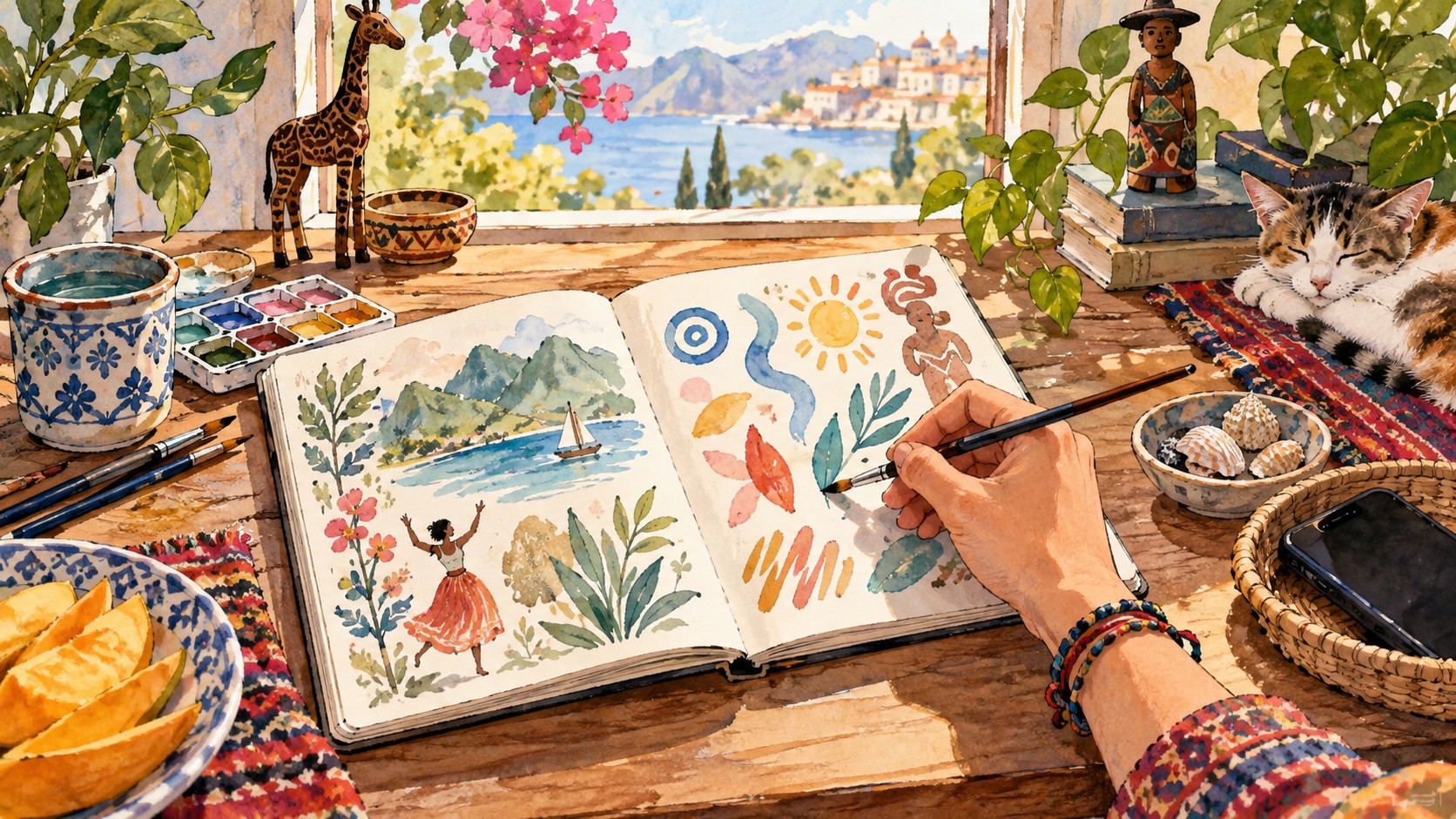
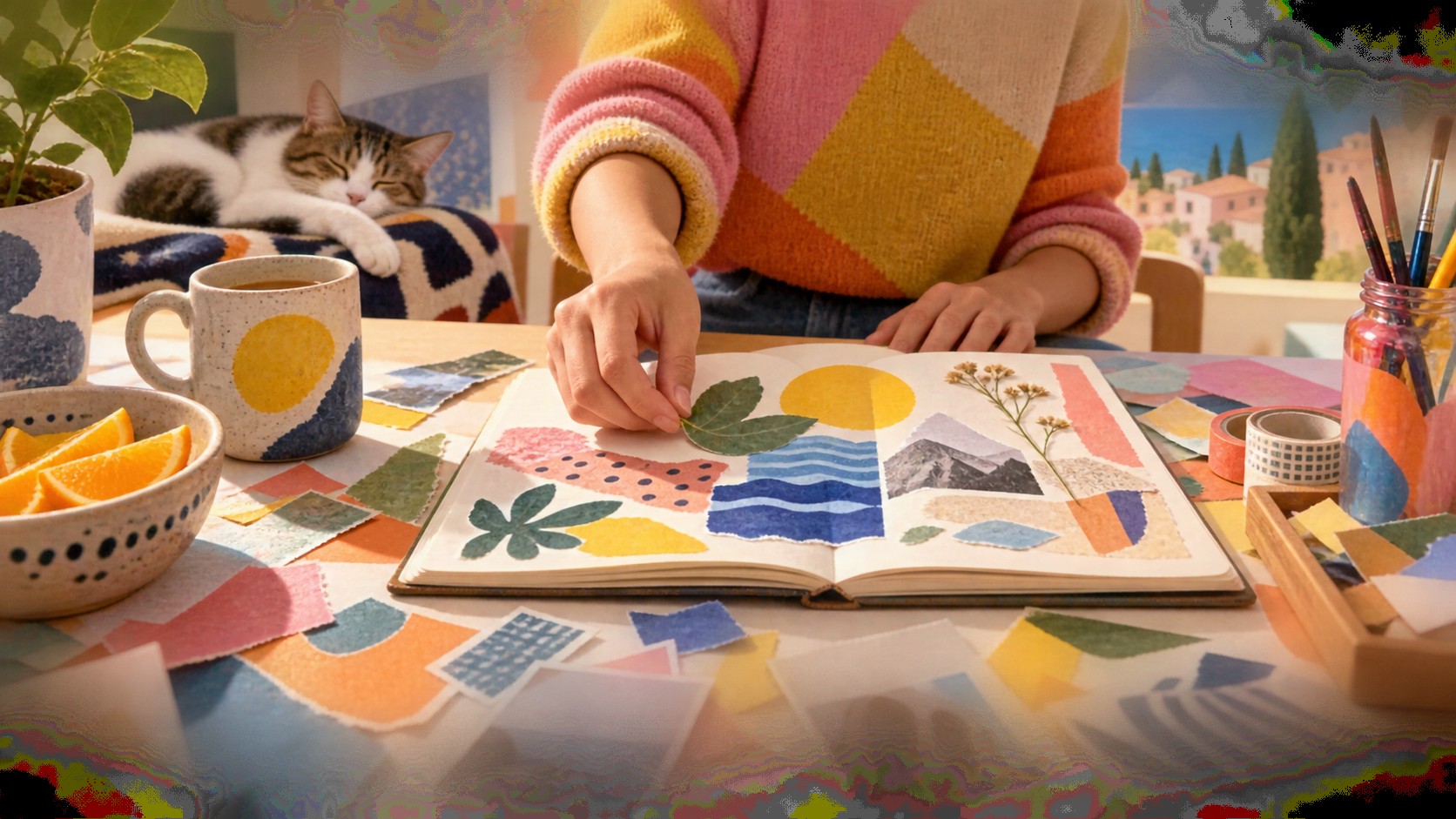
The notebook is still open at an unfinished page. In an imagined scene, someone returns to the table after several weeks and finds a curve, three words, and a coffee stain. No masterpiece is waiting to be rescued. A more modest possibility remains: touching the material again without having to explain the absence. The gesture that makes continuing possible might be leaving an easy way in for the next visit.

Returning to a page without accounting for the gap#
In this example, the interruption does not require a story about failure. Other tasks arrived, the schedule changed, or the desire to draw simply disappeared for a while. If returning begins with calculating everything that could have been produced, the sheet becomes an unpaid bill. Another entrance would involve noticing what exists: the pencil's path, a combination that still invites curiosity, the space left empty. Attention returns to the particular object and stops pursuing an ideal version of the person who supposedly should have finished it by now.
In this example, the interruption does not require a story about failure. Other tasks arrived, the schedule changed, or the desire to draw simply disappeared for a while.
Continuing does not require keeping the previous plan either. A drawing intended as a landscape could become a study of textures; notes for a story might remain a conversation between two objects. That change does not demonstrate a lack of commitment. It reflects how passing time can alter interests. The notebook allows a different relationship with what was started, provided it is not required to justify its usefulness. A page can help someone discover what they want to explore now, even when the emerging result no longer resembles their original intention.
Remembering a starting point differs from enforcing it. A simple note identifying the area someone wanted to explore preserves a clue. An inventory of overdue tasks may add obligations nobody actually chose. The first option makes orientation easier; the second demands a delivery. Someone creating for enjoyment can decide which kind of memory helps. Every attempt need not become a scheduled project, and useful clues need not be lost through rejecting all organisation. A light arrangement shaped around the actual activity can occupy the space between those possibilities.
A short interval with an identifiable exit#
Making time to create is often presented as a matter of discipline, but the size of that interval matters. In the notebook scene, perhaps only the period before preparing dinner is available. It offers room to explore a shape without promising that an extraordinary idea will arrive. An identifiable beginning and ending allow the activity to fit within an existing life. The possibility is not about exploiting every free minute. It is about letting one interval have a different purpose when interest and workable circumstances happen to meet.
The duration need not become a record to beat. If a brief session ends with one line, the next occasion does not owe anyone two. Measuring time may help protect a pause, while counting results shifts attention towards performance. A more concrete question might concern whether it was possible to approach the paper, choose a tool, and try something not already decided. Even that question deserves flexibility. Some days, opening the pencil box provides enough information to recognise that a different activity would be more welcome at that moment.
The exit matters too. Leaving materials spread across a shared table can make things difficult for other people; putting everything away without preserving any clue can make returning unnecessarily laborious. A small folder, a private photograph of work in progress, or a slip marking the page offer different possibilities. Each has limits involving space, access, and convenience. Preparing the next encounter requires neither new equipment nor a dedicated room. It may simply involve choosing where the notebook stays and which detail will recall the curiosity that led someone to open it.
An overlaid sheet changes what is at stake#
On the imagined table sits a piece of thin paper through which the earlier curve remains visible. Placing it over the page offers a particular experiment: drawing a second shape without altering the first. The person can lift it, move it, and look again. The interest of this gesture does not depend on producing a beautiful effect. It introduces a reversible decision into a page that seemed to demand a final choice. An uninteresting addition can be removed to restore the starting point; an intriguing one can remain separate while its question develops.
Different materials permit different operations. Opaque paper can support comparing two proposals side by side, even without showing an earlier mark through it. A copy of a written passage allows another sequence to be tested without losing the previous version. Each changes a tangible condition of the work: the cost of trying. Preparation need not be perfect or become an endless collection of variations. Its purpose is to define an experiment someone can conduct with available resources, whose outcome does not require accepting decisions they are not yet ready to make.
Comparison now happens between the person's own particular possibilities. The rectangle can approach the curve, rotate, or move beyond the page; each shift reveals a different relationship. There is no higher score to pursue and no talent to prove against a finished image. Attention goes to what changes when one piece moves. Afterwards, perhaps a single position is retained, or none at all. That choice does not make the others wasted time. They helped clarify which effect was interesting and which was not, without requiring the notebook page to be settled once and for all.
A mistake leaves information rather than a debt#
The coffee stain in the example offers a useful test. The person returning to the notebook might draw around it, cover it, or move to another sheet. None of those responses is inherently more creative than the others. What matters is noticing what each permits: using an unexpected shape, practising a layer of colour, or retaining clean space for another attempt. The mistake no longer demands an exemplary repair. It can provide information about the material, and it can also be uninteresting. Not every difficulty has to become a compulsory learning opportunity.
When an experiment does invite curiosity, a descriptive note can preserve it: the paper buckled with too much water, the softer pencil produced a pleasing shadow, the sentence lost force when explained too heavily. Such observations belong to particular actions and remain open to change. They assign no fixed identity to the person working. Upon returning, it becomes possible to choose a different variable and notice what happens. Cultural or artistic learning can develop through successive encounters, without requiring every session to demonstrate an improvement that someone else could readily see.
This freedom neither removes effort nor rules out seeking instruction. A person may enjoy an open practice and later want to learn a technique from someone familiar with it. The distinction concerns the purpose of each setting. A classroom exercise may have a defined objective; a notebook at home may be reserved for mixtures, questions, and detours. Confusing them makes every game into an assessment. Distinguishing them allows someone to receive guidance when needed while retaining a place where each choice does not have to be defended or explained to anyone.
Leaving a particular invitation ready#
At the end of the imagined interval, the page remains unfinished. A small blue rectangle now sits beside the curve, and a question about the gap between them occupies the margin. It is not a commitment for tomorrow. It is a recognisable invitation that can be accepted, transformed, or ignored. The gesture of continuity consists in leaving something clear enough that returning will not require reconstructing the whole process, yet open enough for the person to retain freedom when the day, their interest, or their circumstances have changed.
A longer pause does not invalidate that preparation. If the notebook closes again for a month, the clue remains a possible aid rather than a reminder of noncompliance. Sustaining a practice over time may include periods of intense interest alongside periods of distance. Caring for the process also means avoiding the use of its irregularity as evidence against the person who enjoys it. Continuity does not always resemble an uninterrupted chain. Sometimes it appears in how easily an activity can become available again when someone wishes to approach it.
The specific possibility left for someone who recognises this scene is choosing, when feasible, a brief encounter with a material already nearby. Afterwards, they might preserve a clue about their curiosity instead of scoring the result. A pencil beside the notebook, an underlined word, or a colour awaiting another combination could serve that purpose. The value of the gesture is not that it guarantees a future work. It allows the next opening to meet an inviting question, while closing the notebook again remains a decision its owner is free to make.