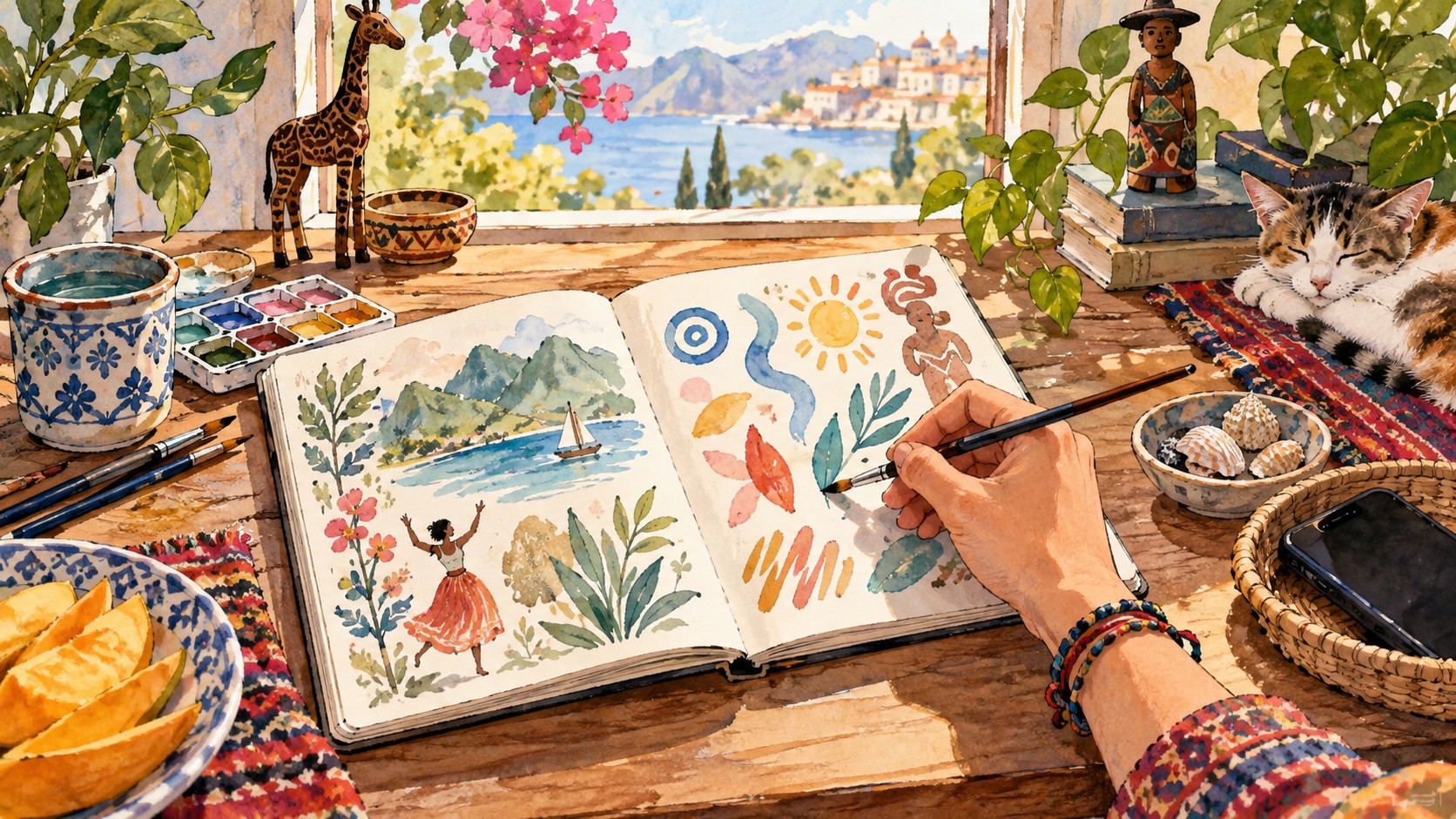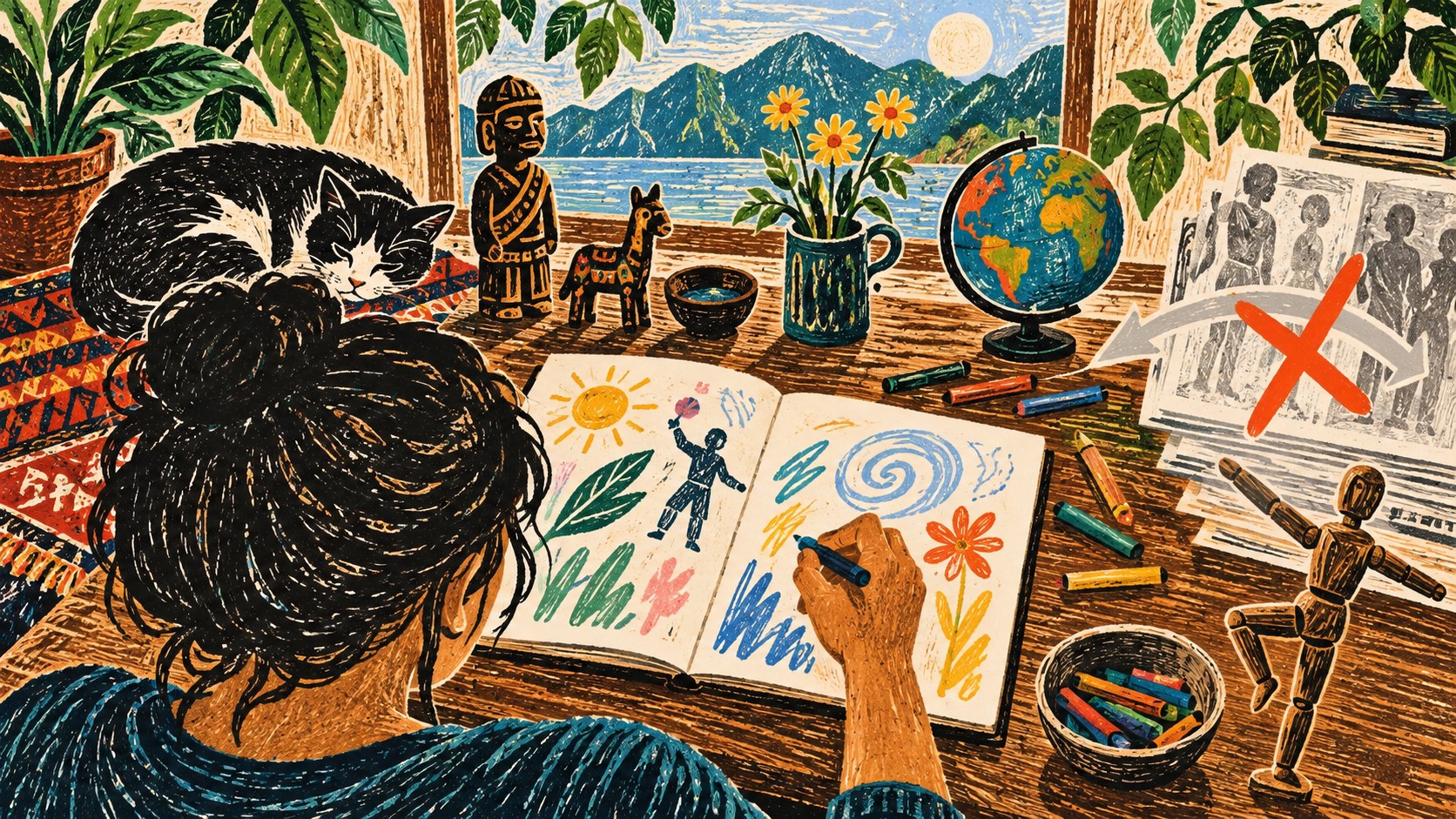
An open notebook on a table can look like unfinished work. It can also be a place where someone tests a line, a word, or a mark without owing anyone an explanation. Supporting creativity without pressure begins with noticing that difference. Not every expressive gesture must become a product, visible improvement, or evidence of talent. Some processes need time, attention, and the freedom not to know what they will become yet.
A space that is not an exam#
Constant comparison narrows the place where learning happens. When every drawing, text, photograph, or idea is immediately measured against other people’s results, curiosity can move aside. A person does not necessarily lose imagination; sometimes they stop showing it because they expect judgement before they begin. Creative time without an exam does not remove care or the chance to learn techniques. It separates two moments: first explore, then decide what might be reviewed, shared, or improved. That separation lets an error become a clue, an unexpected variation, or a reason to change tools rather than a verdict about the person making it.
Constant comparison narrows the place where learning happens. When every drawing, text, photograph, or idea is immediately measured against other people’s results, curiosity can move aside.
A notebook that does not need to become a result keeps the trace of a search. It can hold unfinished sentences, awkward colours, private diagrams, and questions that will take time to find a form. Its value does not depend on every page being ready to show. In settings that demand speed, that trace reminds us that culture and learning are also made through attempts. A supportive person can protect it by avoiding questions that turn every try into performance: what is it for, when will it be finished, or why does it not work as it did before? They can offer open observations instead: I noticed you changed materials, it seems you were trying another shape here, or I can leave you some room if you want it.
Play is a way of finding out#
Creative play does not belong to one particular age. It can be a construction that falls down and is built again, a collection of songs, a digital design, an invented scene, a different recipe, or a melody learned slowly. What these actions share is the chance to rehearse without a final grade. That chance helps people discover preferences, limits, and personal ways of paying attention. It can also make it easier to meet different cultural influences without assuming that there is only one correct way to make something.
Protecting play does not mean ignoring tiredness, limited time, lack of materials, family or school expectations, or earlier experiences of discouragement. That is why helpful support is not simply repeating that someone should be creative. It is making a small margin possible: fifteen minutes with a notebook, a clear table for a while, simple materials within reach, or permission to leave something unfinished. A modest invitation can be more respectful than a large challenge. The person decides whether to use that margin, how to use it, and whether to talk about it. Autonomy is not protected by requiring expression; it is cared for by offering possibilities without intrusion.
An error is information, not an identity#
Many people have learned to read an error as a label: if a piece does not work, then its maker is not suited to that activity. That conclusion is too heavy for a much more specific fact. A proportion may feel unconvincing, an idea may not have found its form, a text may lose its thread, or a rhythm may be difficult. Naming the problem precisely reduces blame and opens options. Someone can change the order, rest, look at references, ask for a careful opinion, or leave that route for another day. None of those choices requires giving up a relationship with creativity.
Someone who accompanies the process can help keep that scale. Rather than promising that everything will work out, they can acknowledge effort without exaggerating it and ask which part of the process needs attention. Sometimes saying little is best. Sometimes it is enough to offer a tool, save an earlier version, or remember that stopping is allowed. If intense distress, persistent blockage, or concerns beyond the creative situation appear, those matters should not be solved alone or turned into a clinical judgement inside an editorial conversation. It is respectful to encourage consultation with the person’s healthcare professional or another qualified source of support where appropriate. Seeking guidance can widen autonomy.
Sharing without making others a measuring stick#
Creation is cultural and shared. People learn by noticing techniques, stories, crafts, songs, images, and ways of solving problems made by others. Sharing can enrich a process when there is agreement about the kind of response wanted. One person may want technical ideas, another may only want to be heard, and another may prefer not to show anything yet. Asking before commenting prevents help from becoming judgement. It is also useful to distinguish an inspiring reference from a diminishing comparison. The first opens paths; the second turns somebody else’s path into an obligation.
In groups, workshops, classrooms, or families, a simple practice is to describe before evaluating. I notice three colour choices, I understood this change of scene, or this silence caught my attention are ways of returning attention without imposing rank. A question can follow: what were you trying to test, or would a suggestion be useful? This protects the authorship of the person working. Careful critique does not disappear, but it arrives when it is requested, addresses specific aspects, and leaves room for disagreement.
A brief practice that can last#
Setting aside a short period to create without evaluating performance can be enough to begin. There is no need to design a perfect ritual. A person can choose a possible time, an accessible material, and a small prompt: copy a texture, write five observations from a walk, sort paper scraps, invent names for colours, or listen to a piece of music and note what changes. The important condition is that the result does not have to justify itself. Afterwards it may be kept, torn up, continued, or never revisited. The point is not to produce more. It is to recover a less watched relationship with the process.
Supporting creativity without pressure calls for ongoing attention rather than grand speeches. It means allowing the notebook to remain a possible place, accepting that some searches will not develop, and recognising that learning includes trying, pausing, and returning differently. It also means knowing when close support is enough and when it is wiser to seek suitable guidance. Between the demand for results and abandonment there is a liveable ground: a small, free practice accompanied with respect. There, expression does not need to prove anything in order to matter.
Returning when it is possible#
Continuity should not be confused with a daily obligation. A practice can pause because of work, caring responsibilities, study, illness, moving home, or simply because attention is elsewhere. Returning does not require recovering the exact point where it stopped. Sometimes reading one page again, choosing a familiar material, or looking at an image that once prompted curiosity is enough. A return without reproach protects more than a rigid schedule. Someone who accompanies the process can remember that creativity does not vanish during a pause and that the work does not have to justify itself to an audience. Creating calmly includes being able to return when conditions allow it, not when an outside demand insists.
Small signs of continuity can matter as well. Keeping a box of materials, writing an idea on a ticket, or leaving a photograph in view can keep a door open without turning it into a duty. These choices do not promise an outcome; they simply make it easier to notice an opportunity when it appears. Cultural practice is often built in this way, through quiet gestures that respect a person’s own rhythm and do not require an immediate explanation.