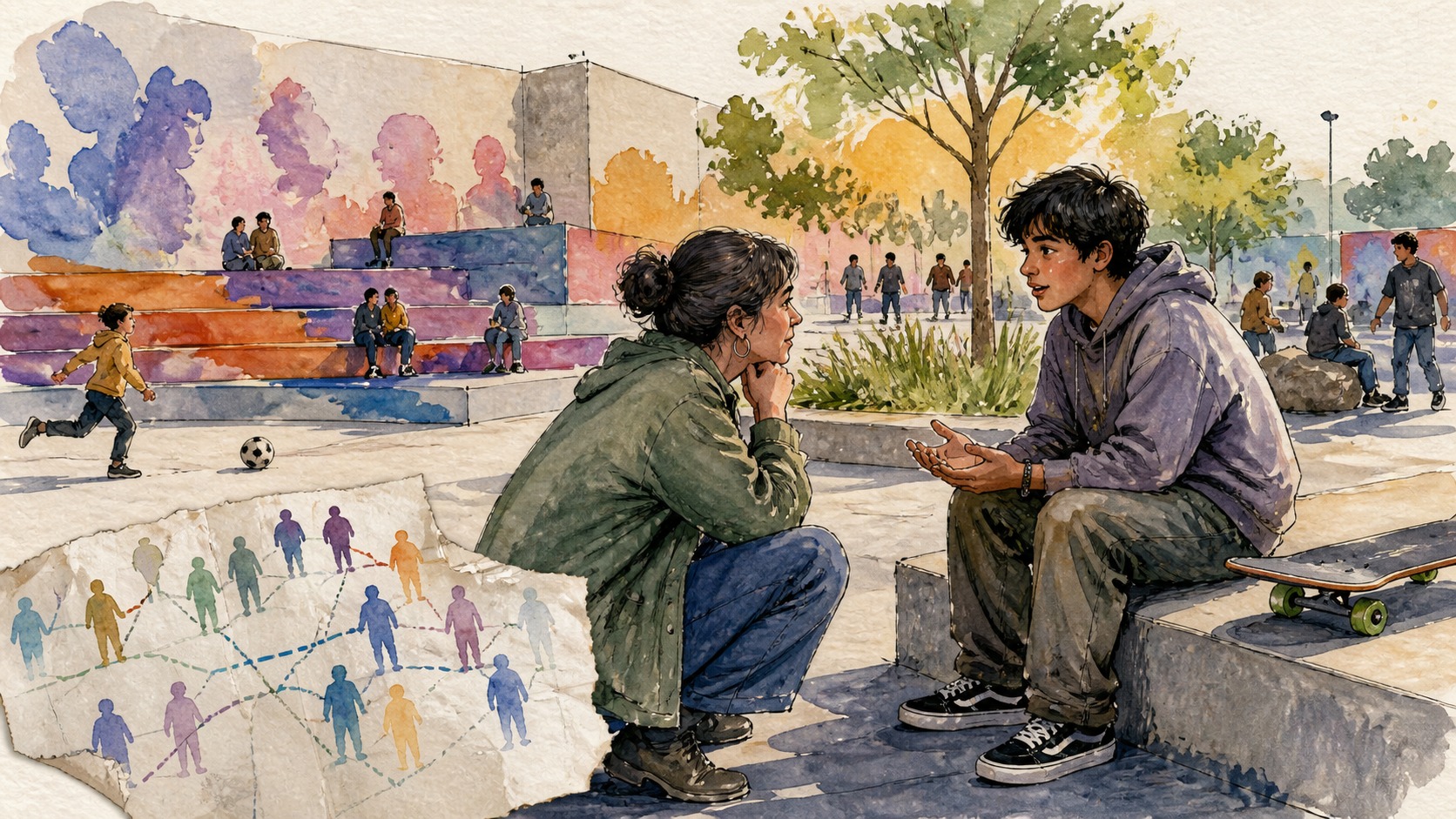
Returning to the classroom after repeated absence needs a realistic plan: listen to what makes attendance difficult, reduce specific barriers, and agree on support that can be reviewed without punishment or labels. This guide offers a gradual starting point for students, families, and schools to rebuild a safe school routine.
1. Describe one concrete situation#
The first step is to describe a scene, not attach a label. Rather than saying that a teenager is irresponsible, a family can note that over two weeks she arrived late on three days and missed the opening activity. The school can add what happened afterwards without guessing at the cause. Date, setting, frequency, supports already tried, and impact are enough to begin. This precision lowers tension because everyone is discussing something that can be checked.
The first step is to describe a scene, not attach a label. Rather than saying that a teenager is irresponsible, a family can note that over two weeks she arrived late on three days and missed the opening activity.
2. Listen before explaining#
Before recommending an action, each person needs space to explain what they notice and what worries them. A short meeting can start with a listening question: what is hardest for this student, and what helps even a little? The student should also be heard in age-appropriate language. Their account is not a formality. It may reveal transport barriers, fatigue, unclear instructions, social conflict, or an expectation the adults had not noticed.
3. Select a priority and a goal#
An effective meeting does not try to repair an entire school life. It chooses one current priority and gives it a visible sign of improvement. For ten days, for instance, the goal might be arriving before the first activity on four days each week. The sign does not measure anyoneʼs worth; it shows whether the plan works. If a goal is too broad, divide it. If it is too difficult, adjust it before it becomes an impossible promise.
4. Share practical actions#
Every action should be specific, proportionate, and realistic in the actual context. A family might prepare a bag and check the journey the night before; the school might welcome the student without turning lateness into a public display; the student might choose an alarm or a trusted contact. Two small actions are better than an unmanageable list. It is also useful to say which support will not continue, so help does not replace an independence that is beginning to grow.
5. Review without blame#
A review date is agreed at the same time as the actions. At that point, compare the information with the goal, ask how the student experienced the agreement, and decide whether to continue, change, or stop. A fair review names progress even when it is partial. If there is no progress, look for the barrier that remains instead of automatically increasing control. This makes the plan shared learning rather than permanent surveillance.
Case: attendance and late arrival#
Case 1. Dani missed several mornings after moving home. His family feared that school would read this as lack of interest, while his tutor thought he was avoiding the classroom. Listening showed that the new journey involved two buses and that he did not know whom to contact after missing one. They agreed on a brief notice, a calm entry, and a route rehearsal for one week. Attendance improved without sanctions or public explanations.
Case: homework conflict#
Case 2. Lucia cried when homework began and her father sent messages every night. The teacher explained that the task was not meant to take an hour; it was designed to practise one strategy. They agreed on a twenty-minute limit, a mark showing where the block occurred, and a classroom review two days later. Lucia regained time to rest and her family stopped acting as a second marker. The indicator was her ability to name the question in one sentence.
Case: participation and wellbeing#
Case 3. Amina spoke little in group work and some classmates answered for her. Her family asked for more participation, while school proposed observing which conditions made it easier first. Amina chose to prepare an idea in writing and share it with a partner before the larger group. Within two weeks she contributed twice voluntarily. The agreement did not force a performance; it created a safe, reviewable route into participation.
Protect privacy#
Agreements should share only information that is needed. Diagnoses, personal messages, and family details should not circulate through informal groups. It helps to state what information is being shared, with whom, for which goal, and how long it will be held. The student deserves to know whenever possible. Privacy does not prevent coordination; it makes coordination more trustworthy. A short record of actions and review is usually enough, without turning a relationship into an endless case file.
When to ask for additional support#
When an ordinary plan is not enough, widening the team may be appropriate. Counselling, learning support, mediation, health, or social services can offer different perspectives under local procedures. The useful question is not who will “fix” the student, but which resource can reduce a particular barrier. Families can ask why a referral is proposed, what consent is required, who coordinates, and how feedback will be given. More professionals should not mean more confusion.
Sources for sound decisions#
UNESCO identifies participation and inclusion as conditions for quality education; UNICEF provides resources on wellbeing and childrenʼs rights; WHO connects supportive environments with mental health; and the European Agency for Special Needs and Inclusive Education stresses the removal of participation barriers. These sources do not replace everyday knowledge from family and school, but they help keep decisions respectful, rights-based, and focused on learning.
Practical follow-up 1#
To make an agreement last, end each conversation with a confirmation sentence: what each person will do, which sign will be observed, and when they will speak again. A family can ask how the student prefers to be informed; school can confirm which resources are already available; and the student can say which support feels respectful. Where there is disagreement, record the unanswered question and seek information before deciding. This habit stops urgency from turning a hypothesis into a conclusion. It also helps distinguish a short-term difficulty from a pattern needing other support. Coordination improves when people know they can correct course without losing dignity. A brief, reviewable, clearly communicated plan offers more safety than a large promise without follow-through.
Practical follow-up 2#
To make an agreement last, end each conversation with a confirmation sentence: what each person will do, which sign will be observed, and when they will speak again. A family can ask how the student prefers to be informed; school can confirm which resources are already available; and the student can say which support feels respectful. Where there is disagreement, record the unanswered question and seek information before deciding. This habit stops urgency from turning a hypothesis into a conclusion. It also helps distinguish a short-term difficulty from a pattern needing other support. Coordination improves when people know they can correct course without losing dignity. A brief, reviewable, clearly communicated plan offers more safety than a large promise without follow-through.
Practical follow-up 3#
To make an agreement last, end each conversation with a confirmation sentence: what each person will do, which sign will be observed, and when they will speak again. A family can ask how the student prefers to be informed; school can confirm which resources are already available; and the student can say which support feels respectful. Where there is disagreement, record the unanswered question and seek information before deciding. This habit stops urgency from turning a hypothesis into a conclusion. It also helps distinguish a short-term difficulty from a pattern needing other support. Coordination improves when people know they can correct course without losing dignity. A brief, reviewable, clearly communicated plan offers more safety than a large promise without follow-through.
Practical follow-up 4#
To make an agreement last, end each conversation with a confirmation sentence: what each person will do, which sign will be observed, and when they will speak again. A family can ask how the student prefers to be informed; school can confirm which resources are already available; and the student can say which support feels respectful. Where there is disagreement, record the unanswered question and seek information before deciding. This habit stops urgency from turning a hypothesis into a conclusion. It also helps distinguish a short-term difficulty from a pattern needing other support. Coordination improves when people know they can correct course without losing dignity. A brief, reviewable, clearly communicated plan offers more safety than a large promise without follow-through.
Practical follow-up 5#
To make an agreement last, end each conversation with a confirmation sentence: what each person will do, which sign will be observed, and when they will speak again. A family can ask how the student prefers to be informed; school can confirm which resources are already available; and the student can say which support feels respectful. Where there is disagreement, record the unanswered question and seek information before deciding. This habit stops urgency from turning a hypothesis into a conclusion. It also helps distinguish a short-term difficulty from a pattern needing other support. Coordination improves when people know they can correct course without losing dignity. A brief, reviewable, clearly communicated plan offers more safety than a large promise without follow-through.
Practical follow-up 6#
To make an agreement last, end each conversation with a confirmation sentence: what each person will do, which sign will be observed, and when they will speak again. A family can ask how the student prefers to be informed; school can confirm which resources are already available; and the student can say which support feels respectful. Where there is disagreement, record the unanswered question and seek information before deciding. This habit stops urgency from turning a hypothesis into a conclusion. It also helps distinguish a short-term difficulty from a pattern needing other support. Coordination improves when people know they can correct course without losing dignity. A brief, reviewable, clearly communicated plan offers more safety than a large promise without follow-through.