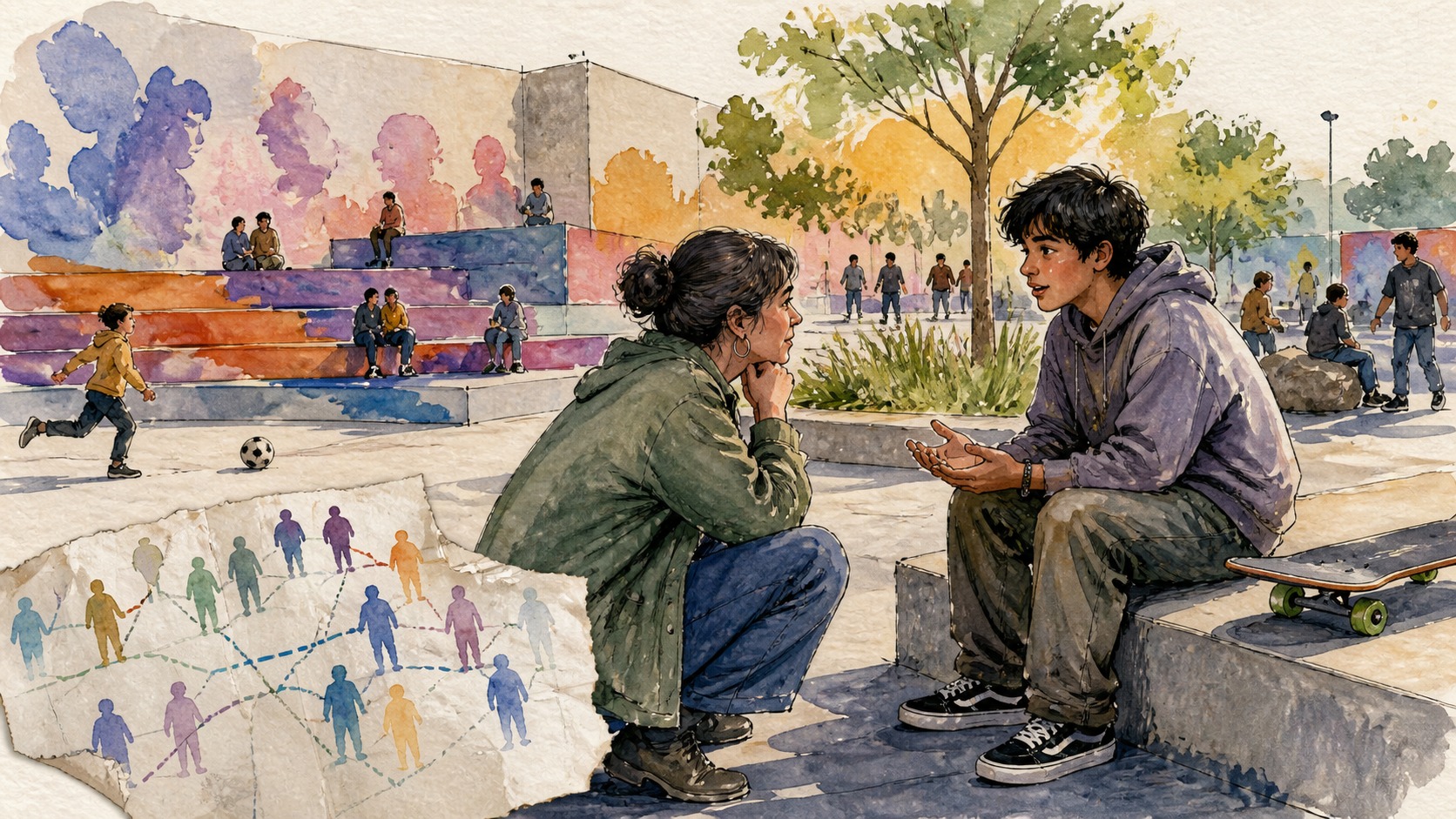
When attendance begins to break down, urgency can push adults toward arguments, sanctions, or impossible promises. A short five-step plan makes it possible to respond to one concrete difficulty with calm, safety, and clear responsibility. It does not replace health care, safeguarding, or school procedures where there is risk; it helps students, families, and schools stop improvising and review what is actually helping.
Why goodwill alone is not enough#
Absence rarely has a single cause. An overwhelming task, a peer conflict, an unsafe journey, family worry, physical pain, anxiety, or a sense of not belonging may overlap. Simply telling a student to attend tomorrow can increase the block when nobody understands what is happening. A plan is not a search for blame or a way to turn a young person's life into a checklist. It organizes a conversation: what is observed, which barrier matters first, what support will be tested, who will sustain it, and when it will be reviewed. That structure reduces contradictory messages and makes it possible to adjust early rather than wait for the problem to grow.
Absence rarely has a single cause. An overwhelming task, a peer conflict, an unsafe journey, family worry, physical pain, anxiety, or a sense of not belonging may overlap.
Step 1: describe the difficulty with facts#
Begin with a description that another person could check. Instead of saying “she does not want to go,” record “on Monday she did not leave home; on Tuesday she arrived for second period; on Wednesday she entered but asked to leave at break.” Add the time, what happened beforehand, and what made continuing easier or harder. Ask the student how they make sense of it too, without demanding a full account at once. A zero-to-ten scale, a written note, or choosing from options can be more accessible than a long interview. Separating facts from interpretations stops a first hypothesis becoming certainty too soon and makes small changes visible.
Step 2: check safety and urgent needs#
Before negotiating timetables or schoolwork, ask whether there is a safety, health, or safeguarding issue. Threats, bullying, violence, self-harm, abuse, lack of care, serious symptoms, or fear of a particular person require the applicable local safeguarding and emergency routes. Do not promise absolute confidentiality where risk exists; it is more honest to explain what information may need to be shared to protect someone. If there is no immediate emergency, agree on a safe way to ask for help during the day and on a trusted contact. Safety is not an optional addition to the plan. It is the condition that makes a return meaningful.
Step 3: choose one workable barrier#
A meeting may reveal ten problems, but trying to solve all of them usually freezes action. Choosing one barrier does not deny the others; it decides where to start. Ask which moment makes attendance hardest: waking up, leaving home, reaching the gate, one lesson, break, lunch, or returning after an absence. Then choose a modest, observable goal for one or two weeks. It might be reaching the building, entering with a known adult, completing the first activity, or staying until break. The goal should be small enough to be possible and meaningful enough to reduce the real barrier. Perfect attendance is not a useful first target if it makes distress invisible.
Step 4: agree support, responsibility, and limits#
Every support needs one plain sentence: what will happen, who will do it, and when. A tutor might meet the student five minutes before class; a family might arrange transport the previous evening; the student might send an agreed signal when a pause is needed; learning support might review a reading adjustment on Friday. It also helps to say what will not happen: no questioning in front of peers, no chain of messages during a crisis, and no removal of a support that helps a return. Supports should protect privacy and not rest entirely on one person. If that person is away, there should be a known alternative.
Step 5: review, learn, and choose the next move#
Set a short review date, even if the meeting takes only ten minutes. Look at the gathered facts, the student's experience, and the burden the plan has placed on everyone. Keep what worked, change what added tension, and choose the next step. A review is not a test of obedience. If the goal was not reached, the useful question is “what made this step too difficult?” rather than “who failed?”. The agreement may stay the same, shrink, expand, or trigger another service. Three written lines—progress, obstacle, next support—give continuity when staff change or a family needs to explain the situation without repeatedly sharing private detail.
Case 1: reaching the gate is already an intervention#
Lucía began crying as soon as she put on her coat and had not entered school for two weeks. Her father pressed her every morning and both ended exhausted. The first conversation showed that the gate was the worst point: she had lost her usual friend and feared being alone before class. The first goal was not a full day; it was reaching the gate on three days. A teaching assistant agreed to meet her there and walk with her to a quiet library for ten minutes. Lucía entered on two days. On the third she could not cross the gate, but she could explain what frightened her. At review, the welcome remained and a voluntary peer was added for first break. The plan worked because it addressed a particular barrier, not because it demanded abstract bravery.
Case 2: schoolwork hiding a learning barrier#
Adrián missed school mainly on days when oral presentations were due. At first, staff assumed he was avoiding responsibility and asked him to make up the work alone. When they described the facts, the learning-support teacher noticed that he also froze over long written instructions and spent hours preparing each presentation at home. The chosen barrier became understanding and organizing the task, not “speaking in public” in general. For two weeks he received chunked instructions, a model outline, and the option to record part of the presentation. Attendance improved, and his family requested an educational assessment before he accumulated more failure. The adjustment did not lower expectations; it created a reasonable route to show learning.
Case 3: safety and belonging before punctuality#
Mei arrived late every day and often left break time early. In a private conversation she said that two peers were sharing images of her and waiting near the changing room. The priority immediately became safety: the school activated its safeguarding and behaviour procedures, explained confidentiality limits, and named a trusted adult. While it investigated, staff agreed supervised routes and an alternative place at breaks. Mei was not asked to confront anyone in order to prove she wanted to attend. Only after safety was more stable did the timetable come under review. The case shows that an attendance plan must never be used to normalize a harmful situation.
Include the student without placing the solution on them#
Participation does not mean that a student must design the solution alone or reveal personal matters in order to deserve support. It means they can choose how to communicate, know the goal, say which measures feel useful or humiliating, and receive information about changes. A young person may prefer a card, a digital note, a meeting with a trusted person, or a visual scale. They may also ask that their account does not travel beyond the people who need to act. When students are included, plans often uncover barriers adults cannot see: corridor noise, the lunch queue, a repeated joke, an inaccessible homework app, or the fear of being noticed after arriving late.
Coordinate family, school, and outside services#
Effective coordination is not sharing every piece of information. It is sharing the minimum needed to carry out the agreement: the goal, responsible people, contact times, warning signs, and review date. Families bring knowledge of routine and wellbeing; school knows teaching adjustments and peer context; health, social, and community services may advise within their responsibilities and with appropriate consent. Naming one contact person prevents families from telling the same story to five professionals. If an outside service is involved, explain what it can do, what it cannot decide, and how the student's privacy will be protected.
Sources that guide but do not replace context#
UNESCO supports inclusive education systems that remove barriers to presence, participation, and achievement. UNICEF provides frameworks on protection, wellbeing, and the participation of children and adolescents. The World Health Organization places safe, supportive school environments within mental-health promotion. The European Agency for Special Needs and Inclusive Education offers resources on inclusion and collaboration. In Spain, education authorities and local public services publish safeguarding, guidance, and coexistence protocols that should be consulted in the relevant area. These sources help people ask responsible questions; they do not diagnose a person or replace required action where risk exists.
A short template for the next difficulty#
End the meeting with five sentences: “we are seeing…”, “the safe priority is…”, “this week we will try…”, “these people will be responsible…”, and “we will review on…”. Keep the agreement somewhere accessible to the people involved and check that the student understands it. If the plan increases fear, shame, or conflict, do not wait for the planned date: reassess the barrier and bring in further help when appropriate. The purpose is not to complete a template. It is to rebuild a school experience that is possible, safe, and dignified, one step at a time.