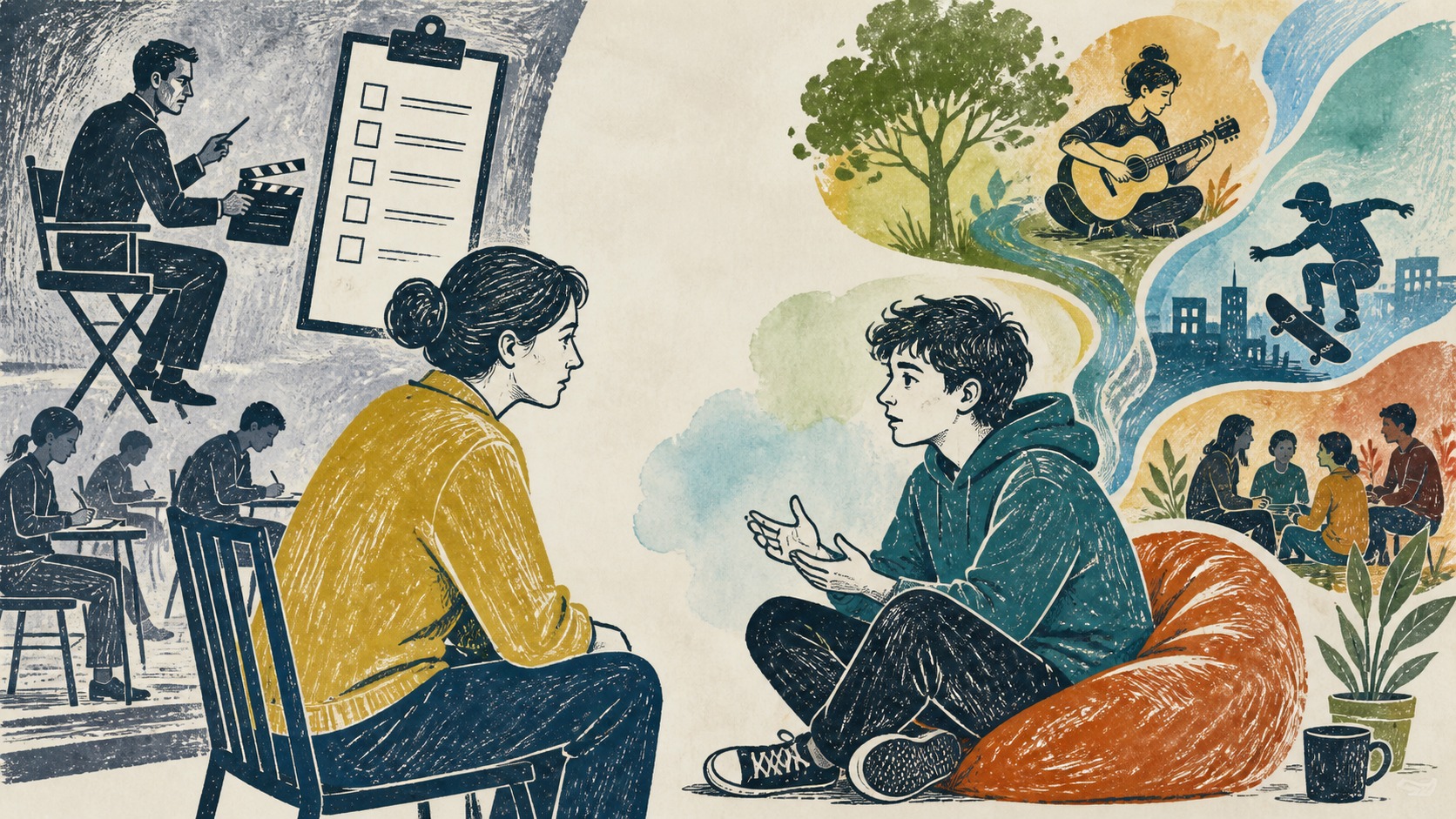
Reviewing progress in support for an autistic person is not an examination or a way to decide whether they have behaved as others expect. It is a conversation for learning which barriers appeared, which adjustments made participation easier, and what next step the person themselves finds useful.
Prepare a review that does not feel like a judgement#
Prepare a review that does not feel like a judgement. A respectful review is prepared with time, a predictable place, and the option to take part by speaking, writing, using pictures, augmentative communication, or a trusted supporter. Before anyone meets, agree the purpose: understand one situation and improve the environment, rather than seek a confession or rate the person. A short agenda and knowledge that a pause is allowed reduce pressure and protect autonomy. Before closing each section, ask one learning question and choose one possible action for the following week.
Prepare a review that does not feel like a judgement. A respectful review is prepared with time, a predictable place, and the option to take part by speaking, writing, using pictures, augmentative communication, or a trusted supporter.
Prepare a review that does not feel like a judgement. It helps to describe what was observable first: what happened, when, what was happening around it, what warning was given, what help was available, and what result followed. Then ask how it was experienced and what it meant to each person. WHO notes that participation is shaped by environmental barriers; NICE supports evidence-based decisions; the NHS provides accessible health information; Autism Europe advocates for rights and inclusion. These sources can guide questions, but they cannot replace the person’s knowledge of their own life. The conversation becomes precise when it ends with a small, checkable change: anticipating a transition, reducing noise, clarifying a literal instruction, allowing more response time, or agreeing how a break can be requested. Record who will do what, which information is private, and when it will be reviewed. If a change does not work, reconsider the barrier and support; do not turn the outcome into a label for the person.
Start with the person’s voice and experience#
Start with the person’s voice and experience. A respectful review is prepared with time, a predictable place, and the option to take part by speaking, writing, using pictures, augmentative communication, or a trusted supporter. Before anyone meets, agree the purpose: understand one situation and improve the environment, rather than seek a confession or rate the person. A short agenda and knowledge that a pause is allowed reduce pressure and protect autonomy. Before closing each section, ask one learning question and choose one possible action for the following week.
Start with the person’s voice and experience. It helps to describe what was observable first: what happened, when, what was happening around it, what warning was given, what help was available, and what result followed. Then ask how it was experienced and what it meant to each person. WHO notes that participation is shaped by environmental barriers; NICE supports evidence-based decisions; the NHS provides accessible health information; Autism Europe advocates for rights and inclusion. These sources can guide questions, but they cannot replace the person’s knowledge of their own life. The conversation becomes precise when it ends with a small, checkable change: anticipating a transition, reducing noise, clarifying a literal instruction, allowing more response time, or agreeing how a break can be requested. Record who will do what, which information is private, and when it will be reviewed. If a change does not work, reconsider the barrier and support; do not turn the outcome into a label for the person.
Separate facts, interpretations, and needs#
Separate facts, interpretations, and needs. A respectful review is prepared with time, a predictable place, and the option to take part by speaking, writing, using pictures, augmentative communication, or a trusted supporter. Before anyone meets, agree the purpose: understand one situation and improve the environment, rather than seek a confession or rate the person. A short agenda and knowledge that a pause is allowed reduce pressure and protect autonomy. Before closing each section, ask one learning question and choose one possible action for the following week.
Separate facts, interpretations, and needs. It helps to describe what was observable first: what happened, when, what was happening around it, what warning was given, what help was available, and what result followed. Then ask how it was experienced and what it meant to each person. WHO notes that participation is shaped by environmental barriers; NICE supports evidence-based decisions; the NHS provides accessible health information; Autism Europe advocates for rights and inclusion. These sources can guide questions, but they cannot replace the person’s knowledge of their own life. The conversation becomes precise when it ends with a small, checkable change: anticipating a transition, reducing noise, clarifying a literal instruction, allowing more response time, or agreeing how a break can be requested. Record who will do what, which information is private, and when it will be reviewed. If a change does not work, reconsider the barrier and support; do not turn the outcome into a label for the person.
Look at barriers before looking for blame#
Look at barriers before looking for blame. A respectful review is prepared with time, a predictable place, and the option to take part by speaking, writing, using pictures, augmentative communication, or a trusted supporter. Before anyone meets, agree the purpose: understand one situation and improve the environment, rather than seek a confession or rate the person. A short agenda and knowledge that a pause is allowed reduce pressure and protect autonomy. Before closing each section, ask one learning question and choose one possible action for the following week.
Look at barriers before looking for blame. It helps to describe what was observable first: what happened, when, what was happening around it, what warning was given, what help was available, and what result followed. Then ask how it was experienced and what it meant to each person. WHO notes that participation is shaped by environmental barriers; NICE supports evidence-based decisions; the NHS provides accessible health information; Autism Europe advocates for rights and inclusion. These sources can guide questions, but they cannot replace the person’s knowledge of their own life. The conversation becomes precise when it ends with a small, checkable change: anticipating a transition, reducing noise, clarifying a literal instruction, allowing more response time, or agreeing how a break can be requested. Record who will do what, which information is private, and when it will be reviewed. If a change does not work, reconsider the barrier and support; do not turn the outcome into a label for the person.
Recognise small and sustainable progress#
Recognise small and sustainable progress. A respectful review is prepared with time, a predictable place, and the option to take part by speaking, writing, using pictures, augmentative communication, or a trusted supporter. Before anyone meets, agree the purpose: understand one situation and improve the environment, rather than seek a confession or rate the person. A short agenda and knowledge that a pause is allowed reduce pressure and protect autonomy. Before closing each section, ask one learning question and choose one possible action for the following week.
Recognise small and sustainable progress. It helps to describe what was observable first: what happened, when, what was happening around it, what warning was given, what help was available, and what result followed. Then ask how it was experienced and what it meant to each person. WHO notes that participation is shaped by environmental barriers; NICE supports evidence-based decisions; the NHS provides accessible health information; Autism Europe advocates for rights and inclusion. These sources can guide questions, but they cannot replace the person’s knowledge of their own life. The conversation becomes precise when it ends with a small, checkable change: anticipating a transition, reducing noise, clarifying a literal instruction, allowing more response time, or agreeing how a break can be requested. Record who will do what, which information is private, and when it will be reviewed. If a change does not work, reconsider the barrier and support; do not turn the outcome into a label for the person.
Ask questions that open options#
Ask questions that open options. A respectful review is prepared with time, a predictable place, and the option to take part by speaking, writing, using pictures, augmentative communication, or a trusted supporter. Before anyone meets, agree the purpose: understand one situation and improve the environment, rather than seek a confession or rate the person. A short agenda and knowledge that a pause is allowed reduce pressure and protect autonomy. Before closing each section, ask one learning question and choose one possible action for the following week.
Ask questions that open options. It helps to describe what was observable first: what happened, when, what was happening around it, what warning was given, what help was available, and what result followed. Then ask how it was experienced and what it meant to each person. WHO notes that participation is shaped by environmental barriers; NICE supports evidence-based decisions; the NHS provides accessible health information; Autism Europe advocates for rights and inclusion. These sources can guide questions, but they cannot replace the person’s knowledge of their own life. The conversation becomes precise when it ends with a small, checkable change: anticipating a transition, reducing noise, clarifying a literal instruction, allowing more response time, or agreeing how a break can be requested. Record who will do what, which information is private, and when it will be reviewed. If a change does not work, reconsider the barrier and support; do not turn the outcome into a label for the person.
Turn the review into one practical adjustment#
Turn the review into one practical adjustment. A respectful review is prepared with time, a predictable place, and the option to take part by speaking, writing, using pictures, augmentative communication, or a trusted supporter. Before anyone meets, agree the purpose: understand one situation and improve the environment, rather than seek a confession or rate the person. A short agenda and knowledge that a pause is allowed reduce pressure and protect autonomy. Before closing each section, ask one learning question and choose one possible action for the following week.
Turn the review into one practical adjustment. It helps to describe what was observable first: what happened, when, what was happening around it, what warning was given, what help was available, and what result followed. Then ask how it was experienced and what it meant to each person. WHO notes that participation is shaped by environmental barriers; NICE supports evidence-based decisions; the NHS provides accessible health information; Autism Europe advocates for rights and inclusion. These sources can guide questions, but they cannot replace the person’s knowledge of their own life. The conversation becomes precise when it ends with a small, checkable change: anticipating a transition, reducing noise, clarifying a literal instruction, allowing more response time, or agreeing how a break can be requested. Record who will do what, which information is private, and when it will be reviewed. If a change does not work, reconsider the barrier and support; do not turn the outcome into a label for the person.
Case 1: a difficult morning before school#
Case 1: a difficult morning before school. The conversation becomes precise when it ends with a small, checkable change: anticipating a transition, reducing noise, clarifying a literal instruction, allowing more response time, or agreeing how a break can be requested. Record who will do what, which information is private, and when it will be reviewed. If a change does not work, reconsider the barrier and support; do not turn the outcome into a label for the person. Before closing each section, ask one learning question and choose one possible action for the following week.
Case 1: a difficult morning before school. It helps to describe what was observable first: what happened, when, what was happening around it, what warning was given, what help was available, and what result followed. Then ask how it was experienced and what it meant to each person. WHO notes that participation is shaped by environmental barriers; NICE supports evidence-based decisions; the NHS provides accessible health information; Autism Europe advocates for rights and inclusion. These sources can guide questions, but they cannot replace the person’s knowledge of their own life. The conversation becomes precise when it ends with a small, checkable change: anticipating a transition, reducing noise, clarifying a literal instruction, allowing more response time, or agreeing how a break can be requested. Record who will do what, which information is private, and when it will be reviewed. If a change does not work, reconsider the barrier and support; do not turn the outcome into a label for the person.
Case 2: a social activity that became exhausting#
Case 2: a social activity that became exhausting. The conversation becomes precise when it ends with a small, checkable change: anticipating a transition, reducing noise, clarifying a literal instruction, allowing more response time, or agreeing how a break can be requested. Record who will do what, which information is private, and when it will be reviewed. If a change does not work, reconsider the barrier and support; do not turn the outcome into a label for the person. Before closing each section, ask one learning question and choose one possible action for the following week.
Case 2: a social activity that became exhausting. It helps to describe what was observable first: what happened, when, what was happening around it, what warning was given, what help was available, and what result followed. Then ask how it was experienced and what it meant to each person. WHO notes that participation is shaped by environmental barriers; NICE supports evidence-based decisions; the NHS provides accessible health information; Autism Europe advocates for rights and inclusion. These sources can guide questions, but they cannot replace the person’s knowledge of their own life. The conversation becomes precise when it ends with a small, checkable change: anticipating a transition, reducing noise, clarifying a literal instruction, allowing more response time, or agreeing how a break can be requested. Record who will do what, which information is private, and when it will be reviewed. If a change does not work, reconsider the barrier and support; do not turn the outcome into a label for the person.
Case 3: a health appointment with too much information#
Case 3: a health appointment with too much information. The conversation becomes precise when it ends with a small, checkable change: anticipating a transition, reducing noise, clarifying a literal instruction, allowing more response time, or agreeing how a break can be requested. Record who will do what, which information is private, and when it will be reviewed. If a change does not work, reconsider the barrier and support; do not turn the outcome into a label for the person. Before closing each section, ask one learning question and choose one possible action for the following week.
Case 3: a health appointment with too much information. It helps to describe what was observable first: what happened, when, what was happening around it, what warning was given, what help was available, and what result followed. Then ask how it was experienced and what it meant to each person. WHO notes that participation is shaped by environmental barriers; NICE supports evidence-based decisions; the NHS provides accessible health information; Autism Europe advocates for rights and inclusion. These sources can guide questions, but they cannot replace the person’s knowledge of their own life. The conversation becomes precise when it ends with a small, checkable change: anticipating a transition, reducing noise, clarifying a literal instruction, allowing more response time, or agreeing how a break can be requested. Record who will do what, which information is private, and when it will be reviewed. If a change does not work, reconsider the barrier and support; do not turn the outcome into a label for the person.
When to seek additional support and close the conversation#
When to seek additional support and close the conversation. A respectful review is prepared with time, a predictable place, and the option to take part by speaking, writing, using pictures, augmentative communication, or a trusted supporter. Before anyone meets, agree the purpose: understand one situation and improve the environment, rather than seek a confession or rate the person. A short agenda and knowledge that a pause is allowed reduce pressure and protect autonomy. Before closing each section, ask one learning question and choose one possible action for the following week.
When to seek additional support and close the conversation. It helps to describe what was observable first: what happened, when, what was happening around it, what warning was given, what help was available, and what result followed. Then ask how it was experienced and what it meant to each person. WHO notes that participation is shaped by environmental barriers; NICE supports evidence-based decisions; the NHS provides accessible health information; Autism Europe advocates for rights and inclusion. These sources can guide questions, but they cannot replace the person’s knowledge of their own life. The conversation becomes precise when it ends with a small, checkable change: anticipating a transition, reducing noise, clarifying a literal instruction, allowing more response time, or agreeing how a break can be requested. Record who will do what, which information is private, and when it will be reviewed. If a change does not work, reconsider the barrier and support; do not turn the outcome into a label for the person.
WHO · NHS · NICE · Autism Europe.