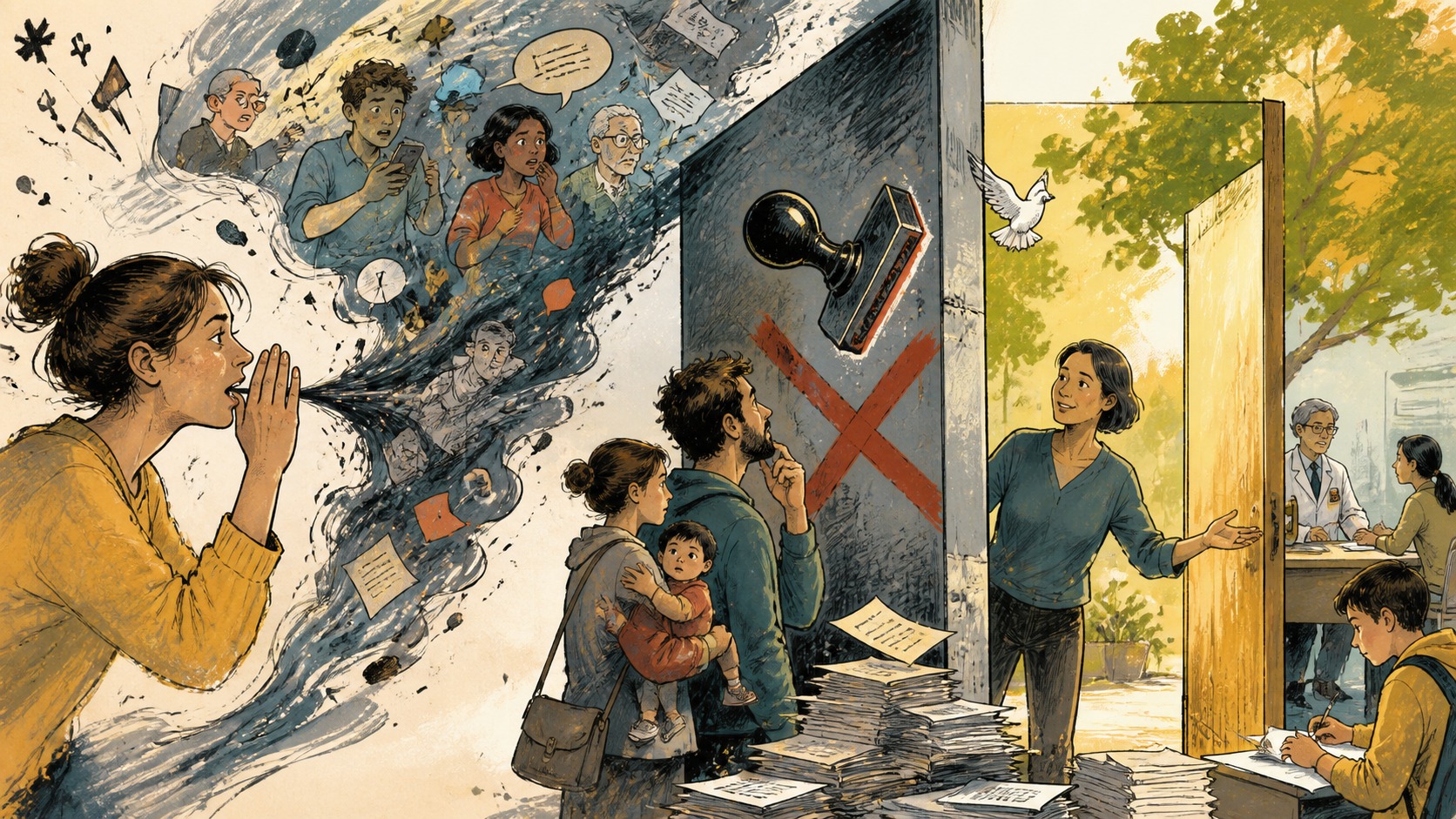
A sibling conflict review should not be a family trial. Its job is to reconstruct what happened, identify impact, assign specific responsibility and choose one adjustment for next time. Blame asks which child is the problem; reflection asks which action, condition or missing skill needs attention. This distinction does not minimise harm or force equal responsibility. It makes room to notice power, protect the child with less freedom and still expect repair from everyone who contributed. The cases and questions below offer a practical way to recognise progress without demanding perfection, public remorse or a single shared story.
A sibling conflict review should not be a family trial.
Wait for enough regulation, not perfect agreement#
Do not begin while children are chasing, shouting or guarding objects. Stop harm, create distance, check injuries and name when the conversation will resume. “We will speak separately after dinner” is more reliable than “we will deal with this later.” One child may need movement; another may need quiet, food or a written prompt. A scheduled pause protects the review from becoming a second conflict and shows that safety comes before explanation.
Ask each child whether they can talk for ten minutes, whether they want to speak or write, and whether they fear retaliation. Keep interviews separate when power or fear is present. HealthyChildren from the American Academy of Pediatrics recommends calm listening, clear rules and individual attention. Calm listening is compatible with a firm boundary; it simply makes accurate information and learning more likely.
Reconstruct five moments rather than one verdict#
Use five boxes: what was happening before, the first signal, escalation, interruption and recovery. Fill them with observable verbs such as entered, moved, sent, blocked, shouted and left. “She is jealous” and “he always starts it” are interpretations, not timeline entries. A sequence exposes decision points and environmental pressures. It may show that the argument began over headphones but escalated when an adult compared the siblings' grades.
Useful prompts include: “What did you see or hear directly?”, “What did someone else tell you?”, “When did you realise you needed help?” and “What did the adult do that helped?” Let conflicting accounts remain side by side. Protection does not require certainty about every second. A family can be unsure who moved a charger first and still establish that closed bedrooms require permission and that taking property never settles a dispute.
Separate intent, impact and next responsibility#
A child may not have intended the eventual harm. A joke sent to one cousin can spread through a class; a shove meant to make space can cause a fall. Ask what the child wanted, what actually happened, what was foreseeable and what must be repaired. “I did not mean it” can be accepted as information without becoming an exemption. The child is not declared cruel, but the consequence remains real.
Responsibility is not automatically fifty-fifty. Consider age, size, allies, passwords, control of space and each child's ability to leave. StopBullying.gov identifies repetition or likely repetition and a power imbalance as central features of bullying. A younger sibling's sharp response after repeated exclusion does not make every part symmetrical. Precision protects accountability from turning into false equivalence.
Track progress through access and recovery#
Counting fights alone misses important change. Track intensity, duration, recovery time and adult support required. Two brief disagreements that end with a respected stop request can be progress. Seven quiet days may not be progress if one child has stopped using the kitchen. Also note whether both siblings retain access to rooms, friends, activities, belongings and trusted adults.
Ask: “Could you say stop?”, “Did the other person stop?”, “How soon did you return?”, “What help did you request earlier?” and “What did you manage independently?” Compare short periods rather than personalities. If afternoons improve while mornings deteriorate, adjust the morning transition. Measures guide the next experiment; they are not a scorecard for deciding which sibling deserves more approval.
Case 1: a shared bicycle and missing permission#
Eleven-year-old Theo took his sister Maya's bicycle without asking and left it unlocked. Nine-year-old Maya found it, rode it home and hid the helmet so he could not use it again. Each described the other as a thief. Their aunt mapped the sequence. Theo had violated permission and security; Maya had recovered her property but then withheld safety equipment. The actions were related but carried different impacts.
Theo cleaned the bicycle, replaced the lock from savings and lost unsupervised access until he could ask reliably. Maya returned the helmet and received a labelled storage place that Theo could not enter. The one-week review asked about requests, storage and adult help, not whether they enjoyed sharing. Progress appeared when Theo accepted a no and Maya contacted her aunt instead of creating a new hazard.
Case 2: sisters recruit friends after an argument#
Fourteen-year-old Erin told three friends not to invite her twelve-year-old sister Jo to a neighbourhood game. Jo responded by posting an embarrassing childhood picture of Erin. Their father first secured the image and contacted the friends without distributing more screenshots. Separate reviews showed an unequal alliance and a separate privacy violation. Treating both as “online drama” would have hidden the different repair each action required.
Erin corrected the exclusion message and stepped out of organising the next two games. Jo deleted the image, asked recipients to delete copies and temporarily lost access to Erin's photo archive. Jo did not have to join Erin's game immediately or accept an apology. Review questions tracked invitations, image circulation, retaliation and safe alternatives. The aim was restored choice, not a staged reconciliation for adults.
Case 3: caregiving becomes sibling control#
Seventeen-year-old Ben collected his eight-year-old brother Lucas after school. When Lucas was slow, Ben threatened to leave and reported every mistake to their parents. Lucas began hiding in the library. The adults had assigned responsibility without limits or backup. They first created a safe transition with a named staff member and another authorised adult, then reviewed Ben's threats and the workload that made escalation predictable.
Ben took responsibility for frightening Lucas; the parents took responsibility for an unsuitable arrangement. Lucas practised notifying staff before going to the library. Repair meant building a reliable system, not forcing the brothers to walk together the next day. Questions clarified who had authority, what Ben could decline, how Lucas would signal a change and which adult would respond. Safety, not gratitude, became the measure.
Choose repair that matches the impact#
Repair may mean returning, cleaning, rebuilding, correcting a rumour, replacing a reasonable share or enabling someone to re-enter a space. It should be connected, achievable and finite. A forced hug or public apology often comforts adults while increasing shame. A useful apology names the act and effect, describes repair and accepts that the recipient may not answer, forgive or meet.
The affected child can choose among safe options but cannot design endless punishment. Ask what needs to return to their control, whether repair should be direct or adult-mediated, and what would restore access. UNICEF presents positive discipline through clear expectations, listening and calm consequences. A related consequence teaches a usable alternative and creates a path back into trust.
Include adult and environmental responsibility#
Adults examine whether they compared children, issued conflicting instructions, arrived late or left one scarce resource without a rule. “What did we fail to anticipate?”, “Which intervention escalated the moment?” and “What can we organise differently?” are accountability questions. A caregiver can apologise for shouting and maintain the boundary on hitting. Correcting an adult mistake models authority that is sturdy enough to learn.
Environmental changes may include separate shelves, visible turns, protected passwords, duplicate school supplies or individual time. The Harvard Center on the Developing Child explains that executive-function and self-regulation skills develop through practice and support. Reducing predictable overload is not surrender. It creates conditions in which children can practise, and support can fade as skills become reliable.
Case 4: brothers disagree about a damaged project#
Seven-year-old Amir said his brother Noah destroyed a cardboard city. Ten-year-old Noah said the city blocked the shared floor and tore when he moved it. Their grandmother resisted demanding one confession. The timeline showed that she had promised Amir the space until Friday but had not told Noah. Noah moved the project roughly; Amir then tore Noah's drawing in retaliation. The missing adult communication mattered without excusing either response.
Noah rebuilt the damaged bridge with Amir nearby but not directing every step. Amir repaired the drawing with archival tape. Their grandmother marked project zones and end dates on a calendar. At review, they examined whether notices were visible, whether each boy asked before moving work and whether retaliation stopped. The most important progress was not friendship during rebuilding; it was each child naming his own action before describing the other's.
End with one seven-day experiment#
Choose one observable change: knock and wait, charge devices in separate rooms, avoid performance analysis in the car, or use a shared pause word. Record who will act, when it starts and what the adult will notice. “We will never fight again” gives no direction. A small experiment reveals whether time, space, ambiguity or missing help is driving the repeated pattern.
Set the review date before ending. Ask what became easier, what remained difficult, which repair is incomplete and which support can fade. A new incident does not erase earlier progress; it may show that the signal came too late or that one context needs another plan. Autonomy grows when siblings notice escalation, seek help sooner and contribute to adjustments, not when adults withdraw all support at once.
Know when family review is not enough#
Injury, persistent fear, credible threats, movement control, concerning sexual behaviour, sustained cruelty, self-harm or withdrawal from school and activities require professional assessment. Immediate danger calls for local emergency services. Primary care, school safeguarding and child mental health professionals can hear siblings separately and consider development, trauma and family patterns. A restorative conversation must never delay a required protection response.
Bring a short chronology of observable acts, frequency, attempted measures and outcomes rather than a file of character judgements. the American Academy of Child and Adolescent Psychiatry provides family guidance on stress and adjustment, while local professionals can assess the individual situation. Reviewing without blame does not soften harm. It uses accuracy, repair and support so responsibility becomes a route to safer behaviour instead of a permanent family identity.