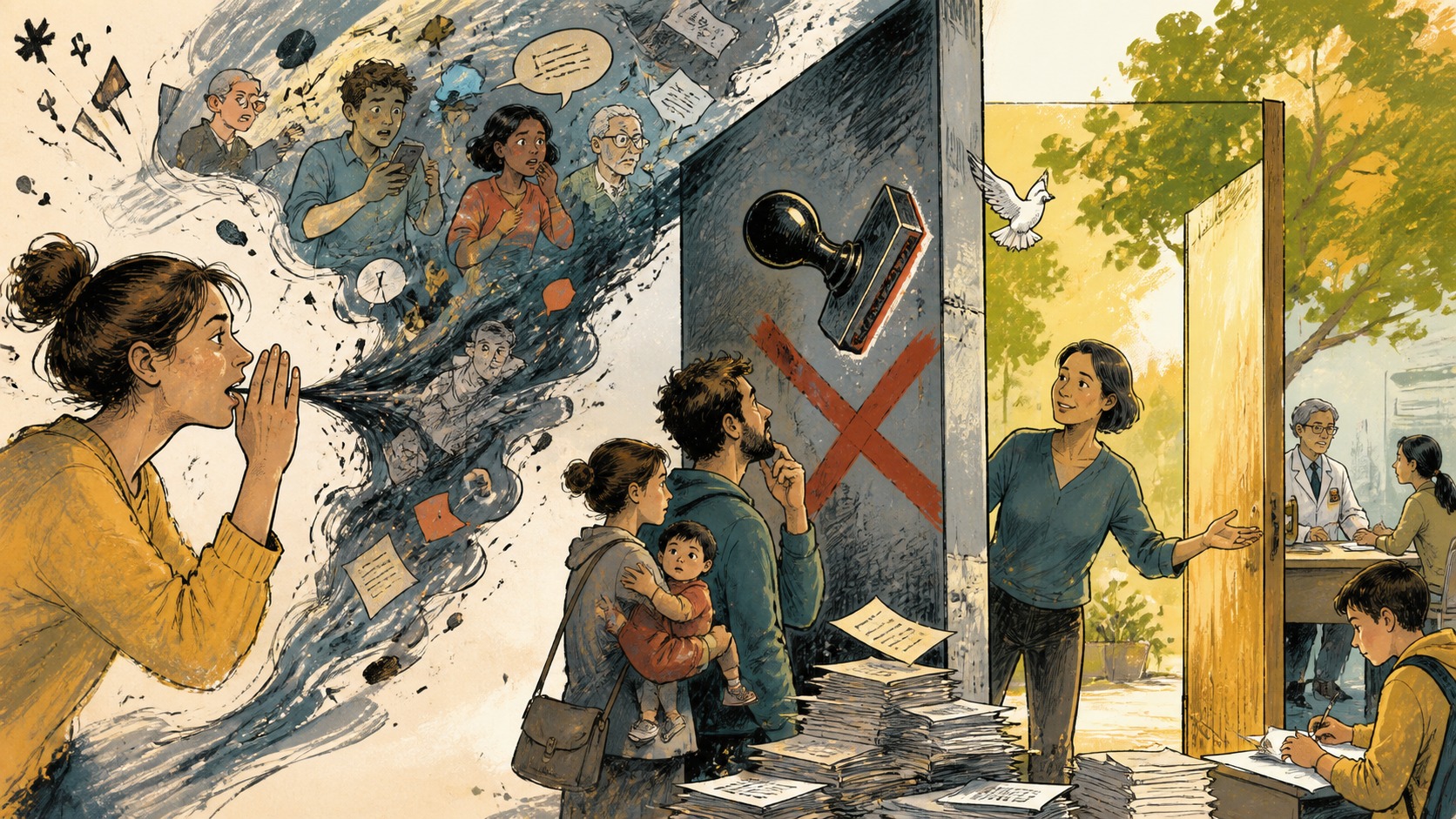
Sibling jealousy and alliances do not always stay at home. They can reappear on a school bus, in a team changing room, at a youth centre or through classmates online. Each adult then sees only one section of the pattern. Coordination should not expose a family's private history or impose the same consequence everywhere. It should define the right being protected, assign a small action to each setting, give children a safe route to help and schedule review. A concise agreement closes gaps without making children carry accusations between adults.
Sibling jealousy and alliances do not always stay at home.
Open a shared plan only when the problem crosses settings#
A repaired quarrel over a household object does not belong in a school file. Coordination becomes useful when conduct continues in another place, disrupts attendance or learning, recruits peers, restricts access to an activity or requires action from another responsible adult. The starting question is not “Who is the difficult sibling?” but “Which part cannot be made safe by one setting alone?”
State the aim as observable freedom. Both children can attend the club without intimidation; a student can eat lunch without organised exclusion; each sibling can use an education account independently. “They will become close again” is not an operational goal and may force contact. Schools manage participation and safety at school, families manage home routines and community organisations manage the activity they supervise.
CDC describes parent engagement as parents and school staff working together to support learning, development and health. Shared responsibility is strongest when the task and boundary of the partnership are explicit rather than when every adult receives every detail.
Carry the same protections, not identical punishments#
Four protections can travel across settings: no hitting or blocking exits; a request to stop teasing or contact is respected; images and secrets are not used for humiliation; asking for help does not trigger retaliation. A school may use its behaviour process, a family may change device access and a sports club may rearrange groups. These responses differ while upholding the same rights.
The agreement also lists unsafe adult shortcuts. An older sibling will not supervise the younger one. Joint mediation will not occur when one child is afraid or cannot leave freely. No public apology or family-group disclosure will be required. Adults will not promise confidentiality they cannot keep under safeguarding duties; they will explain what must be shared, with whom and for what purpose.
HealthyChildren from the American Academy of Pediatrics recommends clear family ground rules and calm intervention when a child's physical or emotional wellbeing is at stake. That combination allows independence to grow without treating lack of adult involvement as a goal in itself.
Appoint contacts who can actually act#
The family names one coordinator and a backup. The school or organisation does the same. They choose an authorised channel, ordinary response time and urgent route. A coordinator confirms facts, actions and review dates. The role does not include diagnosing children, investigating every past dispute or promising a sanction controlled by somebody else.
Across two homes, adults communicate directly unless a documented legal restriction changes that route. Children may express needs and preferences, but they do not transport screenshots, policy changes or blame. With teenagers, adults distinguish information the young person can share, information shared with consent and information that safety requires adults to pass on. Explaining those categories in advance protects trust.
Responsibility is mapped by time and place: classroom, lunch, transport, changing room, library session and home. A counsellor may advise, yet the first adult present needs a simple action. A plan that depends on a specialist who attends on Thursdays leaves children unprotected on Monday.
Write a one-page working agreement#
Seven fields are enough: observable conduct; contexts where it occurs; a two-week objective; action in each setting; help available to each child; measures to record; review date and participants. “Blocked the doorway twice after practice” guides protection. “Has always been controlling and jealous” turns interpretation into identity and invites confirmation bias.
Every action needs an actor and time. A caregiver will separate accounts that evening. A teacher will provide different arrival routes for five days. A coach will check the exit after practice. Each child can use a code word for distance. “Everyone will monitor things” creates no dependable behaviour and cannot be reviewed.
Keep prevention, response and repair distinct. Prevention changes a transition, object or supervision arrangement before trouble. Response stops harm, hears children separately and informs the contact. Repair restores what was affected by returning, deleting, correcting or rebuilding. The harmed sibling never owes forgiveness, a hug or renewed play as proof that repair worked.
Use the minimum information needed for the task#
Before sending a message, ask whether the recipient needs that fact to perform the assigned action. Diagnoses, custody history, medical detail, screenshots and third-party accounts should not circulate because they are interesting. Use approved channels and the applicable local rules on privacy and safeguarding. Families normally know what is shared unless immediate disclosure would increase a risk and a formal protocol directs otherwise.
A useful note separates observation, source and decision: “The activity leader saw the door blocked at 5:10, separated both children and called the coordinator.” It does not add rumours. When both siblings attend the school, each child's record remains separate. When only one attends, staff should not create an informal dossier on the sibling outside their institution.
The US Department of Education's student privacy office explains that personally identifiable education-record information generally needs consent or an applicable exception and that data-sharing arrangements often require protective agreements. Laws differ across jurisdictions, but purpose limitation, restricted access and traceability remain sound safeguards.
Run a short meeting that produces a decision#
A thirty-minute agenda can cover purpose, direct observations, each child's need, one small trial and review. It should not reconstruct years of sibling history. Conflicting accounts are recorded as different accounts rather than settled by a vote on which child is the problem. Every participant identifies what can change in their own setting the following day.
Children can contribute through a prior conversation, drawing, visual scale, short form or partial attendance. They should not hear a sibling's private information or defend themselves before a room of adults. Afterwards, give each child a plain explanation: who will help, what happens after a stop request, where they can go and when their view of the trial will be collected.
UNICEF advises families to build relationships with teachers and school leaders, learn the school's response mechanism and work with counsellors or safety groups when concerns arise. Sibling conflict is not automatically bullying, but that partnership route matters when intimidation or exclusion uses the school environment.
Give community adults narrow, useful roles#
A library, sports club, youth organisation, extended family member or community service can offer different spaces, transport, supervision or respite. It does not need the complete family story. Ask for one contribution: separate practice groups for three weeks, an adult at the exit, two study stations or a ride for one child. Community support should increase options rather than recruit more judges.
Access barriers belong in the agreement. Work schedules, language, disability, cost and weak digital access may exclude a crucial caregiver. Offer professional interpretation, easy-read text, visual supports, telephone contact or another meeting time. A child must not interpret a meeting about their own family conflict; that gives them information and responsibility no child should carry.
Harvard's Center on the Developing Child identifies at least one stable, committed relationship with a supportive adult as a central protective factor in resilience. A coordinated network should add reliable relationships, not a crowd of adults who know labels but do not act.
Create a route for incidents that move between places#
If conduct begins at home and continues through peers at school, the first adult makes the present situation safe, preserves only necessary evidence and contacts the named person. The receiver acknowledges the message, applies their setting's responsibility and replies with three items: what they observed, what they did and what they need. They do not forward allegations widely or announce another institution's consequence.
A green level can cover occasional disagreement without fear or harm. Amber can cover repetition, humiliation, exclusion, digital continuation or loss of access and triggers coordination. Red includes injury, credible threats, coercion, weapons, strangulation, concerning sexual conduct, self-harm or an adult's inability to protect. Red activates local emergency or safeguarding procedures rather than waiting for the scheduled review.
The American Academy of Child and Adolescent Psychiatry advises adults not to minimise severe sibling aggression and notes that frequent or intense aggression may require professional assessment. Writing escalation thresholds early makes outside help part of responsible planning rather than evidence of failure.
Case 1: a home alliance becomes school exclusion#
Twelve-year-old Malik persuaded two friends not to let his ten-year-old sister Aisha sit with them after a home argument. Aisha began reporting stomach aches before lunch. Their mother contacted the year lead with dates and observable conduct, asking the school to protect participation rather than decide the household dispute. Separate conversations confirmed the exclusion.
For two weeks, Aisha had a named lunch contact and a safe table. Malik could not use class groups to continue family disputes. At home, his mother supervised deletion of messages and a factual correction. Aisha did not attend a joint meeting or accept an apology. The school reminded all students about exclusion without exposing the siblings' private history.
Review covered lunch attendance, new messages, access to friends and help required. Aisha ate in the dining room for a full week and no retaliation appeared. Visible supervision then faded while her contact remained. The evidence of progress was restored ordinary access, not compulsory closeness with Malik.
Case 2: coaching turns into control#
Sixteen-year-old Grace continually corrected her thirteen-year-old brother Owen during athletics and reported his mistakes at home. The coach assumed this was helpful experience. Owen later disclosed that Grace also stood across the changing-room exit until he listened. The coach stopped the conduct immediately, arranged different training groups and sent a factual note to the family contact.
The three-week agreement made coaches give instructions directly to Owen. Grace was no longer an intermediary. Their father stopped asking her to “keep him focused” and provided separate transport twice a week. Owen chose an adult at the track and could leave practice through another exit. Grace could offer help only if Owen requested it and the coach approved.
Review asked whether Owen attended, left freely and received feedback without humiliation. He attended every session and there were no blocked exits. He later chose to share a warm-up, but changing arrangements stayed separate. Voluntary contact showed more freedom; increased time together was never the target.
Case 3: education passwords across two homes#
Sofia and Daniel moved between two households. After a dispute, Daniel changed a shared account password and Sofia missed homework submissions. One home removed all devices; the other restored access without knowing the incident. The siblings carried conflicting messages for several days while school staff saw only late work.
Caregivers opened one adult email thread, created individual education accounts, placed recovery control with adults and separated school access from entertainment privileges. The teacher learned only that credentials had been interfered with and offered a short deadline extension. Daniel restored settings under supervision; Sofia chose a new password she did not disclose to him.
Review tracked unauthorised access, completed work and direct communication between homes. No further access occurred and submissions resumed. School did not arbitrate domestic device rules, while the households did not make the teacher their messenger. Each setting completed its own task and the system gap disappeared.
Adapt support without charging the cost to a sibling#
Young children need immediate action, visual prompts and two safe choices. Teenagers need privacy, real participation and an expiry date for restrictions. Neurodivergence, trauma, pain or disability may require advance warning, sensory adjustment or augmentative communication. Adaptation changes the scaffold; it never makes another sibling the regulator, interpreter or permanent carer.
Blended families, foster families, kinship care and two-home arrangements require a clear record of who can consent, receive information and act. Court orders and protection measures take priority and should be interpreted by qualified professionals. A household agreement cannot override legal restrictions or an institution's safeguarding procedure.
Cultural expectations about age, privacy and mutual help deserve respectful discussion. Language and routines can be adapted without excusing violence or coercion. Being older, female, more verbal or fluent in the community language does not create a duty to tolerate harm or manage the entire network.
Measure access and burden, not only incident totals#
The smallest useful log records date, context, action, response and outcome. Fewer reports do not prove safety if one child has stopped attending. Review access to rooms, activities and friendships; attendance; sleep and concentration; recovery time; and adult help required. Speak to children separately about whether apparent peace depends on avoidance or silence.
At review, choose one of four outcomes: continue, adjust, fade or escalate. Continue a measure that protects without excessive restriction. Change one variable when a difficulty clusters around a specific transition. Fade one support when skill and safety are stable. Escalate for fear, injury, concealment or declining function. Record the decision and another date so monitoring does not become indefinite.
WHO recommends evidence-based parenting interventions to reduce harsh parenting, strengthen parent-child relationships and prevent emotional and behavioural difficulties. Primary care, child mental health, social services or safeguarding teams can expand the plan when a family-school agreement is too small for the pattern.
Finish with a route everyone can understand#
The final card completes nine prompts: we are protecting; we observed; home will; school will; community will; each child can; we will record; we will review on; we will seek urgent help if. Read it with the children, remove blaming language and give each participant only the version needed for their role. Date every later change.
Good coordination does not promise a conflict-free family. It makes adult responsibility visible, gives every child a route out and stops important information depending on a sibling messenger. Families, schools and community organisations remain different systems. By agreeing on essential protections, guarding privacy and reviewing real effects, they prevent the spaces between them from becoming part of the problem.