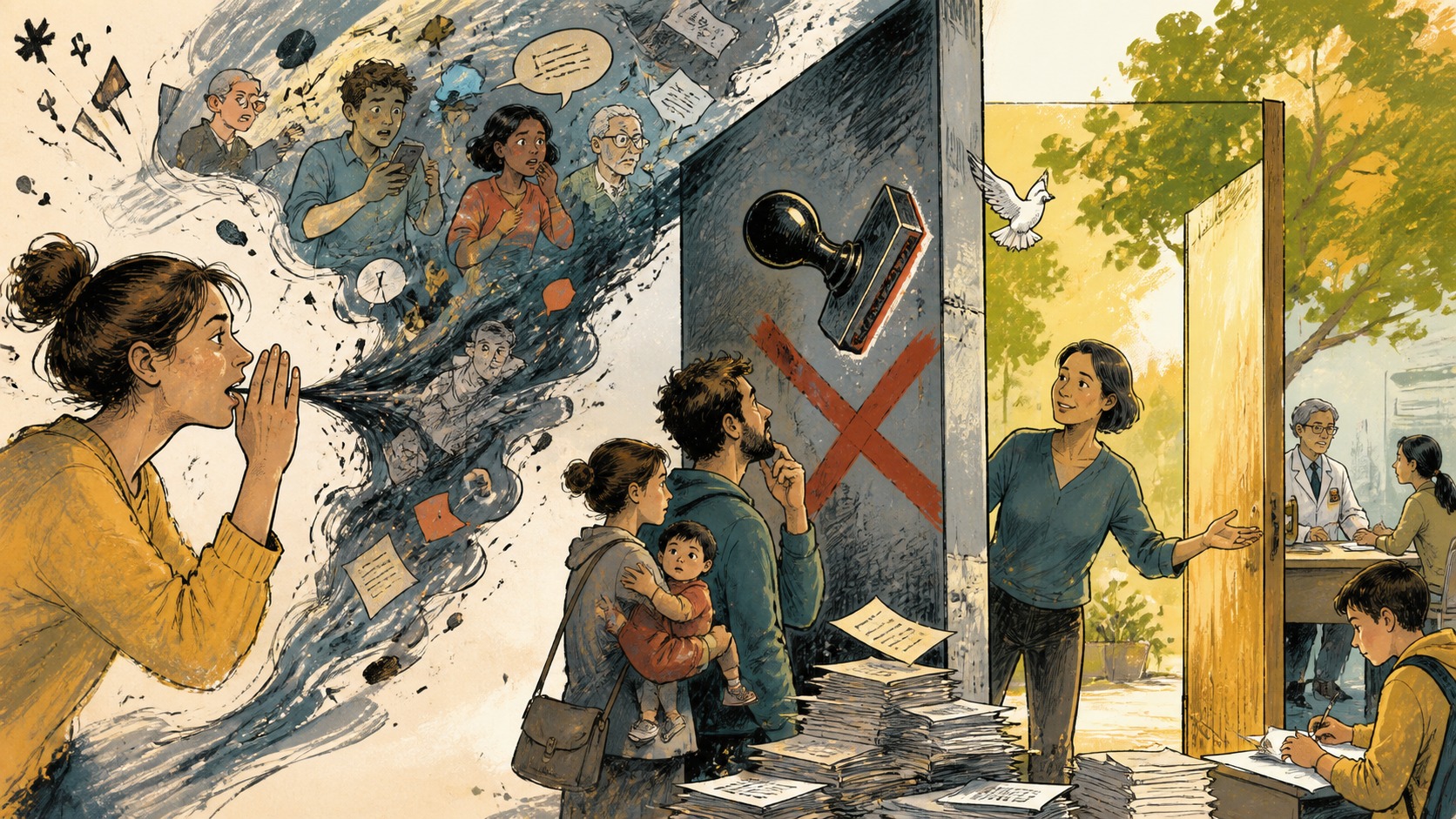
Siblings can argue over an object without a family turning every scene into a trial. The difficulty begins when an adult has only two responses: decide who is right at speed or supervise every exchange forever. This five-step plan offers a third route for a dispute about shared things: stop harm, collect facts, name needs, test one small alternative and review evidence. The aim is not constant affection. It is for both children to be safe, use what is available to them and ask for help before a fight writes the rules.
Before the next dispute#
An argument over a charger, tablet or sofa often begins before the shouting. Tiredness, an unannounced transition, an invisible turn or the belief that the other child always wins may already be present. Preparing a five-step card while everyone is settled prevents improvised threats. It also lets caregivers agree which objects are put away, which spaces offer distance and which words do not humiliate anyone. Preparation does not erase emotion; it creates a route when thinking becomes difficult.
Caregivers should separate a safety rule from a household preference. No hitting, blocking an exit, taking a device to punish or exposing another child are limits. Choosing a film order can use a turn. This distinction prevents endless mediation and protects the child with less strength, age or ability to answer back. The related article on signals and thresholds for help can help adults decide when a home plan is too small.
Step one: a pause that protects#
The pause starts with safe physical action: separate bodies, remove the item and attend to any injury. It does not require deciding who began or demanding eye contact. A useful sentence is, “I will not let you hurt each other; I am separating you now and I will hear you next.” A quiet voice does not weaken the boundary. It prevents the instruction becoming another provocation and tells each sibling what happens next.
Regulation is not an order to become calm. One child may drink water, sit near an adult, walk in the hall or request quiet; the other may prefer distance. The pause ends when there is enough safety to hear one short sentence, not when an apology appears. UNICEF outlines discipline that preserves both connection and limits. Strangulation, weapons, credible threats, coercion, intense fear or injuries require local urgent help; no household procedure replaces immediate protection.
Step two: facts without labels#
Then the adult listens separately and asks for an observable sequence: what were you doing, what changed, what did you do, what happened next and what do you need now? “Took my headphones,” “shut the door” and “I pushed the chair” are more useful than “selfish.” Accounts can differ without either being a complete lie. The purpose is to locate the alterable point in the scene, not obtain a dramatic confession.
Fixed labels turn a difficulty into an identity. Calling a child jealous can hide an unfair turn; calling the older sibling responsible can make them tolerate too much. If messages or photographs are involved, stop circulation and retain only what is needed for protection, never forwarding material to family chat. AACAP says aggressive fighting should not be minimised. Listening follows stopping harm because nobody explains well while expecting retaliation.
Step three: need and right#
The adult states the problem in one neutral sentence: “You both wanted the console and there was no visible turn.” Then separate need from strategy. Wanting play, privacy, fairness or attention is legitimate; hitting, threatening, hiding a key or posting ridicule is not. This distinction recognises an emotion without licensing the behaviour that caused harm.
Not every dispute is symmetrical. If one sibling controls passwords, doors, physical strength or adult reaction, equal concessions are not appropriate. Restore protection and access first; then hear ideas. Shared mediation is reasonable only when each child can say no, leave the conversation and ask for help again without punishment. HealthyChildren provides paediatric guidance on sibling rivalry. Equality is not dividing blame; it is protecting equivalent rights.
Step four: a testable alternative#
The trial should last a few days and fit on a card: twenty minutes with a timer, headphones in a shared box, permission before entry and a code word for adult support. Each child holds one concrete action. Changing one variable makes effects visible; imposing eight new rules creates another occasion for failure and surveillance.
Repair should fit impact. Returning minutes, rebuilding an object, deleting an image or correcting a rumour teaches more than reciting apologies. The child who was harmed does not owe a hug, renewed play or acceptance of an apology to prove maturity. Harvard Center on the Developing Child describes executive function as a practised capacity. Adult support can fade in stages: demonstrate the timer, watch closely, remain available and eventually review data only.
Step five: a short review#
Set the review date before the trial: three days, one week or five uses of the item. Check safety, response to “stop,” real access, recovery time and help required. Counting fights alone misleads if one child no longer enters the room. The important question is whether both gained safe freedom or merely quiet.
A review ends with a decision. If the agreement reduced harm, retain it and remove one support. If it fails at the same time every day, alter the transition. If injuries, fear, control, destruction, isolation, sleep changes or school difficulty increase, consult paediatrics or child mental health. The plan supplies concrete information and avoids reducing family life to “they cannot get along.”
A case involving a shared console#
Eleven-year-old Iria used the console after dinner; eight-year-old Joel believed his turns vanished when visitors stayed late. One night Joel hid the controller and Iria grabbed his arm. Their father stored the console, checked the arm and spoke to each child. He found an unclear rule and a physical response that could not happen again.
They tested a turn board, a fifteen-minute alarm and five minutes to finish a game. Joel had to place the controller on the table; Iria had to call their father if he did not. Iria helped apply ice and lost access that evening for grabbing; Joel returned the hidden time next day.
A week later there were protests, but no physical contact and two turn changes without an adult.Siblings can argue over an object without a family turning every scene into a trial.
When negotiation is not appropriate#
Some situations should not become a meeting of equals: a blocked door, repeated threats, blackmail with secrets, intimate images, sustained cruelty or fear of returning to a space. The adult protects, records facts and seeks support. Asking for help does not label one sibling bad; it recognises that the family needs more capacity than a fridge rule can provide.
Avoid making the older child a police officer. They may help voluntarily, but should not lose rest to monitor another child. In separate homes, adults share safety information directly. Children do not carry accusations from one house to another. The article on family roles without fixed labels helps reveal those invisible burdens.
Make the plan a habit#
At the end of review, name an action rather than an identity: “you stopped,” “you asked for time,” “you returned the item.” When several weeks show safety and access, remove one support at a time. Keep the card available to reopen the plan before crisis. Five steps do not promise permanent harmony; they teach that a need can be heard, harm can be stopped and a solution can change when evidence shows it is not working.
undefined
An observation sheet that does not police#
A simple sheet can record date, object, preceding transition, stop signal, help requested and outcome. It is not used to total blame or prove that one child is difficult. It helps reveal patterns: perhaps clashes happen after school, when hunger is high, or when a rule changes with the adult on duty. Two weeks of notes can correct one condition without inventing an explanation about anyone’s character.
Siblings may participate by choosing symbols or reviewing only their own part. A teenager needs to know who will see a digital note and how long it will remain. Privacy is part of safety: useful observation does not become an archive for relatives, teachers or friends. The adult keeps the minimum information required and shares it only when it helps protect someone or obtain the agreed support.
The sheet also makes adult effort visible. It may show that a rule worked on Monday because someone was available and failed on Thursday because nobody anticipated dinner. That information does not blame a caregiver; it identifies a need for relief, a schedule adjustment or added support. A fair plan does not demand a skill from children that adults have not yet organised around them.
At the end of each week, each sibling can answer three questions: what became easier, what still felt unfair and what specific help they want to test. Hearing those answers does not require accepting every request. It requires offering an understandable response. Review then teaches participation without transferring adult responsibility for maintaining a safe setting to children.
The agreed date prevents one difficult evening from defining the whole relationship. It gives both children a predictable opportunity to say whether access, privacy and safety have actually improved in ordinary family life, and it lets adults adjust support before another crisis grows. It reminds caregivers that evidence includes freedom to enter a room, use a shared object and refuse contact without fear, not simply the absence of a loud argument.