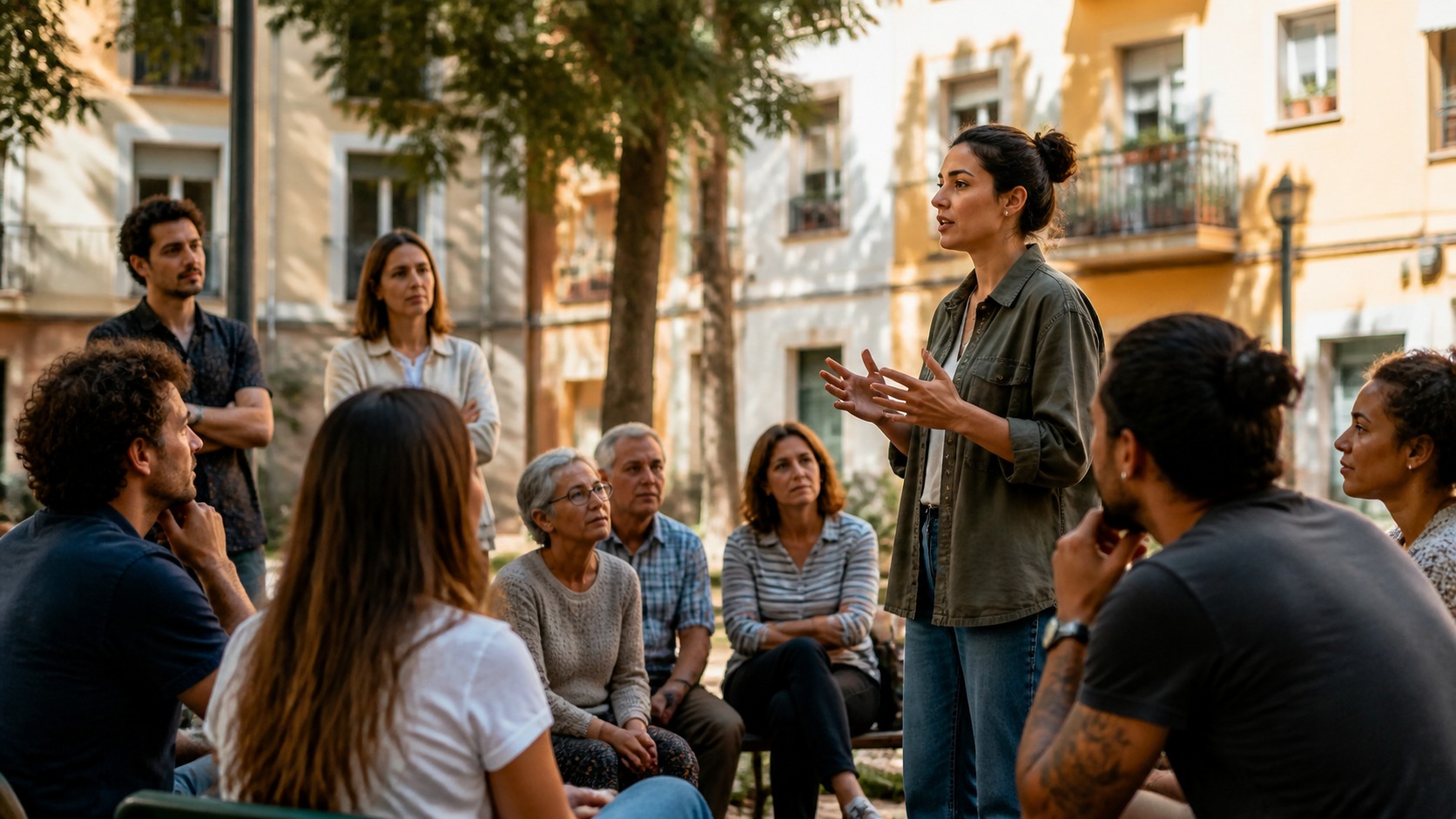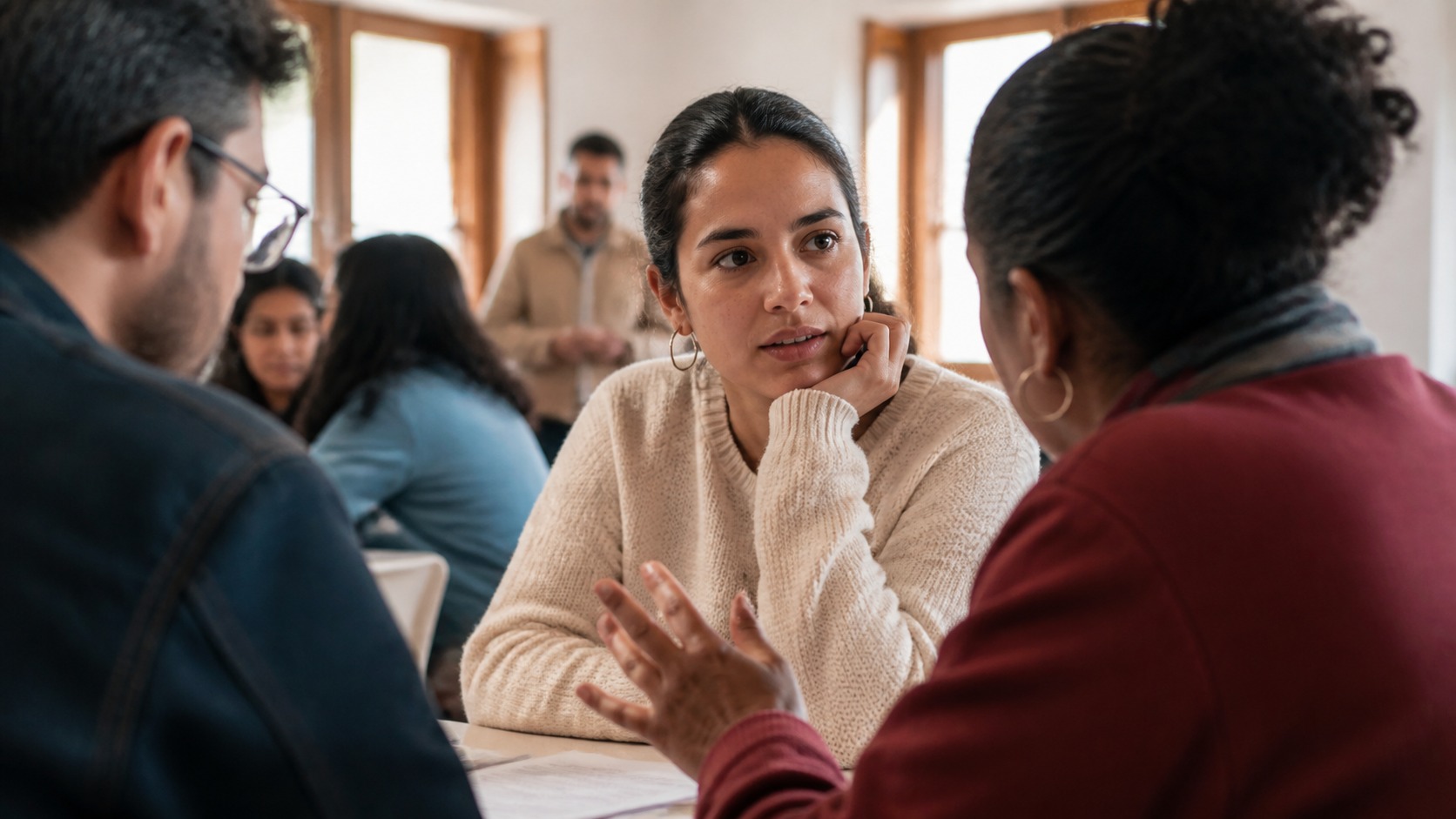
A difficult conversation about heat, flooding, or public space can prevent a major problem when it identifies who bears risk and who decides. Apparent courtesy often protects schedules and projects while leaving unprotected the person living on the hottest street, working outdoors, or unable to evacuate. Curiosity seeks evidence, responsibility distributes tasks, and care preserves dignity and safety. Shared shade often begins with disagreement heard in time.
Silence is not preparedness#
Climate plans bring together legitimate, unequal interests. Planners seek street transformation, businesses need access, residents fear costs, and technical teams manage deadlines. If a meeting avoids tension to display consensus, conflicts return during emergency. An uncomfortable question about housing, work, mobility, or budgets may expose the condition that will make a measure fail.
Climate plans bring together legitimate, unequal interests. Planners seek street transformation, businesses need access, residents fear costs, and technical teams manage deadlines.
An absence of objections does not prove agreement. Someone with less power may stay silent through fear, language barriers, fatigue, or limited time. A tenant household may avoid challenging renovation because it fears higher rent. A worker may not report exposure under an insecure contract. Participation needs protection, accessible formats, compatible schedules, and a visible response.
Caring for conflict does not mean extending it without decision. What can change, which risks are unacceptable, and when action will occur are defined. Urgent measures begin while structural solutions are discussed. Disagreement is documented and reviewed with new evidence. Rapid closure without tasks merely transfers cost; an open process without deadlines also abandons people.
Naming risk, power, and distribution#
Climate risk is not equally distributed. Temperature, water, and smoke interact with housing, health, age, income, mobility, work, and networks. A municipal average may conceal a treeless street or a building that remains hot at night. Conversation should use maps and data alongside journeys and accounts. Context determines who can turn an alert into action.
Decisions redistribute space and resources. Creating shade may reduce parking; drainage may require construction; protecting a riverbank may limit uses; opening refuges needs staff. Describing a solution as purely technical conceals political choices. Deliberation explains benefits, costs, alternatives, and compensation. Every preference cannot be satisfied, but nobody should bear a risk without knowing why.
Maintenance power must also be named. Planting is insufficient without water and care; an alarm does not help without response; a map is useless where the route is inaccessible. Every resource needs an owner, budget, and backup. Communities cooperate without replacing public obligations. Volunteers should not assume dangerous tasks or infinite availability.
Preparing a conversation that produces decisions#
Before the meeting, clear information covers purpose, scope, data, uncertainty, schedule, and authority. Materials use suitable formats and languages. Affected groups include workers and people usually missing. The invitation provides care, transport, or compensation where these are barriers. Community organisations support connection without replacing individual voices.
During conversation, facts, hypotheses, values, and experiences are separated. Technical claims receive sources and limitations. An individual account is not automatically generalised, but it may reveal a mechanism and is not dismissed. Facilitation asks what evidence would alter each position. Lower-status contributors are heard before leadership fixes its view.
Minutes record agreements, disputes, owners, deadlines, and review criteria. Each uncertainty becomes a test. Proposals receive reasoned responses. A rejected alternative is accompanied by reasons and residual risk. The final decision is communicated accessibly. Transparency cannot remove conflict, but it enables accountability.
Curiosity without extracting experience#
Responsible curiosity investigates everyday life: where shade is sought, which warning is understood, which journey is avoided, and what task falls on families. It does not turn each experience into an endless questionnaire. Necessary information is gathered with consent and privacy. Residents contributing diagnosis and design work are paid and receive results.
Negative data matters. Low refuge attendance does not prove low need; it may show transport, distrust, or unsuitable hours. More complaints may indicate a safer channel. Figures need denominators, exclusions, and context. Curiosity keeps open the possibility that the plan is wrong.
Tests use real conditions: midday, night, weekends, rain, and low staffing. Diverse people travel routes. Exercises can expose failures and remain successful as learning. The institution is not seeking a perfect performance. It seeks problems that can still be corrected without harm.
Case 1: shade versus parking#
A municipality proposes replacing parking spaces with trees, benches, and a canopy on a very hot street. Businesses fear losing customers, older residents request shade, and delivery workers need loading access. The first meeting tries to reassure through images and avoids discussing use. The project polarises around climate versus the economy as if only two choices existed.
A second table observes schedules, temperature, mobility, sales, and deliveries. Accessible loading remains during defined periods, connections improve, and continuous shade follows essential routes. Trees are combined with an immediate structure and watering budget. A reversible phase tests temperature, use, access, and commerce. Disagreement produces a fuller design. Shared shade stops being a symbol against one group.
Case 2: housing in a flood zone#
After repeated floods, an authority proposes limiting ground-floor uses and considers relocation. Tenant households fear losing affordable homes, owners request compensation, and civil protection cannot guarantee rescue. Initial politeness avoids value, attachment, and inequality. A technical paper explains risk but not who will pay for adaptation.
The process provides independent advice, translation, and varied meeting formats. Immediate measures, renovations, insurance, compensation, and voluntary rights-protected relocation are identified. Criteria and limits are published. Nobody receives a promise of absolute safety. Families contribute to routes and alerts. The conversation remains difficult but reduces the risk of displacing people with fewer resources while protecting life.
Case 3: an open refuge without enough staff#
A district announces that a sports centre will open during a heatwave. Staff warn that extended hours have no relief, but management requests exceptional cooperation. Community groups offer volunteers without a health protocol. The measure appears generous and avoids budget discussion. After two days, exhaustion, confusion, and waiting increase. Safety depended on invisible work.
Review calculates shifts, breaks, transport, and referral. Support is hired, community coordination funded, and volunteer roles bounded. Hours match need and actual capacity, while other spaces distribute demand. Workers can close an unsafe area. Indicators include workload and quality, not open hours alone. Conversation about resources prevents a refuge promise becoming risk.
Responsibility during decisions and emergencies#
Every action has a primary owner and substitute: warning, opening, maintenance, transport, care, and communication. Departments know dependencies. A strategy committee does not replace operational command. During an emergency, coordination makes decisions within agreed criteria and records changes. It accounts for them afterwards.
Activation and stopping rules are defined early. Temperature, water, or smoke thresholds trigger measures alongside local information. If a refuge loses cooling or a route becomes unsafe, an alternative exists. Staff can stop without awaiting a long chain. People receive consistent messages.
Responsibility includes not promising what cannot be sustained. A shade map states hours; an alert acknowledges uncertainty; a refuge publishes capacity and rules. Communication avoids alarm and false reassurance. It explains known facts, action, and the next update. Trust grows through precision and fulfilment.
Care that sustains relationships in disagreement#
Care recognises fear, loss, and attachment. Climate renovation may alter habits, views, access, and property value. Listening does not require abandoning necessary measures, but it enables transition and repair. Emotion is not used to discredit; it is connected to needs and decisions.
Language avoids stigmatising vulnerable neighbourhoods. Vulnerability is not an identity but a relationship among exposure, sensitivity, and capacity. Residents contribute knowledge and agency. Communication does not present them as passive recipients or use stories without consent. Dignity remains during conflict.
Cooperation needs limits. Checking neighbours, sharing shade, or reporting a drain can strengthen community. Unsupported, these practices exhaust the same people. Plans provide resources, training, and relief. Solidarity complements rights and services rather than replacing them.
Repair when a voice was ignored#
If an unheard warning leads to harm, response first addresses health, housing, expense, and safety. Events are communicated without blaming the person unable to protect themselves. Records are corrected and support channels offered. The person chooses participation in investigation. A specific apology acknowledges responsibility.
System repair changes design, protocol, staffing, budget, and participation. It asks why the voice did not arrive or lacked power. Every action receives an owner, date, and verification. Closing a recommendation does not demonstrate change; the next event tests it. Aggregate learning is published.
Loss may require compensation or restored opportunity. Solutions are transparent and not conditional upon silence. Not every harm can be reversed, but acknowledgement and reduced recurrence matter. Repair turns a late conversation into a stronger future duty.
Indicators for listening before harm#
Exposure, effective shade, night temperature, timing, accessibility, understanding, use, withdrawal, maintenance, and workload are measured. Data can be separated by area with privacy. Averages cannot replace streets and cases. Definitions and limits are explained. Climate information must itself be accessible.
Participation indicators include diversity, formats, answered proposals, influence, and confidence to disagree. Attendance counts are insufficient. A crowded meeting may still have little power. Teams ask who is missing and why. Responses connect to change.
Review continues after the project. Trees grow or die, uses change, and risks evolve. Dates and owners remain. If a solution creates another problem, it is corrected. Institutional humility treats adaptation as a process rather than a closed construction.
Institutional sources for rigorous deliberation#
The Intergovernmental Panel on Climate Change provides evidence concerning impacts, adaptation, and vulnerability. The World Health Organization supplies information about heat, climate, and health. These references support framing risks without reducing them to one variable.
UN-Habitat provides resources about climate change and urban settings. The European Environment Agency offers institutional information concerning adaptation. Frameworks require applicable regulation, local data, and community experience. No source alone decides how costs and protection should be distributed.
A conversation that becomes shade#
A difficult conversation has value when it changes a plan, budget, schedule, or responsibility. Curiosity discovers connections, responsibility allocates resources, and care protects relationship. Decorative consensus is not the goal. The aim is a decision capable of acknowledging limits, costs, and risks.
Shared shade may be the visible outcome of many disagreements properly heard. Its value lies in being where needed, remaining available, and requiring no conditions of use. A prepared neighbourhood does not eliminate every conflict; it learns to sustain it before emergency. In doing so, it prevents major problems and turns participation into infrastructure for safety, dignity, and trust.