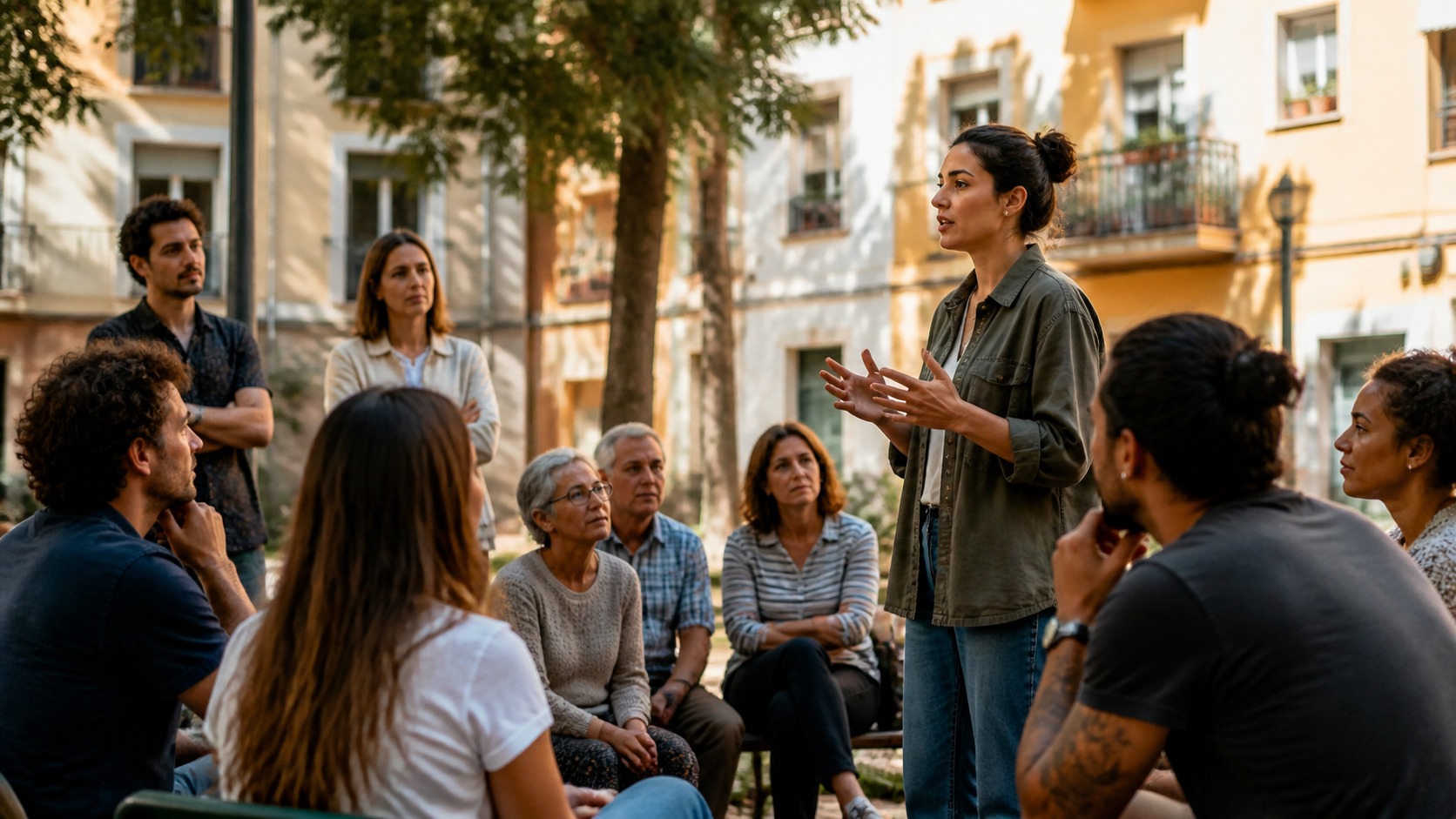
A climate intervention should not be judged only at the moment when it lowers temperature, opens a cooling centre, or evacuates a street. The decisive question is how people, relationships, and neighbourhood capacities are left afterwards. A response can solve an emergency while creating dependence, debt, or loss of voice. Another can protect today and strengthen autonomy for tomorrow. Evaluating what follows means observing dignity, safety, repair, maintenance, and shared power throughout the whole life of an action.
Success does not end with the emergency#
Response indicators often focus on the critical moment: people assisted, water removed, alerts sent, or degrees reduced. These figures matter, but they do not describe what happens a week or a year later. A family may be evacuated safely and remain trapped in precarious temporary housing; a park may become cooler after construction while losing community uses that sustained care.
Response indicators often focus on the critical moment: people assisted, water removed, alerts sent, or degrees reduced.
Evaluation needs several time horizons. Physical protection comes first, followed by continuity of services, health, income, relationships, and capacity to decide. In the medium term, maintenance, distribution of costs, and institutional learning need review. A favourable initial result cannot compensate for later deterioration, just as an initial difficulty may be acceptable when it leads to a lasting and fair solution.
Autonomy as a climate outcome#
Autonomy does not mean that each household must solve risk alone. It means having information, resources, rights, and relationships to make choices without coercion or abandonment. A policy builds autonomy when it expands real options: transport to cooling centres, support for home adaptation, reporting channels, and knowledge of warnings. It reduces autonomy when help depends on inaccessible procedures or replaces existing networks without a stable alternative.
Measuring autonomy requires asking who controls resources, who can alter a decision, and what happens if the project ends. Participation during design matters, as does later capacity to supervise, challenge, and correct. A prepared neighbourhood does not rely on one exceptional individual or an opaque contract. It retains distributed skills and public memory.
Dignity during and after intervention#
Dignity appears through privacy, treatment, accessibility, and freedom from stigma. A cooling centre may work thermally while humiliating visitors by requiring public proof of poverty. Financial assistance may arrive quickly yet exclude somebody unable to navigate the form. The manner of protection is part of the outcome rather than a communications detail separate from safety.
After an emergency, affected people should be able to reconstruct their lives without being permanently reduced to victims. Their knowledge is recognised, decisions explained, and control over data and images returned. Evaluations ask whether a service expanded choices or created fear of seeking help. Confidentiality and consent require review because information collected in crisis should not circulate indefinitely.
Safety without transferring risk#
A measure may reduce visible danger by moving it to another group or time. Diverting water protects an avenue but can flood a lower area; closing a road improves air yet complicates care access; cooling an inefficient building creates future energy costs. Analysis must follow chains of effect and compare who gains security with who accepts new burdens.
Project boundaries rarely match those of risk. Catchment, mobility, and access maps help identify transfers. Testimony exposes unanticipated effects. Where every cost cannot be removed, it should be disclosed, mitigated, and compensated. Just safety does not turn a less visible population into a sacrifice zone.
Case 1: immediate shade and a square without community#
A square received large shade structures in response to heatwaves. Temperature fell and the opening was celebrated, but the design removed market stalls and corners where carers met. Months later there was less daily activity, and some people avoided the space after dark. The thermal indicator showed success while social autonomy weakened.
Review included walks, timetables, and interviews. Supports were moved, part of the market returned, and lighting and shared storage were added. Traders helped schedule use without inheriting structural maintenance. Evaluation began measuring duration of visits, diversity, and feelings of safety alongside temperature. Asking how the square would be left restored functions erased by the single objective.
Case 2: safe evacuation and an impossible return#
After flooding, residents of an apartment block were moved quickly to temporary accommodation. The operation prevented personal injury, but building repair was delayed and information arrived in fragments. Families lost work, nearby schooling, and care networks. The official assessment concentrated on completed evacuation and did not follow the cost of months away from the neighbourhood.
A later repair plan assigned a named contact, transport assistance, a public construction timetable, and participation in return decisions. Legal support and reimbursement of documented expenses used accessible processes. Initial safety remained valuable, but it became the first stage rather than the whole result. The right to return in dignified conditions entered the definition of climate success.
Case 3: a neighbourhood network exhausted by success#
During a heatwave, a community network made calls, delivered water, and accompanied older residents. Its response was praised as solidarity, and authorities made it a regular part of the plan without added funding. By the next summer, coordinators were exhausted and several routes went uncovered. Immediate success had consumed the capacity being celebrated.
A revised agreement funded coordination, training, insurance, and rest while public services took clinical and logistical duties. The network kept its role in trust and early detection without replacing professional jobs. Rotations and limits were established. Evaluating carers' wellbeing showed that cooperation lasts only when it distributes resources rather than treating community availability as a free reserve.
Material and institutional repair#
Repair responds to harm through restitution, compensation, support, correction, and guarantees against repetition. It should begin early even while full investigation continues. Affected people help define priorities but should not prove every detail through disproportionate procedures. Assistance needs adjustment for language, mobility, and documentation barriers.
Institutional repair changes protocols, budgets, and responsibility. If a warning system failed, replacing messages is insufficient; criteria, channels, and supervision need review. Progress should be published with owners and deadlines. An apology without modification may demand emotional closure while risk remains. Verifiable repair turns the aftermath into learning.
Maintenance and continuity beyond a project#
Every intervention needs an operating plan identifying resources, tasks, spare parts, data, and succession. Without it, service deteriorates after initial funding ends. Life-cycle costs should be approved with capital investment, and maintainability tested before construction. The people providing care need a role in design.
Continuity covers absence, supplier change, and simultaneous events. Accessible instructions, current contacts, and trained substitutes protect knowledge. Service levels reveal when a solution stops working. When interruption is expected, people need notice and an alternative. The community should not discover dependency at the worst possible moment.
Indicators showing how the neighbourhood is left#
Evaluation should measure capacities alongside immediate products: access to information, network diversity, recovery time, control over decisions, and service stability. Data can be broken down by age, gender, disability, income, and area where safe. Average improvement may conceal a group taking much longer to recover housing or mobility.
Qualitative methods are essential. Repeated interviews, diaries, and walks show shifts in trust, caring burdens, and use of space. Limits are explained and privacy protected. Findings return to those who contributed, who can check whether interpretation matches experience. Measurement should not extract stories without producing a response.
Governing exits and succession#
Projects often plan entry and activity but not their ending. An exit strategy defines which functions continue, who receives resources, which data remains, and how pending commitments are settled. If a pilot will stop, this is communicated early without creating false expectations. If it becomes permanent, staff and budgets are formalised.
Leadership succession also matters. An initiative dependent on a charismatic figure is fragile. Distributing documentation, authority, and relationships increases resilience. Community organisations should retain contractual autonomy and the ability to disagree without losing all support. The aftermath is stronger when cooperation means explicit interdependence rather than subordination.
Participation with power to review#
The community should participate not only before a decision but in monitoring, audit, and correction. A diverse committee with information and resources can review indicators and trigger reconsideration. Its authority and limits need publication. Participation without data access or a formal response provides presence but not power.
Conflicts should remain on record, including minority disagreement. If a predicted consequence appears, the process can recover the warning rather than denying it. Complaint channels need deadlines, appeal, and protection from retaliation. Collective autonomy grows when challenging a measure is a normal part of governing it.
Institutional sources for a longer horizon#
The Intergovernmental Panel on Climate Change examines adaptation, vulnerability, and resilient development in the Sixth Assessment Report, Working Group II. The World Health Organization connects heat and health protection in its climate change, heat, and health fact sheet. UN-Habitat gathers urban resilience approaches through its climate programme. The European Environment Agency provides comparative policy and evidence in its adaptation portal. These references guide practice, but the question of what follows requires situated monitoring.
The question that orders the whole process#
Asking how everyone will be left changes design from the beginning. It requires anticipation of maintenance, risk transfer, exhaustion, dependency, and repair. It also reveals benefits an instant metric cannot capture: new networks, shared knowledge, and greater capacity to make claims. The future stops being a final note and becomes a present criterion.
Dignity requires protection without humiliation; safety requires that risk is not transferred; repair requires an answer to harm. A prepared neighbourhood combines these duties with lasting autonomy. The best intervention is not the one producing the quickest image, but the one leaving people with more options, institutions with greater accountability, and relationships able to provide care. That inheritance turns shared shade into collective capacity.