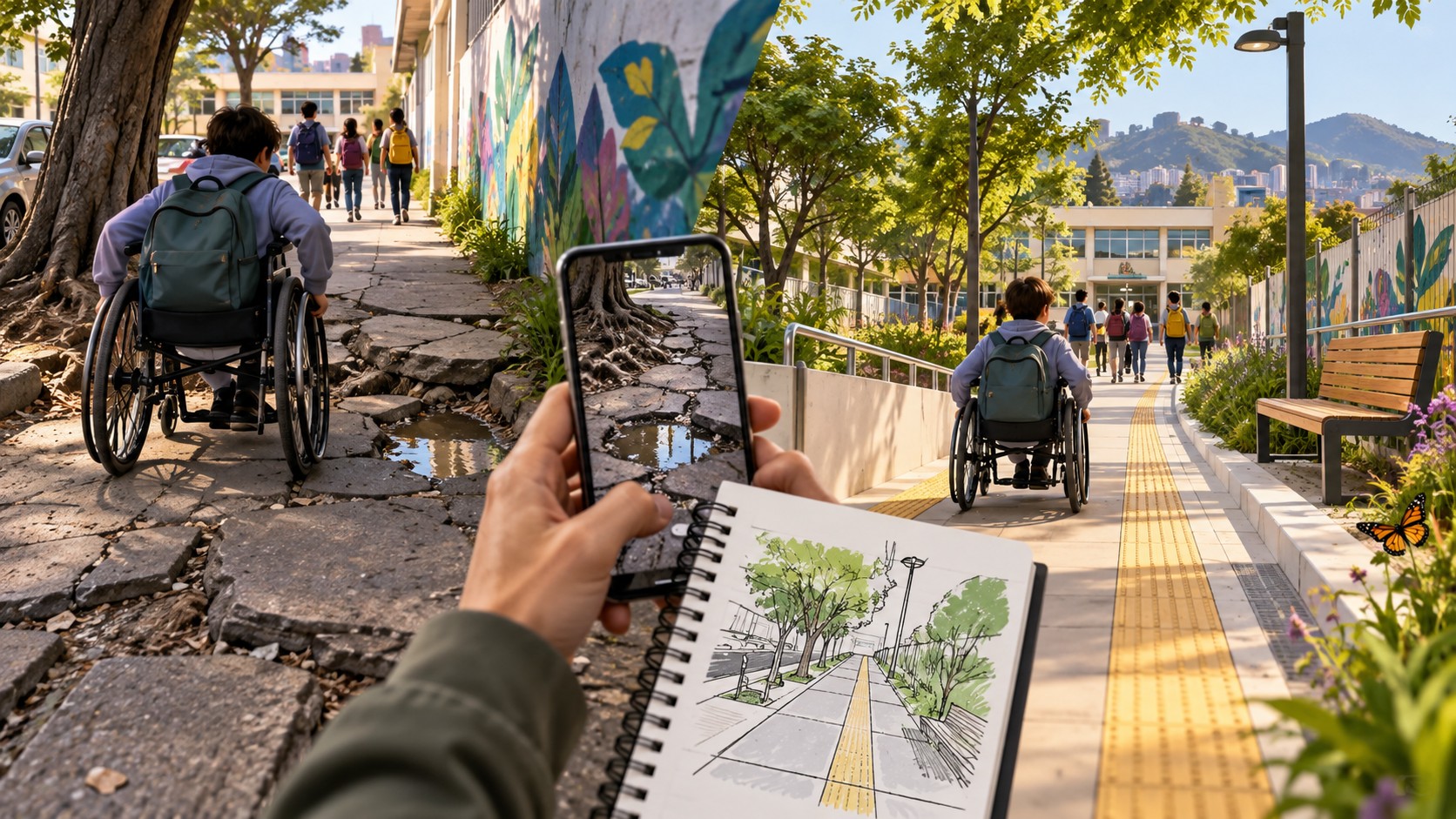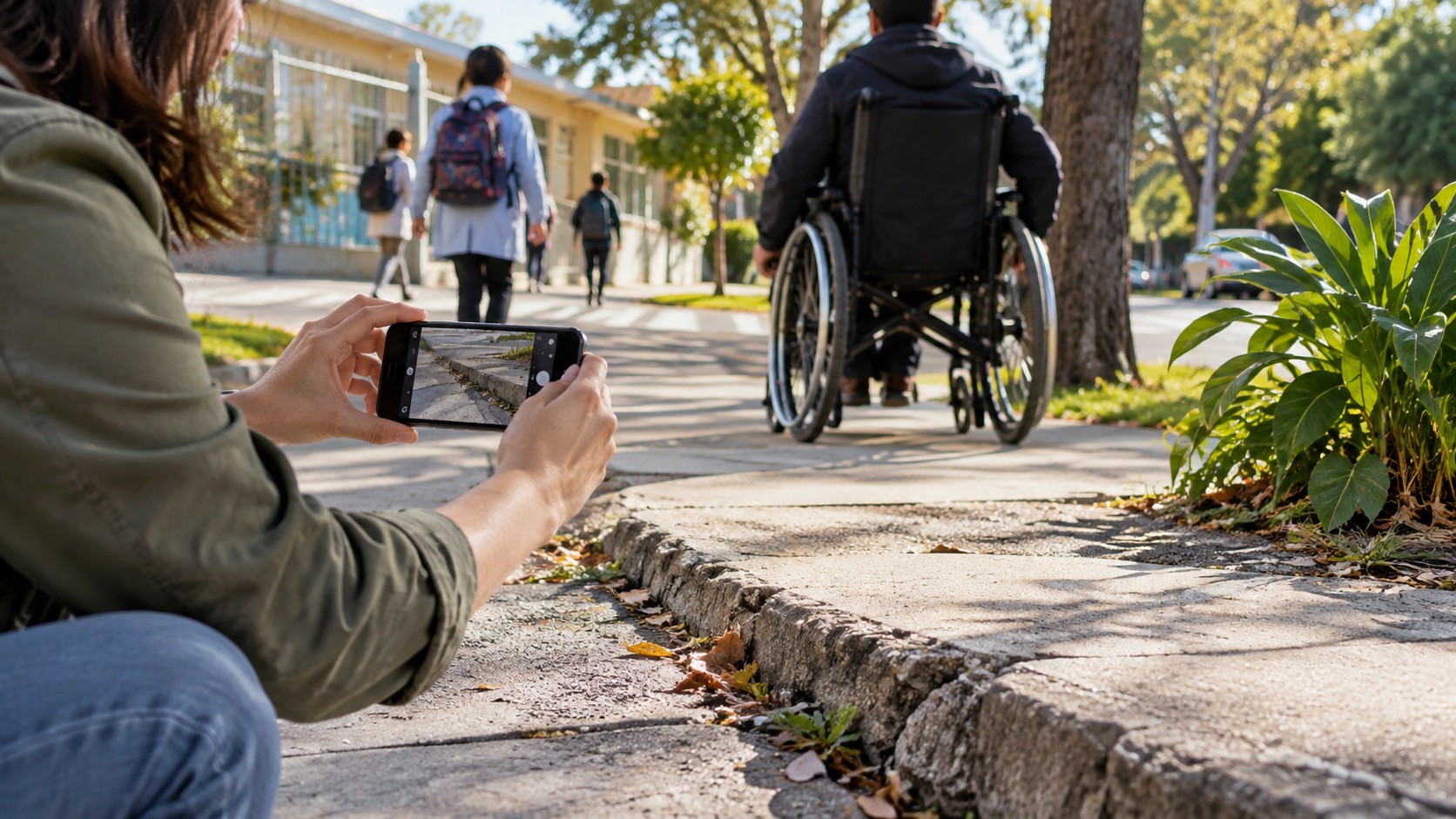
A photograph of a raised paving slab has been sitting in a phone gallery for several days. In this invented example, the person who took it remembers that it interrupts the route to school, but the framing no longer reveals which entrance is nearby. The concern exists; it has not yet become a useful report. One way forward could be as specific as adding a location reference and expressing the question that would allow another person to examine the problem.
From an isolated image to an understandable observation#
The photograph shows an uneven surface, but leaves out some of its context. It does not explain the direction of approach, which movement is interrupted or whether there is room to pass alongside it. None of this requires an extensive investigation. A starting point is to distinguish clear memories from details that would need checking on another occasion. A modest, located observation is easier to interpret than a collection of images whose meaning depends on a conversation the recipient has never heard.
The photograph shows an uneven surface, but leaves out some of its context. It does not explain the direction of approach, which movement is interrupted or whether there is room to pass alongside it.
In the scene, a short note could place the slab between the school gate and the tree nearest the corner. It could add that the passage narrows there and that a review of the route is being requested. If the person does not know why the slab has risen, that question can remain open. Describing an irregularity does not require diagnosing its cause. Attributing it directly to a root, building work or maintenance would turn a supposition into a fact that the photograph alone cannot establish.
The time of observation also helps explain its limits. A photograph taken when classes finish shows a condition during that period, rather than every possible situation. Recording when the problem was noticed makes a later difference understandable without accusing anyone of exaggerating or denying what happened. The location may be empty during one visit and crowded during another. The note preserves a particular experience for examination. It does not claim to represent every hour of the day or everyone who travels along the route.
A small question can organise the next action#
The report gains direction when it says what needs clarification. Asking somebody to check a particular section differs from demanding a solution designed from a photograph. The first approach leaves room to assess the location and consequences that are not yet understood. Here, the question could concern maintaining an uninterrupted passage beside the entrance. It need not specify the material for a future intervention, its cost or its timetable in order to identify a difficulty deserving attention from whoever is responsible for examining it.
Making the question smaller does not make the issue less important. It selects a point from which discussion can move forward. A complaint combining paving, lighting, opening hours and every local construction project may express understandable frustration, while also scattering the response. If several issues need different handling, separating them makes it possible to recognise which has been addressed and which remains open. The raised slab would keep a clear identity even if it also belonged to a broader conversation about journeys to the school.
Before sending, it would be useful to check that the chosen channel accepts this kind of observation and that the message allows its location to be found. That check can prevent a request remaining in an inbox unable to handle it. Sending identical text to numerous recipients is not necessary to demonstrate concern. When the appropriate destination is unknown, asking where to report the issue may be a sufficient next step. The uncertainty about the recipient should not disappear behind the appearance of a report already properly submitted.
Documenting without manufacturing perfect evidence#
The person preparing the message need not repeat an uncomfortable situation to obtain a more persuasive picture. They can use what they observed and explain which part was not recorded. Nor do they need to arrange objects, alter the setting or ask someone else to act out a difficulty. Documentation opens an enquiry rather than answering every question in advance. An imperfect photograph with an honest description may be more informative than a carefully organised scene that no longer reflects the ordinary use of the location.
A wider visual reference may help when it can be obtained from a suitable position without obstructing passage. However, another photograph is not always required. A simple drawing, a short explanation or a recognisable entrance could supply the missing context. The choice depends on what information is needed, rather than on producing an impressive dossier. Especially beside a school, focusing documentation on the ground and its surroundings makes it possible to explain the issue without turning the people passing through into the main subjects of the report.
Words expressing uncertainty deserve to remain in the text. If the person has seen the difficulty only once, they can say so. If they think they remember an earlier occurrence, they can distinguish that recollection from a verified date. Such precision does not necessarily weaken the request; it makes the contribution easier for somebody else to understand. A useful report does not demand confidence about everything. It requires observed facts, interpretations and questions to remain distinguishable without the reader having to guess what the writer meant.
Submitting a report is not the same as improving a route#
Several different stages may follow submission: acknowledged receipt, a request for information, an announced inspection or a reported intervention. Each addresses part of the process. An automatic acknowledgement does not show that anybody has visited the location, while a visit does not guarantee that the difficulty has been resolved. Keeping these distinctions prevents both celebrating a change that has not happened and dismissing every intermediate action as useless. The original short note can acquire a date and the response received without becoming a daily monitoring commitment.
If the channel supplies a reference for enquiries, keeping it with the message makes a later question easier. If it does not, the existing submission details can be retained. There is no need to build a complicated folder or collect information about other people. The purpose is to resume the exchange without describing everything from the beginning again. Someone who does not wish to pursue further follow-up can leave it there. Reporting a difficulty does not mean accepting indefinite work or personally guaranteeing that the responsible organisation will act.
Waiting may leave reasonable uncertainties. Perhaps the reply does not say whether the specified point has been examined, or it mentions another section. A further enquiry can focus on that discrepancy, accompanied by the original report's reference. Silence need not be interpreted as indifference, and a repair date need not be invented. Maintaining confidence without information is not required either. It is possible simply to state that the issue remains insufficiently answered and identify which missing detail would make the actual status of the request understandable.
Looking again with a different question#
If an intervention is later reported, returning to the location can serve a different purpose from the first record. The question is no longer only how to show the slab, but whether the route permits the movement previously interrupted. A surface that looks new can coexist with another nearby narrowing. An everyday observation neither replaces specialist assessment nor certifies universal accessibility. It offers something more limited: the condition of that section during a new visit and the changes that the person using it can actually describe.
Another person's experience might reveal a difficulty absent from the first report. This does not automatically make the intervention a failure or invalidate what has been achieved. It allows the question to be adjusted and recognises that improvement can be real while remaining incomplete. When an update is shared, both elements deserve precise description. Communication that separates an observed change from an outstanding issue helps subsequent decisions begin with current information. Earlier observations remain available rather than being erased simply because something has now been altered.
For someone with a similar forgotten picture on their phone, the immediate possibility might be to turn it into a short note: where the point is, what was observed and what they would like examined. They can then decide whether to send it to an appropriate recipient. The gesture has a recognisable end, although improving the surroundings may take longer. In the opening scene, the photograph would stop depending on a private memory and begin supporting a concrete question about a path that other people also use.