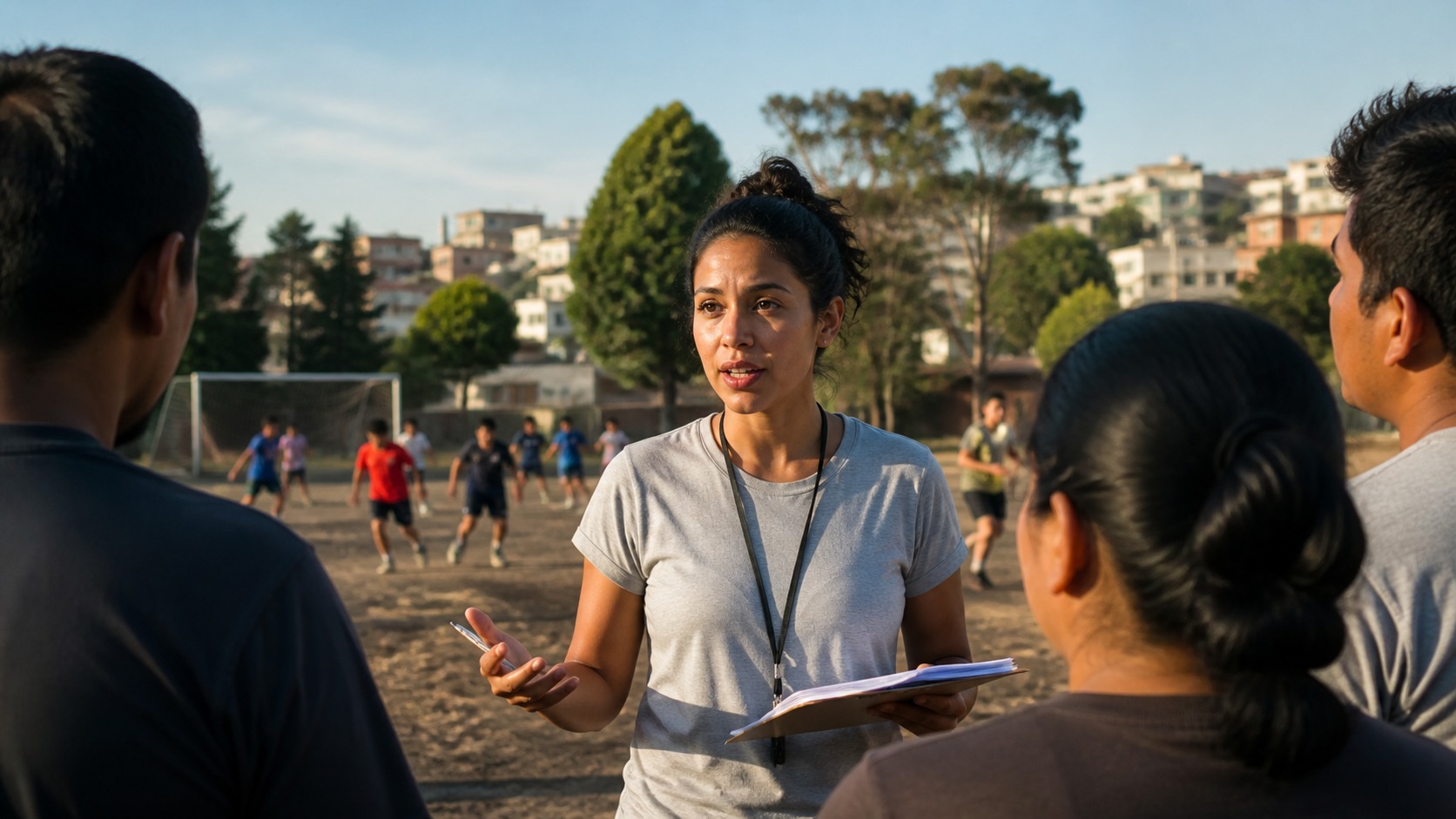
The first fifteen minutes reveal whether a youth process shares power or merely fills seats. The route to the room, the language of welcome and the answer to an uncertain question establish who is expected to know the system already. A young voice leaves a mark when doubt is treated as knowledge and when contribution reaches a visible decision. Designing arrival well does not make public questions simplistic; it distributes the context, safety and choices required for genuine cooperation.
Arrival is the process's first exercise of power#
Before discussion begins, furniture, registration and jargon communicate authority. A raised table and unexplained acronyms tell newcomers that expertise belongs elsewhere. Clear signs, identifiable support and several participation routes say that learning is permitted. Welcome is therefore operational rather than decorative. It influences who asks a question, who masks confusion and who quietly leaves believing the invitation was addressed to a different kind of young person.
Before discussion begins, furniture, registration and jargon communicate authority.
The opening should answer purpose, open decision, fixed limits, use of information and date of feedback. Delivering these facts at the end asks participants to contribute without informed choice. Early clarity allows someone to speak, reserve a view or withdraw. It also prevents organisers from implying power they do not possess. Honest constraints are more respectful than an enthusiastic promise that collapses when a difficult proposal appears.
Official start time is not the whole measure of access. A late bus, security queue or software update may repeatedly exclude the same people from context. Observing actual arrival can change timing, signs, technical support and recap. Recurrent lateness may be design evidence rather than a character flaw. A process committed to knowledge investigates the route before judging the person who travelled it.
A doubtful question can improve everyone's information#
“What is this going to change?” may sound sceptical, but it often reveals an unclear purpose. A humble facilitator thanks the speaker, answers directly and records what needs checking. Defensiveness teaches the group that only comfortable questions are welcome. A transparent response protects quieter participants who shared the doubt and may expose a gap between the promise of influence and a decision that was already closed.
Public speaking is only one entrance. Anonymous notes, paired conversation, maps, drawings and later messages support different rhythms. Offering them does not lower intellectual expectations. It stops verbal speed and familiarity with meetings from masquerading as superior knowledge. Nobody should be forced to contribute; everyone who wishes to contribute should find a safe route with an equal chance of affecting the outcome.
Safety also requires understandable confidentiality limits. If a disclosure of harm creates a duty to act, participants need to know who will receive the information and what follows. Personal testimony should not be demanded to prove a barrier that can be observed another way. Data minimisation preserves dignity and keeps a public process from becoming an extraction of intimate experience.
Concrete case 1: a youth board opened with a wall of acronyms#
A municipal youth board began each meeting with a technical report full of abbreviations. Returning members spoke; newcomers spent an hour reconstructing responsibilities and voting rules. Staff interpreted silence as poor preparation. One teenager asked which decisions could actually change. Only then did it become clear that nobody had explained the board's authority. Procedure was rewarding institutional memory instead of insight about local life.
The opening was redesigned around a decision map, short glossary and one example from proposal to outcome. A returning young member and an officer welcomed newcomers together. Accessible papers arrived early, while an anonymous card collected questions. The information was not diluted; it was organised around action. Participants could locate complex detail after understanding why it mattered and where their authority began and ended.
For three months the board tracked first-time contributions, questions, return and changes linked to new voices. A proposal about evening transport altered the meeting schedule. Another received a reasoned refusal because the power sat elsewhere. Feedback named both outcomes. The board learned that membership should not require passing a silent exam in hidden knowledge before a person's lived expertise becomes credible.
Concrete case 2: a workshop whose door looked closed#
A library invited teenagers to redesign its courtyard. The workshop occupied a side room behind an opaque door; the only sign was inside, and reception had not been briefed. Several invitees wandered, hesitated and left. Organisers initially described low attendance as disengagement. Two participants later mapped the approach and showed that exclusion had occurred before anyone offered a chair or asked a question.
The next session used signs from the street, a greeter, transport details and a messaging number. The open room offered varied seating, water and a quiet corner. At the start, staff explained that furniture and hours could change, while an emergency exit could not move. Naming the constraint prevented a later surprise from appearing as rejection. A walk through the courtyard preceded abstract discussion.
One person who never spoke in the group sent a note about afternoon glare that made reading impossible. The prototype changed and feedback credited the observation without identifying its author. Accessibility was not proven by persuading everyone to behave in the same way. It was proven because a different route carried relevant knowledge into the shared decision with equal practical weight.
Concrete case 3: a fast digital vote with invisible abandonment#
An environmental fund launched mobile voting on youth proposals. Registration requested address, identity document and email before displaying any option. People who completed it voted quickly, producing an excellent average time, but many abandoned the first screen and vanished from the metric. Their first fifteen minutes were spent proving identity rather than understanding purpose, cost or what a winning vote could deliver.
Review separated information, participation and duplicate control. Unnecessary fields disappeared, required data received explanations and in-person points carried equal weight. A demonstration allowed practice without submission. Each proposal showed cost, constraints and schedule. Confirmation named the result date and the route for questions. Non-digital participation stopped being a charitable substitute and became an equivalent public channel.
Evaluation compared abandonment by stage and tested whether voters could explain what happened next. Data were deleted after their stated purpose. Many participants rejected every available option. Instead of treating this as noise, officials recognised that solutions had been designed before young people helped define problems. The next round added a problem-framing phase. A critical response changed the process itself.
Five authoritative sources ground participation in rights#
The UN Committee on the Rights of the Child General Comment No. 12 develops the right to be heard and to have views given due weight. Suitable information, free expression and effective consideration are central. The opening must enable understanding and voice rather than invite ceremonial presence.
UNICEF's Engaged and Heard guidelines connect meaningful adolescent participation with inclusion, safety, organisational commitment and evaluation. They help teams ask whether newcomers receive support or must decode the system alone. They also place feedback within process quality because listening without consequence steadily consumes trust.
The Council of Europe Revised European Charter on youth participation links rights, means, space, opportunity and support to influence decisions. Physical presence therefore cannot prove power. Without tools, time and consequence, a visibly diverse room can remain politically closed.
The OECD Guidelines for Citizen Participation Processes emphasise purpose, accountability, transparency, inclusion and evaluation. Applied to youth work, they require the opening to explain the decision and the journey of information. A polished closing report cannot repair ambiguity that shaped every contribution from the beginning.
UNESCO's operational strategy on youth frames young people as actors and partners, not only beneficiaries. That view changes the welcome. Organisers receive knowledge capable of revising the plan rather than an audience expected to approve it. Cooperation includes allowing an early question to alter direction.
A functional fifteen-minute protocol#
Before opening, someone unfamiliar with the project tests invitation, transport, entrance, registration and connection. The review covers mobility, reading, hearing, language, cost and privacy. Each identified barrier receives a correction and alternative. This rehearsal is not theatre. If the door cannot be found or a modest device cannot load the platform, the process is not ready to interpret absence as a lack of interest.
Minutes zero to five orient without compulsory personal introductions: support people, toilets, breaks and exit are clear. Minutes five to ten describe the decision through one concrete example. Minutes ten to fifteen explain limits, information use, safeguarding, responsibility and feedback. An anonymous question checks understanding. It tests the design rather than examining participants and allows repair before contributions are collected.
Exact timing can flex. An important conversation or access issue may slow the sequence. The functions remain: orientation, consent, safety and power. If purpose is still unclear, the presentation should stop. Collecting more opinions about a misunderstood question does not create better evidence. Humility means revising the invitation instead of blaming young people for answers that organisers cannot interpret.
Measure access without turning arrival into surveillance#
Timing, abandonment, questions and use of formats can be recorded in aggregate. A brief voluntary prompt can ask whether purpose was clear and whether a comfortable contribution route existed. Data should serve improvement and then be deleted. Device tracking and permanent identities are unnecessary for discovering a hidden entrance or confusing instruction. Participation should not require surrendering privacy to prove that design failed.
Patterns need comparison without forcing numerical equality. If newcomers consistently speak less or telephone contributions never affect decisions, a barrier may exist. Short accounts help interpret the numbers and should not expose identifiable uncertainty. The objective is not to make everyone talk. It is to ensure that silence is a choice rather than the predictable product of missing context, unsafe dynamics or an inaccessible route.
The final measure is a trace in the decision. Each contribution becomes accepted, tested, pending or declined with a reason. Feedback arrives through the promised channel and on the stated date. The first fifteen minutes tell the truth because they foreshadow that accountability. When they offer context, several entrances and a right to doubt, a young voice can cooperate without performing adulthood and leave a result anyone can verify.