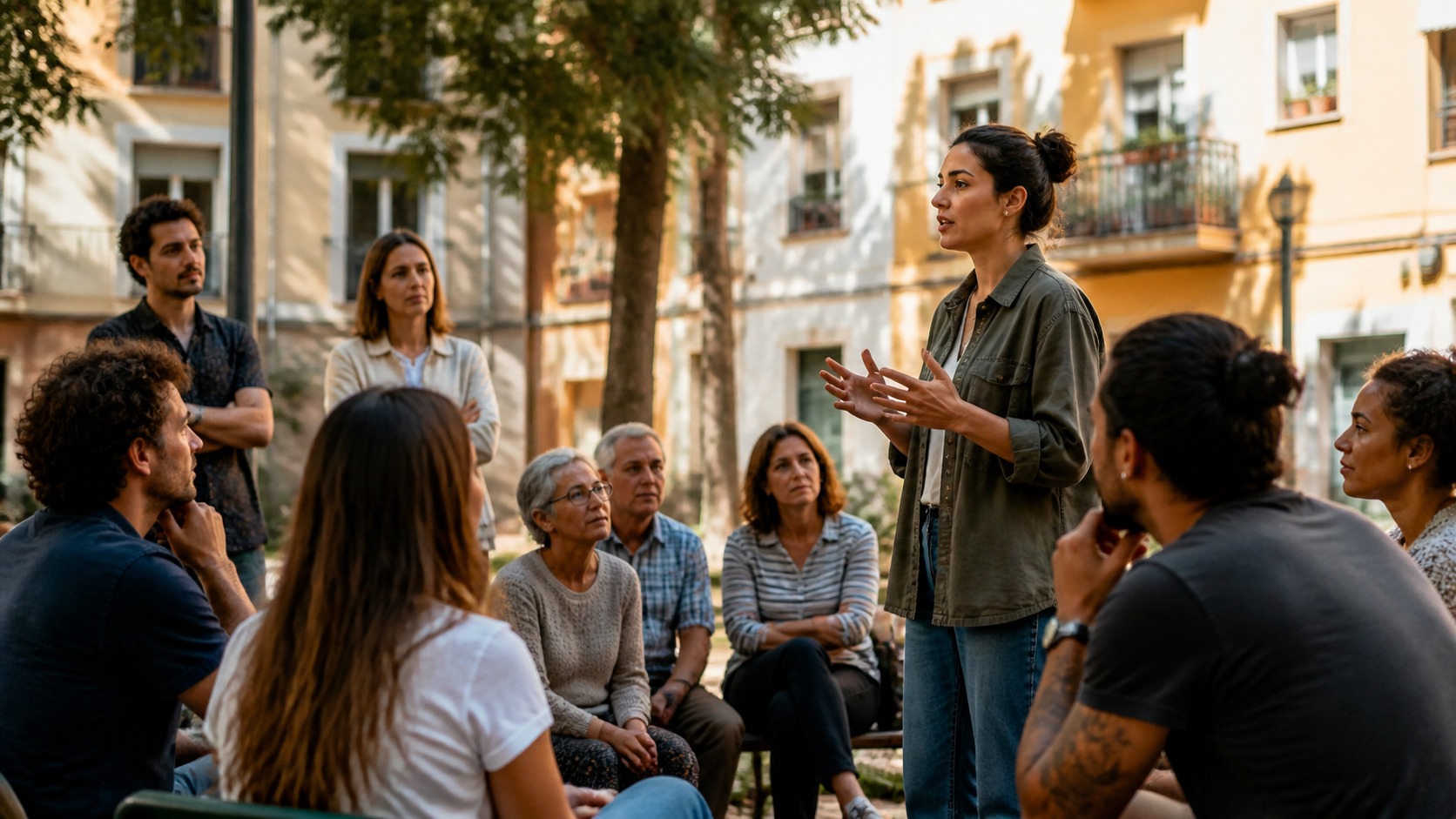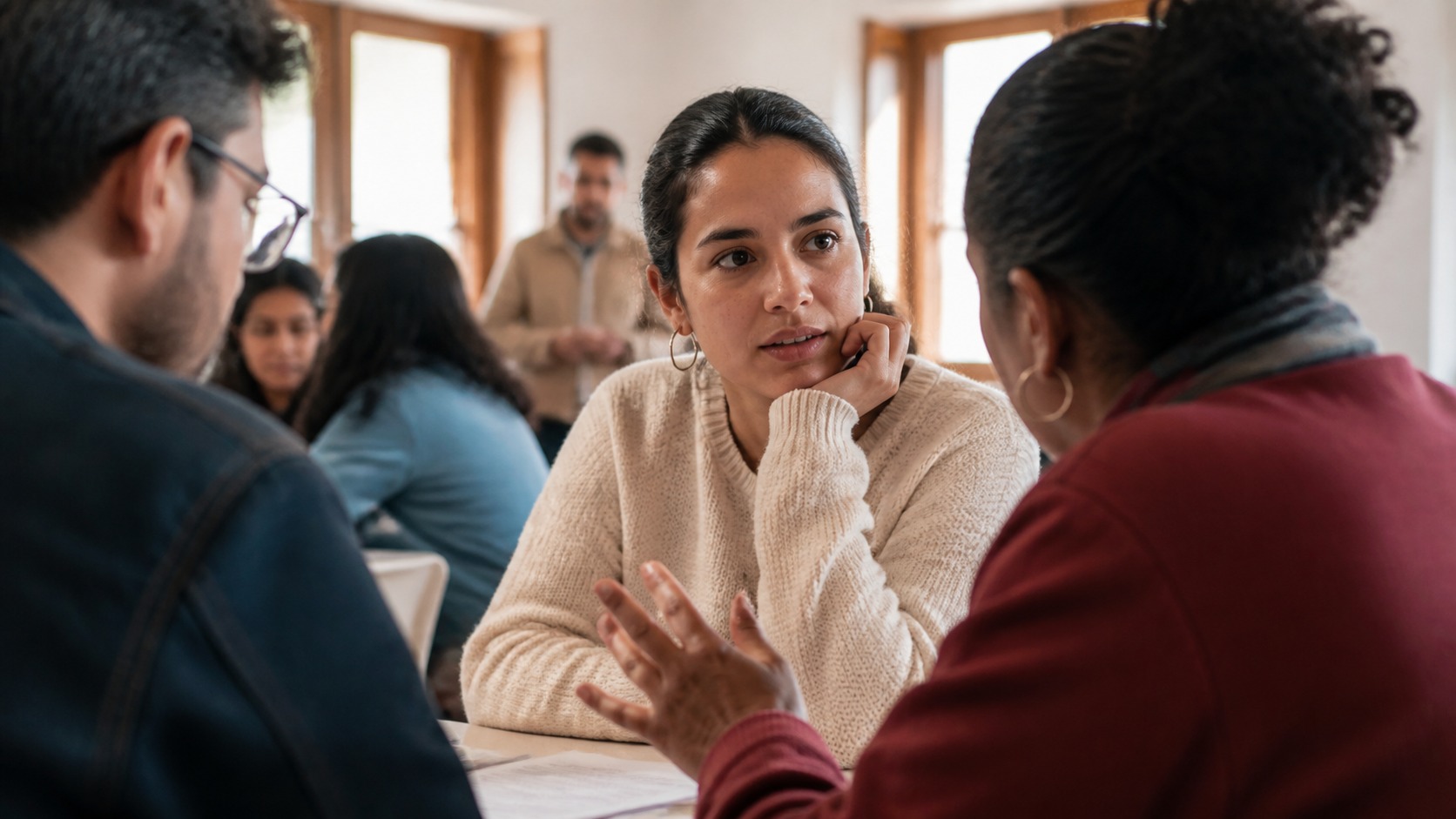
Disputes about shade, water, mobility, or cooling centres do not necessarily mean that a community is broken. They often reveal legitimate needs, scarce resources, and costs distributed unequally. A carefully handled conflict does not pursue immediate silence. It creates safe conditions for naming interests, testing evidence, acknowledging harm, and assigning responsibility. When the process protects dignity, reduces danger, and offers verifiable repair, disagreement can improve a climate decision and strengthen relationships capable of carrying the next emergency.
Disagreement is part of adaptation#
Adapting a neighbourhood means changing places that already have users. A green corridor may remove parking; a schoolyard serving as a cooling space requires staff; restrictions in a flood zone may affect homes and businesses. Benefits and burdens rarely arise in the same place or at the same time. Conflict is therefore not an anomaly to conceal. It supplies information about interests, vulnerabilities, and dependencies that the project has not yet integrated.
Adapting a neighbourhood means changing places that already have users. A green corridor may remove parking; a schoolyard serving as a cooling space requires staff; restrictions in a flood zone may affect homes and businesses.
A demand for quick harmony usually favours people with more time, technical language, or institutional access. Those with less power may remain quiet to avoid retaliation while official minutes record consensus. Their silence does not remove tension; it postpones it until implementation, when correction is more expensive. Responsible governance distinguishes aggression, which needs limits, from legitimate disagreement, which requires space and rules.
Caring for conflict without freezing decisions#
A careful process combines openness with clear deadlines. It states which elements can change, which are constrained by law or safety, and who will make the final choice. It explains how contributions and responses will be documented. Participation loses credibility when every option appears available and is later dismissed without reasons. Boundaries set at the start prevent false expectations and focus negotiation where genuine discretion exists.
Care does not mean extending debate indefinitely while danger grows. Temporary measures may be necessary during a heatwave or flood. They should be justified, time-limited, and reviewed afterwards. Urgency must not become a device for turning an exception into a permanent rule. A timetable for listening, deciding, testing, and evaluating protects effectiveness and legitimacy together.
Safety to speak and physical safety#
Conversation is useful only when people can participate without intimidation. Rules are needed against insults, threats, and disclosure of sensitive information, supported by facilitation that distributes speaking time. Some experiences are better shared through small groups, interviews, or anonymous channels. Psychological safety does not require every claim to be accepted as true. It guarantees that a claim can be examined without attacking the person who raises it.
Physical safety remains the primary boundary. A proposal that preserves an inaccessible route, increases heat exposure, or blocks evacuation cannot be balanced as a mere preference against minor convenience. Technical criteria should be explained plainly and opened to questions. This prevents expertise from becoming closed authority while stopping a majority from voting to transfer serious risk onto a minority.
Dignity recognises people and their reasons#
Dignity begins by refusing to reduce anyone to a label. A person defending parking may be protecting a caring responsibility; someone demanding vegetation may have experienced heat stress; a resident anxious about a nearby cooling centre may express prejudice but may also raise specific management questions. The process separates interest, position, and conduct. Understanding a motive does not fully validate it, but it makes more precise alternatives possible.
Institutional language also matters. Labels such as resistance to change can disqualify people before they are heard. Facts should be described instead: what is proposed, which cost is feared, and what evidence exists. Accessible material, translation, and compensation for time support dignified participation. A written response to every substantial issue shows that the community was not used as ceremonial scenery.
Case 1: trees, deliveries, and pedestrian heat#
A commercial street was to receive trees and wider pavements, removing several loading spaces. Early meetings set shopkeepers against families walking to school. The authority tried to end debate by invoking the climate emergency, although it had studied neither delivery schedules nor temperatures along the route. Enforced silence increased distrust, and several businesses threatened to obstruct construction.
Mediation mapped needs instead of factions. Shade, pedestrian movement, and logistics were observed for two weeks. The agreement retained the trees, created timed shared loading areas, introduced carts for the final distance, and established a six-month trial. A mixed committee reviewed incidents. Nobody obtained their complete opening position, but costs were acknowledged and the street improved without making its daily economy invisible.
Case 2: a schoolyard used as a cooling space#
The municipality announced that a shaded schoolyard would open during summer. Families welcomed the measure, while school employees noted that there were no shifts, cleaning resources, or emergency procedures. The initial response portrayed their objections as a lack of solidarity. In reality, the plan transferred a public obligation to already stretched workers and exposed visitors to an unreliable service.
The conflict was redirected through an inventory of tasks and risks. The municipality funded staff, insurance, water, and training; the school provided knowledge of the site; a neighbourhood organisation designed activities without taking responsibility for supervision. Capacity, opening hours, and weekly review were agreed. The yard opened safely. Recognising a labour constraint produced stronger cooperation than a moral appeal intended to replace resources.
Case 3: repair after a failed warning#
A flood warning did not reach several ground-floor homes. At the subsequent meeting, technical managers explained how the application operated while residents described material losses. Tension rose because the technical presentation appeared to deny harm. Ending the meeting would have prevented immediate discomfort, but it would also have confirmed that the institution listened only when it was not challenged.
A second session began by acknowledging facts and urgent needs. Support was provided for cleaning and documenting loss, alert channels were reviewed, and telephone calls, mediators, and street signs were added. An independent audit published the timeline. Repair could not erase the losses, but it connected apology with resources and change. Conflict generated a more inclusive system and a concrete basis for rebuilding trust.
Facilitation, power, and representation#
A facilitator is not neutral towards violence or inequality, although they should be impartial among solutions compatible with rights. Their task is to clarify questions, balance speaking time, summarise agreements, and identify missing information. When a commissioning authority facilitates its own dispute without checks, independent observation or shared chairing can strengthen legitimacy.
Representation requires active review. An open meeting does not guarantee diversity if held at an impossible hour or behind digital registration. Mapping affected people, visiting sites, and working with trusted networks broadens participation. No individual automatically represents an entire group. Minutes should state who attended, whose voices were absent, and how their input will be sought before the decision closes.
From stated positions to a map of needs#
Positions are commonly expressed as yes or no, yet beneath them are needs that may be combined. Objection to construction can reflect access, income, rest, or fear of displacement. Support for the project can reflect health, safety, or intergenerational justice. A map of needs does not promise complete compatibility. It shows where adjustment is possible and where a choice must be made according to public criteria.
Evidence should accompany that map. Thermal measurements, hydraulic studies, accessible route audits, and usage data help reject false claims and compare options. Testimony explains impacts hidden by averages. Every source needs a date and limitations. When uncertainty remains, a reversible trial with indicators and thresholds can replace a contest between absolute predictions.
Agreements that can be verified#
A sound agreement identifies actions, owners, budgets, deadlines, and a monitoring method. Words such as improve or endeavour are inadequate unless translated into service levels. Consequences for missed obligations and a path for reopening discussion must be clear. Publishing a simple, accessible version reduces conflicting interpretations and allows new participants to understand the commitment.
Unresolved disagreement should also be recorded. A final decision can be legitimate without unanimity when criteria, compensation, and safeguards are explained. Hiding a minority view removes valuable evaluation information. If a risk predicted by dissenting participants later appears, the record enables a response without starting again and prevents officials from denying that a warning existed.
Repair requires more than an apology#
Repair begins with acknowledgement of harm and responsibility, but it needs a material response. It may include restitution, compensation, support, service correction, or a guarantee against repetition. Affected people should help define what would be useful without carrying the whole administrative burden. Repair should prioritise those who suffered most, not those best equipped to complete a claim form.
Institutional changes form part of the future guarantee: new thresholds, training, contract revision, or external oversight. Progress should be reported regularly, including delays. An apology without follow-up can deepen an injury because it asks people to close emotionally an issue that remains materially open. Verifiable repair changes conflict into public learning.
Institutional sources for responsible practice#
The Intergovernmental Panel on Climate Change examines vulnerability, equity, and adaptation in the Sixth Assessment Report, Working Group II. The World Health Organization describes heat risks and protective responses in its climate change, heat, and health fact sheet. UN-Habitat brings together urban policy through its climate change programme. The European Environment Agency provides comparative frameworks in its adaptation portal. These references help set standards, while local deliberation determines how to apply them without overlooking specific inequalities.
A stronger community is not a silent community#
Community strength appears in the ability to move through disagreement without abandoning anyone or discarding evidence. It requires rules, time, resources, and boundaries against violence. It also means accepting that a decision may leave residual costs deserving mitigation and follow-up. The aim is not universal satisfaction. It is a process people can understand and question while their rights remain protected.
When dignity shapes treatment, safety sets boundaries, and repair responds to harm, conflict leaves useful social infrastructure. The resulting relationships allow earlier warnings, shared resources, and faster correction during the next emergency. Shared shade then becomes more valuable than a promise because it rests on an agreement tested in reality. Carefully handled conflict does not weaken climate action. It makes that action fairer, more resilient, and capable of lasting.