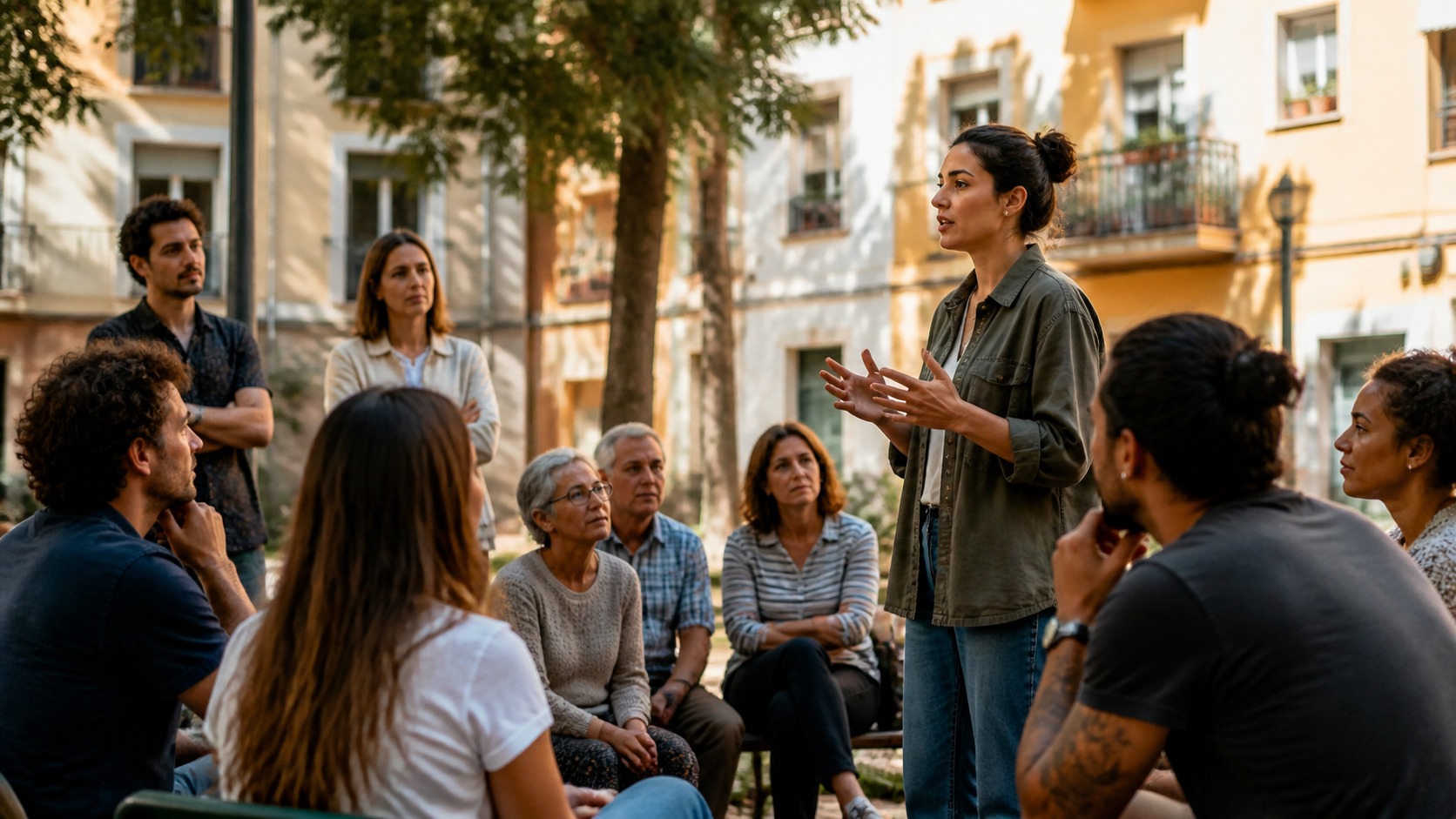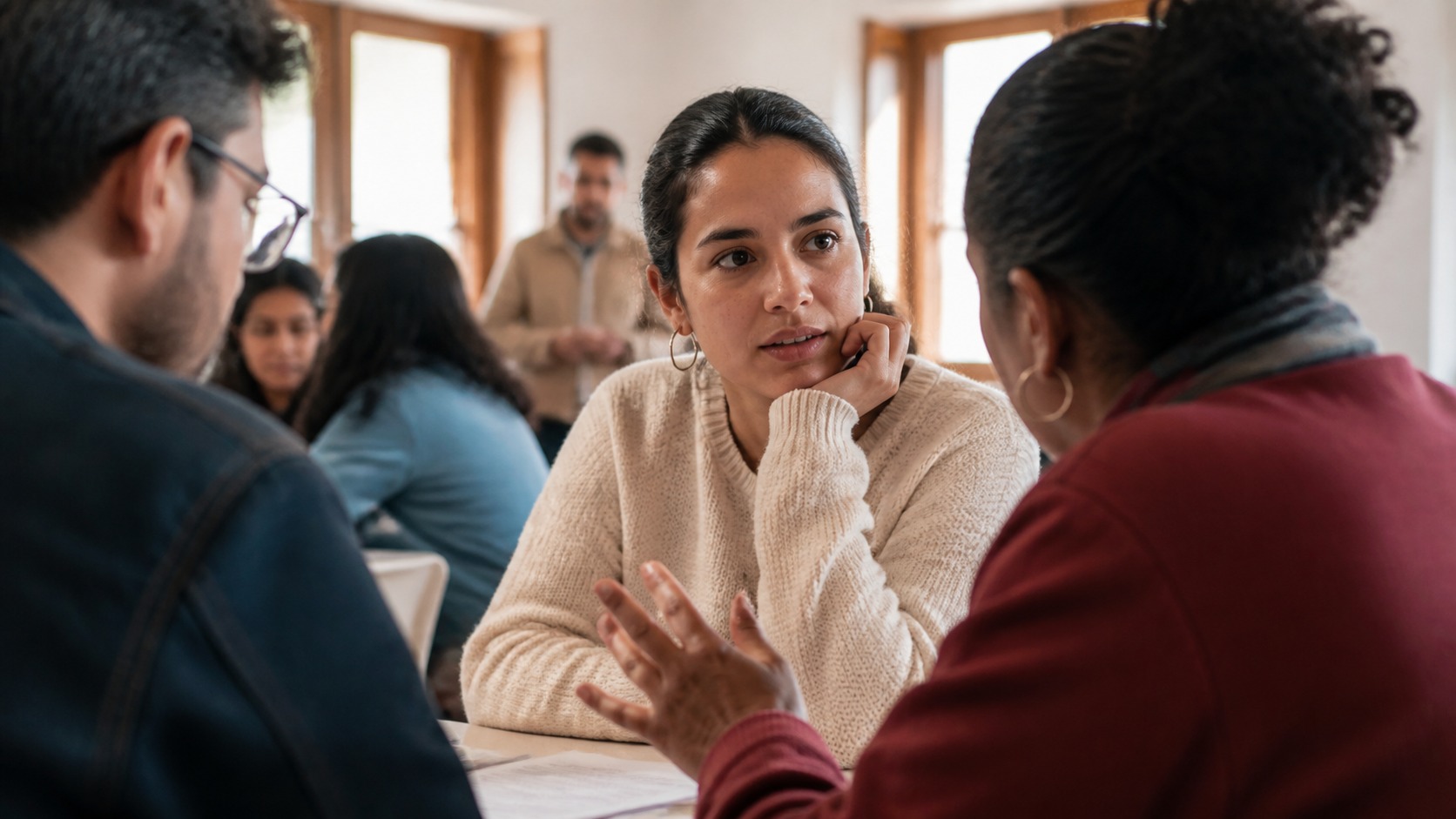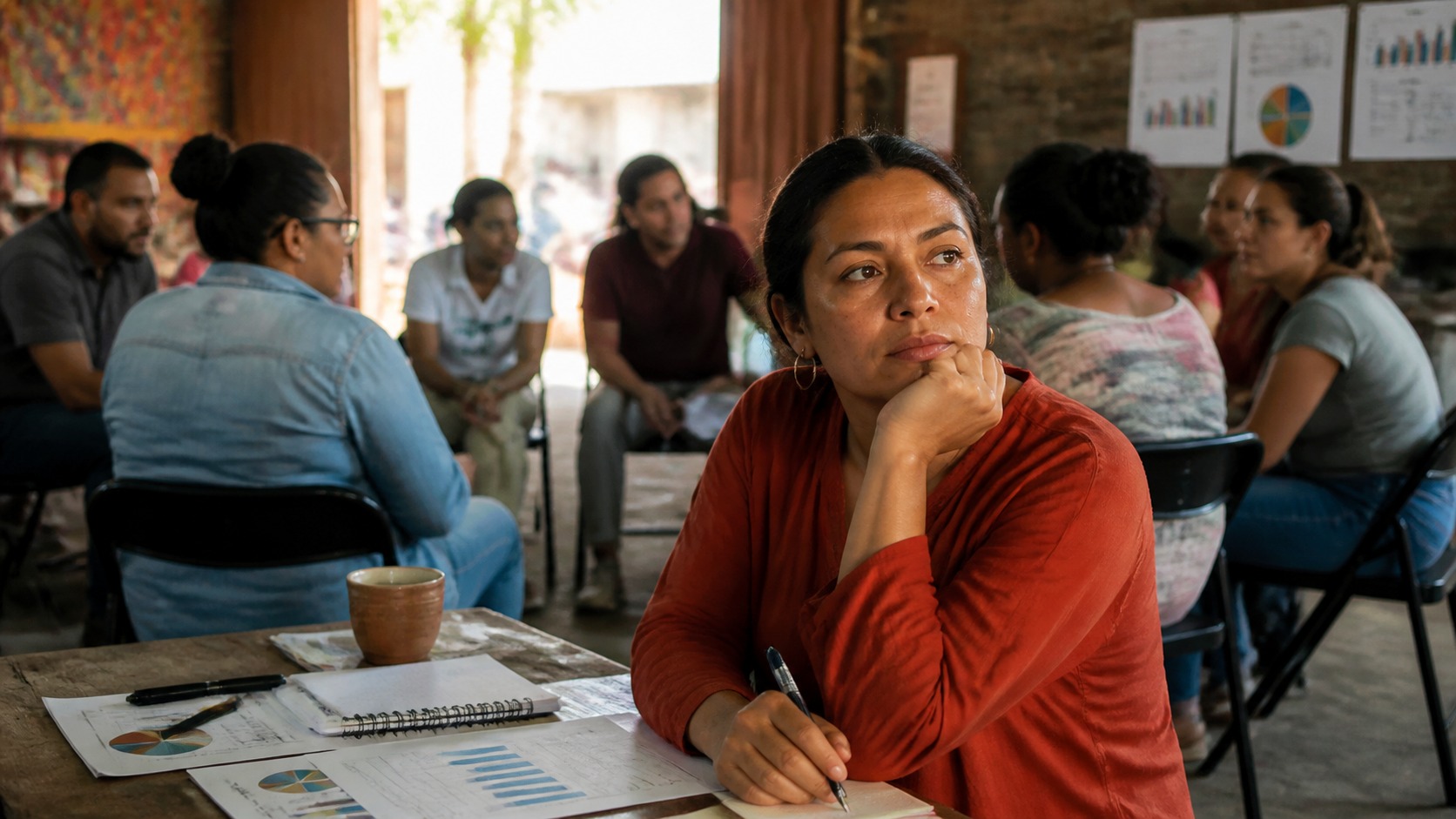
Listening to a teenager about climate risk does not mean asking them to endorse an adult solution in youthful words. It requires abandoning a questionnaire that already contains the answer, accepting unexpected rhythms and priorities, and explaining how much power their contribution really has. People crossing treeless schoolyards, crowded transport, and overheated homes every day possess situated knowledge. When that knowledge changes schedules, investment, and design criteria, participation stops being a performance and becomes democratic infrastructure for freer, fairer, and safer neighbourhoods.
Listening must stop functioning as an exam#
Many youth consultations operate like invisible tests. The process rewards somebody who uses institutional vocabulary, proposes a budget-ready measure, and maintains a tone adults consider reasonable. A participant expressing anger, uncertainty, or a fragmented experience appears unprepared. The format then selects answers compatible with the adult script and mistakes skill at adapting to the exercise for the quality of knowledge.
Many youth consultations operate like invisible tests. The process rewards somebody who uses institutional vocabulary, proposes a budget-ready measure, and maintains a tone adults consider reasonable.
Genuine listening asks before interpreting. It permits silence, examples, drawings, walks, and peer conversation. An experience need not instantly become a technical proposal. The responsible team can later translate an observation into project criteria and return to check its interpretation. That feedback prevents appropriation of a young person's voice and demonstrates that listening also requires institutional work.
A distinct experience of climate exposure#
Adolescent exposure has particular places and times. Heat is experienced on the journey to school, in paved yards, sports facilities, bus stops, and bedrooms used for study. Official warnings may reach an adult in the household but miss somebody spending the afternoon elsewhere. Economic dependence restricts choices about ventilation, travel, or places to rest.
Young people also hold distinctive capacities. Friendship networks distribute information quickly, knowledge of informal uses identifies places absent from official maps, and digital familiarity can support incident records. Recognising these strengths must not turn teenagers into unpaid volunteers or make them responsible for protecting everyone. Their participation complements public duties; it does not replace them.
Giving up the script without losing purpose#
An open process needs a clear question but not a predetermined answer. It can ask how to reduce heat exposure around a secondary school and allow unexpected issues to emerge: harassment on a shaded route, transport prices, lack of water, or a shop's ban on sitting. These diversions are not separate from climate. They identify conditions determining whether a measure will be used.
Facilitation retains purpose through synthesis and testing. It distinguishes facts, perceptions, wishes, and conflicts. Legal, budgetary, and safety constraints are explained without becoming automatic conversation stoppers. If something cannot change, reasons are given. Where discretion exists, the decision maker and timetable are identified. Freedom to contribute needs sufficient information if it is not to become an empty promise.
Equity within the category of youth#
There is no single adolescent voice. Age, gender, disability, origin, income, caring roles, education, and immigration status produce different experiences. Inviting only a school council or established organisations excludes those in work, outside education, or distrustful of institutions. Deliberate recruitment seeks diversity and states which profiles remain absent.
Material conditions matter. Compatible hours, transport, food, accessibility, interpretation, and suitable compensation or recognition are needed. Repeated unpaid attendance selects those able to donate time. Data protection must be understandable and proportionate: participants learn what will be recorded, who will see it, and how consent can be withdrawn, without having to expose personal histories for an opinion to count.
Case 1: a schoolyard designed from an aerial image#
A school planned trees around the edge of its yard because the drawing showed large open strips. During a walk, students explained that those areas were avoided because of conflict between groups, while the lunch queue occupied the unshaded centre. The earlier survey had asked only which tree species they preferred. Following that script would have added vegetation without improving the period of greatest exposure.
The team observed different hours, protected privacy, and tested movable structures at waiting points. Lunch shifts were reorganised, drinking water added, and some planting moved towards actual routes. Later review measured both temperature and feelings of safety. Young participants did not simply choose a colour or species; they changed the question from where trees would fit to where protection was needed.
Case 2: a cooler route that felt too long#
A municipal map recommended a shaded path to the library. It was thermally cooler, but young people avoided it because it crossed a poorly visible passage where intimidation occurred. Nobody mentioned this in a formal session. The information emerged on a walk supported by trusted youth workers when participants were asked not only about heat but about decisions made along the journey.
The response combined selective pruning for visibility, suitable lighting, community presence, and an alternative entrance. Details that might identify informants were withheld. Months later, the walk was repeated with different participants. The case showed that a thermally efficient route is inaccessible when it sacrifices perceived or actual safety, and that the listening format determines what can be said.
Case 3: a cooling centre where staying was unwelcome#
A library appeared on the youth cooling-centre map, yet its rules demanded complete silence and prohibited food. Teenagers caring for younger siblings felt watched and eventually went to a shopping centre. Municipal statistics recorded few visits and concluded that interest was low. A workshop held outside the building revealed that the problem was not thermal performance but the social form of access.
The library created a conversation zone, provided water and snacks, trained staff, and admitted groups without special registration. Young people helped draft conduct rules while supervision remained an institutional responsibility. Use, conflict, and temperature were evaluated. The centre expanded its reach because listening changed everyday rules, not because a campaign persuaded teenagers to adapt to a hostile place.
Adult power and the obligation to respond#
The generational relationship contains an asymmetry that must be named. Adults control budgets, schedules, access to evidence, and the final decision. An invitation to participate does not remove that power. A process becomes more honest when it explains which authority is shared, which remains with the administration, and how a response can be challenged.
Every substantial contribution deserves feedback. A public record can summarise what was heard, what will happen, what was declined, and why. It should use accessible language and preserve confidentiality. If a project is delayed, participants need an update. Later silence teaches that participation is pointless; a specific answer, even a negative one, keeps future cooperation possible.
Suitable methods and safeguarding#
Combining workshops, interviews, maps, photography, audio, and walks expands forms of expression. Activities should be tested to avoid leading questions, and declining to answer must remain possible. When accounts of violence, health, or danger arise, a referral protocol and trained staff are required. Climate participation should not accidentally become an intervention nobody is equipped to handle.
Small groups can reduce pressure but also reproduce hierarchy. Facilitators observe who interrupts, who translates, and who becomes isolated. Anonymous input helps with sensitive subjects, while continued dialogue builds trust. No method is universally suitable; evaluation asks which voices it enabled and which it obstructed.
From opinion to verifiable change#
Listening connects to decisions through established criteria. If young people identify a critical bus stop, temperature, waiting time, use, and alternatives are measured. An owner, budget, and deadline follow. A temporary intervention can be tested before permanent construction. Findings are then returned and participants are asked whether the described problem was solved.
Indicators should include not only attendance but diversity, influence, safety, and continuity. Reviews can record how many contributions changed design, which resources followed, and what commitments remain open. High attendance does not compensate for an absence of effect. Participation is evaluated as part of project governance rather than as a communications event.
Intergenerational cooperation without instrumentalisation#
Cooperation works when each party contributes capacities and receives recognition. Young people can observe, set priorities, and evaluate use; technical teams translate requirements; teachers and youth workers sustain processes; the authority funds and answers. A photograph of teenagers should not legitimise a closed choice, and unpaid work should not be presented as empowerment.
Intergenerational disagreement is valuable. A demand may conflict with maintenance, funding, or other people's rights. Instead of dismissing it as naive, constraints can be exposed and alternatives explored. Negotiating real limits supports citizenship only when adult power also accepts changes to its assumptions. Reciprocity distinguishes dialogue from one-way education.
Institutional sources protecting rights and health#
The Committee on the Rights of the Child connects children's rights and the environment in General Comment number 26. UNICEF gathers evidence on children and the climate crisis in its environment and climate change programme. The World Health Organization describes thermal risks in its heat and health fact sheet. UN-Habitat places action in an urban context through its climate change programme. These references support standards, while each neighbourhood must apply them through concrete experience.
Lasting democratic infrastructure#
Listening to adolescents requires continuity. A standing panel, seasonal meetings, and incident channels can track change without relying on one consultation. Successive groups should inherit memory without forcing the same people to participate forever. Funding, staff, and a calendar convert intention into institutional capacity.
Giving up the script does not mean giving up responsibility. It means accepting that experience can change a diagnosis and that an unexpected answer deserves investigation. Freedom grows when influence is real; equity improves when absent voices are sought; participation matters when it leaves a verifiable trace. A neighbourhood then learns to design shade and protection with those who will live longest with the consequences of today's climate choices. Regular public follow-up also lets new cohorts test whether earlier commitments remain useful, accessible, and fair as climate conditions and daily routines change.