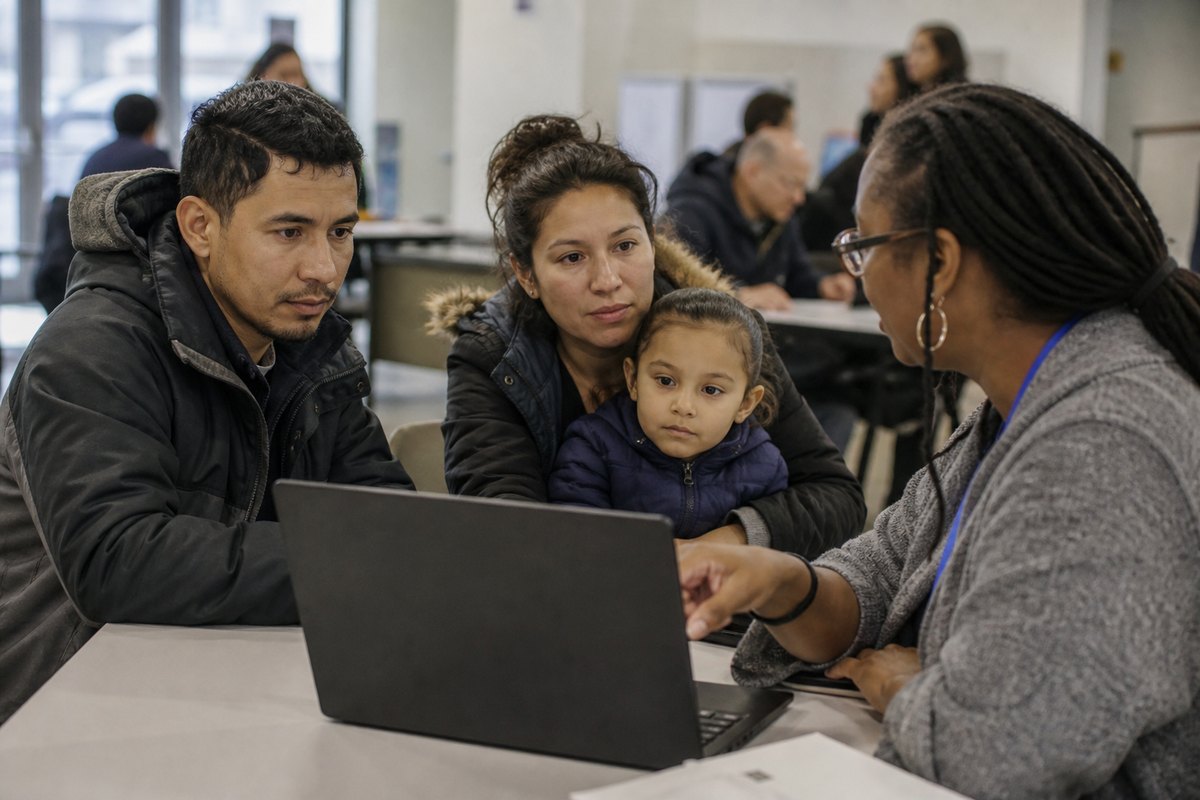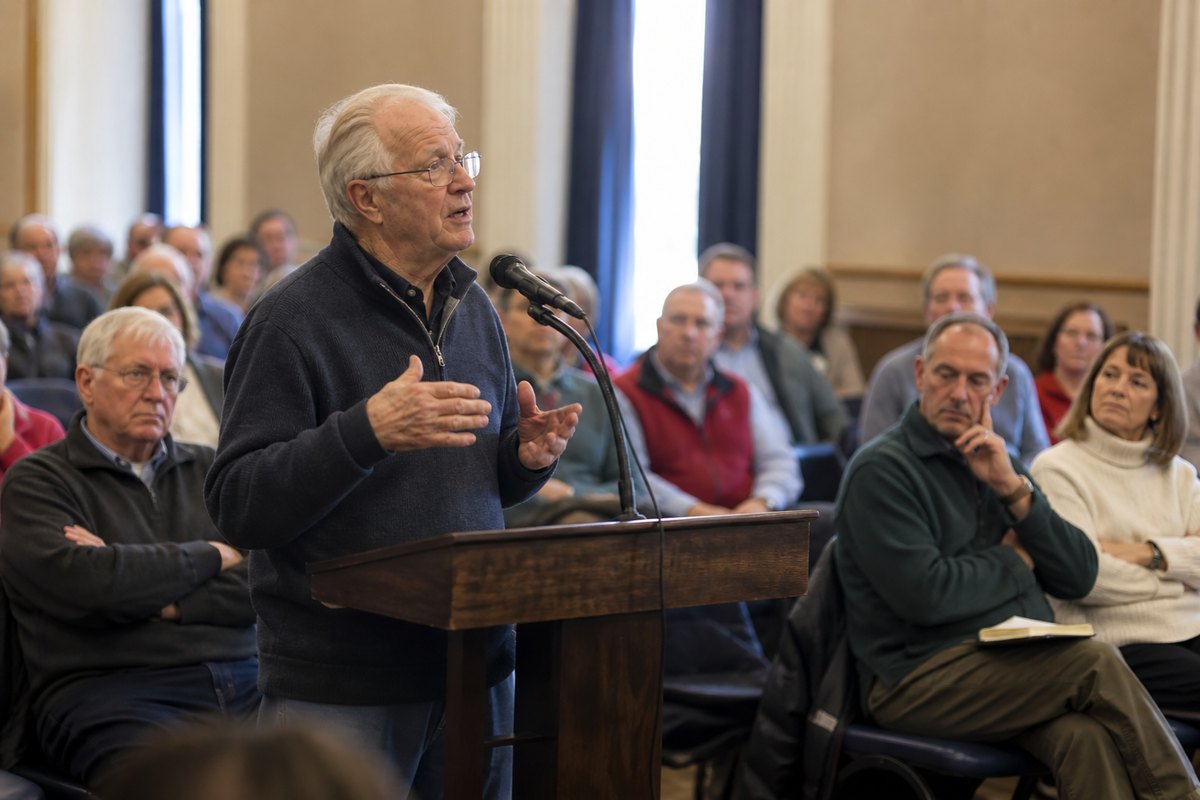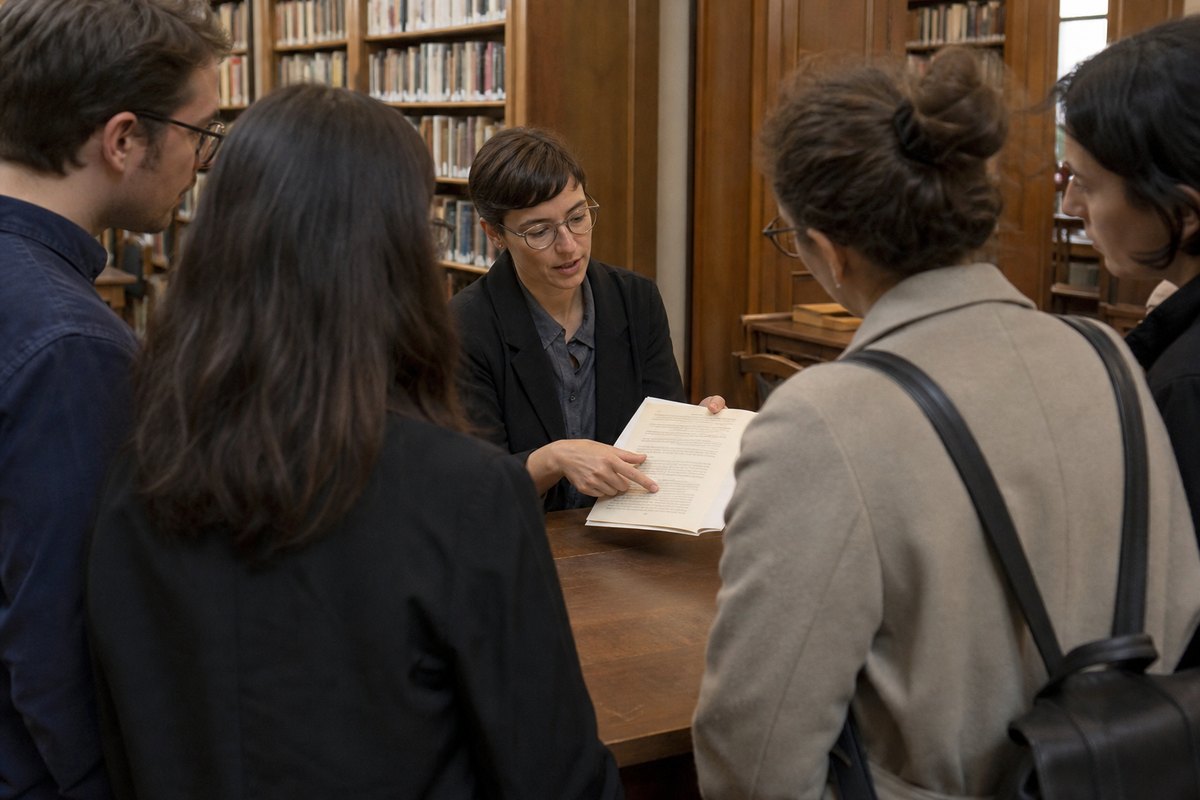
A decision seems abstract while it fits on a slide: improve mobility, digitize a service, renovate a square, or prepare a neighbourhood for heat. It stops being abstract the minute someone describes who will wait longer, which tree will disappear, what data will be requested, who may make a mistake, and how much it will cost to turn back. Communities that rehearse the future do not claim to predict it. They turn a general intention into scenes that can be debated, enabling better-informed decisions, wider capacity to act, and earlier detection of harm.
From an impeccable statement to a concrete experience#
Collective decisions often begin with words that nobody rejects: efficiency, innovation, safety, sustainability, or modernization. The apparent agreement conceals the different futures each term can contain. A more efficient service may save time for most people while excluding those who need in-person assistance. A safer street may calm traffic or divert it into another area. Abstraction enables speed, but it also avoids naming uncomfortable distributions.
Collective decisions often begin with words that nobody rejects: efficiency, innovation, safety, sustainability, or modernization.
Specificity arrives when the community constructs a scene with a place, a time, and people. It asks not only whether a proposal works, but how it performs on a rainy Tuesday, an August night, or a week with fewer staff. It does not imagine an average user. It includes an older resident, a caregiver in a hurry, a teenager, a small retailer, a person with limited mobility, and the worker maintaining the infrastructure.
This step does not mean dramatizing every consequence. It gives human scale to hypotheses that would otherwise compete as slogans. A scene makes it possible to mark which element comes from evidence, which is an inference, and which expresses a political preference. Disagreement then stops looking like irrational resistance: it may reveal missing information, legitimate interests, or uncertainty erased by the original presentation.
The decisive minute comes when a person can complete the sentence: if this option is approved, tomorrow that person will have to do this, lose that, or gain this possibility. From that moment, the decision acquires accountable people, deadlines, and review criteria. The conversation no longer asks participants merely to support or oppose an appealing idea; it compares effects and asks which combination is fair and repairable.
Rehearsing is neither predicting nor staging a spectacle#
A future rehearsal is a test of shared reasoning. It proposes several plausible scenarios, introduces pressure, and observes how an option responds. It does not promise accuracy. Its value lies in expanding the field of view and preparing adaptable decisions. Unlike a single prediction, it keeps alternatives open; unlike a futuristic spectacle, it gives those present materials they can question, alter, and use.
Spectacle focuses attention on a dazzling image and reserves knowledge for specialists. Rehearsal does the opposite: it displays assumptions, explains limits, and assigns roles. A model, a walk, a script, or a simple simulation is useful when it permits intervention. Technological sophistication does not guarantee learning. A table with a map, cards, and realistic timings sometimes reveals more than a closed visualization whose logic nobody can inspect.
The practice also distinguishes the probable, the possible, and the preferable. The probable describes evidence-based continuities; the possible introduces reasonable changes; the preferable declares values. Blending them produces false certainty. Separating them allows a community to recognize what it knows, fears, and wants. Such honesty strengthens the decision because it prevents a moral choice from being presented as an inevitable technical conclusion.
A good rehearsal ends with observable changes: a clause added to a contract, an accessible route, a smaller pilot, a maintenance budget, or a review date. If a session produces only enthusiasm, photographs, and new vocabulary, the future remains a spectacle. Common practice begins when what has been learned changes who decides, what receives funding, or how the initiative can be stopped.
The threshold that turns an idea into responsibility#
Before commitment, there is a particularly valuable margin. The design can still change without defending sunk costs or institutional prestige. Within this margin, a community can establish a threshold of specificity: no proposal advances until it can explain beneficiaries, burdens, dependencies, alternatives, and an exit. The requirement does not obstruct innovation; it prevents urgency from replacing judgement.
This threshold requires traceability. Every promise should connect to evidence, an accountable person, and a way to observe the outcome. Every significant risk needs a preventive measure and a signal that triggers review. Uncertainties must remain visible. When a formal record disguises them, the organization loses an opportunity to learn, and affected people receive consequences they were never able to discuss.
Reversibility deserves separate attention. Some trials can be undone easily; others create contracts, databases, habits, or infrastructure that are difficult to leave. The greater the irreversibility, the deeper the rehearsal must be. The process should also identify who bears an error. If the benefit is institutional while the cost of failure falls on households with little room to adapt, formal approval does not make the process legitimate.
Responsibility does not require unanimity. It requires significant disagreements to be recorded, minorities to understand the reasoning, and a remedy to exist when actual impact contradicts expectations. A decision may proceed despite uncertainty, but it must state why, for how long, and under what circumstances it will be corrected or withdrawn.
Case 1: a public square prepared for heat#
A municipality plans to renovate a square and presents images of shade, plants, and meeting areas. The proposal receives broad support until a rehearsal sets the scene at four o'clock on a July afternoon. The plan reveals that young trees will take years to provide shade, drinking fountains sit away from older people's routes, and the proposed paving retains heat.
The community organizes a thermal walk with residents, shopkeepers, cleaning staff, children, and municipal specialists. Each participant crosses the square at different times, records resting places, and identifies maintenance tasks. A nearby care home explains its schedule; the market identifies delivery periods; several families show where they wait after school. The future stops being an image and becomes bodies moving through space.
The rehearsal does not cancel the project. It changes its sequence. The municipality provides temporary shade from the first summer, preserves mature trees, redistributes benches, and reserves permeable ground. It also allocates an irrigation budget and publishes temperature and usage indicators. The concrete decision establishes who will measure, when review will occur, and which areas will change if the outcome fails to protect those most exposed.
The main lesson is not that heat was imagined, since it was already known, but that heat was located in schedules, routes, and responsibilities. The square can be evaluated from its opening rather than years after an inaugural photograph. Rehearsal turns a climate aspiration into present obligations and allows the design to be debated by the people who will experience its daily performance.
Case 2: digital appointments at a health centre#
A healthcare network proposes that most appointments be requested through an application. Its purpose is to reduce calls and organize demand. Initial figures promise savings, but a simulation follows three profiles: a person with low digital literacy, a worker with changing shifts, and a patient who needs to explain complex symptoms. Supposed simplicity produces a different obstacle for each person.
During the rehearsal, reception staff, clinical professionals, patients, and data protection officers act out the complete process. They do not stop at the confirmation screen. They check what happens when someone forgets a password, shares a phone, needs translation, or receives an incorrect classification. They also count the time the application saves the centre and the invisible work transferred to relatives.
The organization adopts a hybrid system. It retains telephone and in-person support, simplifies mandatory data, and creates human review for certain answers. It establishes a short period for detecting abandonment and compares outcomes by age, language, and socioeconomic position. No channel is treated as residual: each is part of the service and receives resources in proportion to observed demand.
The decision is no longer whether to digitize. It becomes a question of which tasks should be automated, what support is guaranteed, and what inequality would be unacceptable. The pilot has limited scope, a published duration, and an authority able to pause it. Efficiency is therefore tested against access, clinical quality, and privacy before becoming a general obligation.
Case 3: shared energy in a residential community#
A residential community considers installing solar panels and a shared battery. The financial calculation looks favourable, but agreement stalls: some households can advance money, others rent their homes, and several fear a large special charge. A workshop represents three futures involving prices, maintenance, and people moving home. The debate reveals that technology was not the only matter; a relationship of ownership and risk was also being designed.
The rehearsal assigns roles normally absent from the meeting: a tenant who will move, a household in debt, the person expected to manage the system, and a future neighbour who will buy without knowing the contract. Participants compare distribution rules, contingency funds, and exit procedures. An installer contributes technical data but does not choose distributive criteria that belong to the community.
The solution combines staggered contributions, a repair reserve, accessible information, and an annual review of allocation. The contract specifies how energy will be valued, who may audit the accounts, and what happens when a home is sold or rented. A small initial phase also allows real consumption to be observed before the installation expands. The decision gains precision without losing its climate ambition.
The case shows that sharing infrastructure requires a shared capacity to understand and govern it. Without that dimension, the community could purchase efficient equipment and create an opaque dependency. With it, the energy future becomes a practice of cooperation: every person knows the relevant rights, obligations, and route for correcting a rule that produces an unexpected effect.
Sustaining a plural conversation without diluting the decision#
Participation loses meaning when it gathers only familiar voices or when every session starts again from zero. A community needs a map of affected parties, varied formats, and a public memory of the process. People do not contribute identical knowledge: a service user knows its friction; a maintainer knows its dependencies; a legally accountable person knows its obligations. The method must integrate these perspectives without pretending they are interchangeable.
It must also clarify authority. Listening does not mean promising that every suggestion will be accepted. The responsible institution or group explains what can change, what constraints exist, and who will make the final decision. It then publishes how contributions were used. This response guards against decorative participation and distinguishes reasoned disagreement from a consultation that never had influence.
Differences in time, language, and confidence require compensation. Providing care, translation, alternative hours, or material in advance broadens actual presence. Paying for community knowledge may be appropriate when an institution requests sustained work. Anonymous channels can also reveal risks that would remain unspoken in a meeting dominated by hierarchies or dependent relationships.
Conflict does not necessarily indicate that the process has failed. It may show that the decision distributes real costs. The professional task is to make those costs comparable, seek alternatives, and state the chosen criterion. Hiding conflict beneath an inspirational vision merely postpones it until infrastructure, a rule, or a contract makes correction more expensive.
A simple discipline for practicable futures#
A useful routine begins with a scene: who does what, where, and at what time. It continues with three scenarios sufficiently different to put the proposal under pressure. It then identifies early signals, irreversible consequences, and people who would bear failure. Finally, it converts learning into conditions for implementation. Depending on the scale of the decision, the process may take an hour or several months.
Documentation should be concise and reusable. A record can include purpose, assumptions, voices present and absent, tests, indicators, stopping thresholds, an accountable person, and a review date. Its function is not to produce bureaucracy but to preserve reasons when teams and circumstances change. Memory prevents every warning from being treated as new and makes it possible to assess whether a promise was fulfilled.
Indicators combine quantity and experience. Time, cost, temperature, or usage reveal patterns; interviews, observation, and complaints explain how they arise. An average must never conceal small groups that are especially affected. If an overall improvement seriously worsens life for people with fewer alternatives, the rehearsal must trigger correction instead of turning them into a methodological footnote.
The ability to stop completes the practice. Someone must have the authority, information, and resources to pause when an agreed signal appears. Without that power, review is ceremonial. A prepared community does not interpret a pause as failure: it treats it as part of responsible design and evidence that learning matters more than defending a previous decision.
The common future begins before opening day#
The future becomes common when it no longer belongs to the person presenting the vision and can be questioned by those who will bear its consequences. Every participant need not become a foresight specialist. The process needs to offer intelligible scenes, real alternatives, and the capacity to influence outcomes. Imagination gains public value when it changes present commitments.
The three experiences reveal a pattern: the square, the application, and the energy system appeared to be sector-specific decisions, yet each reorganized time, access, risk, and power. Rehearsal exposed that social architecture before it became fixed. It did not guarantee a perfect answer; it produced one that was more transparent, adaptable, and attentive to differences within the community.
That is the minute a decision stops being abstract: one person can name its effect, another can challenge its assumption, and an authority can change the proposal. From then on, the future is not a stage to contemplate. It becomes a common practice of anticipation, care, and learning, tied to decisions that can be explained and reviewed.