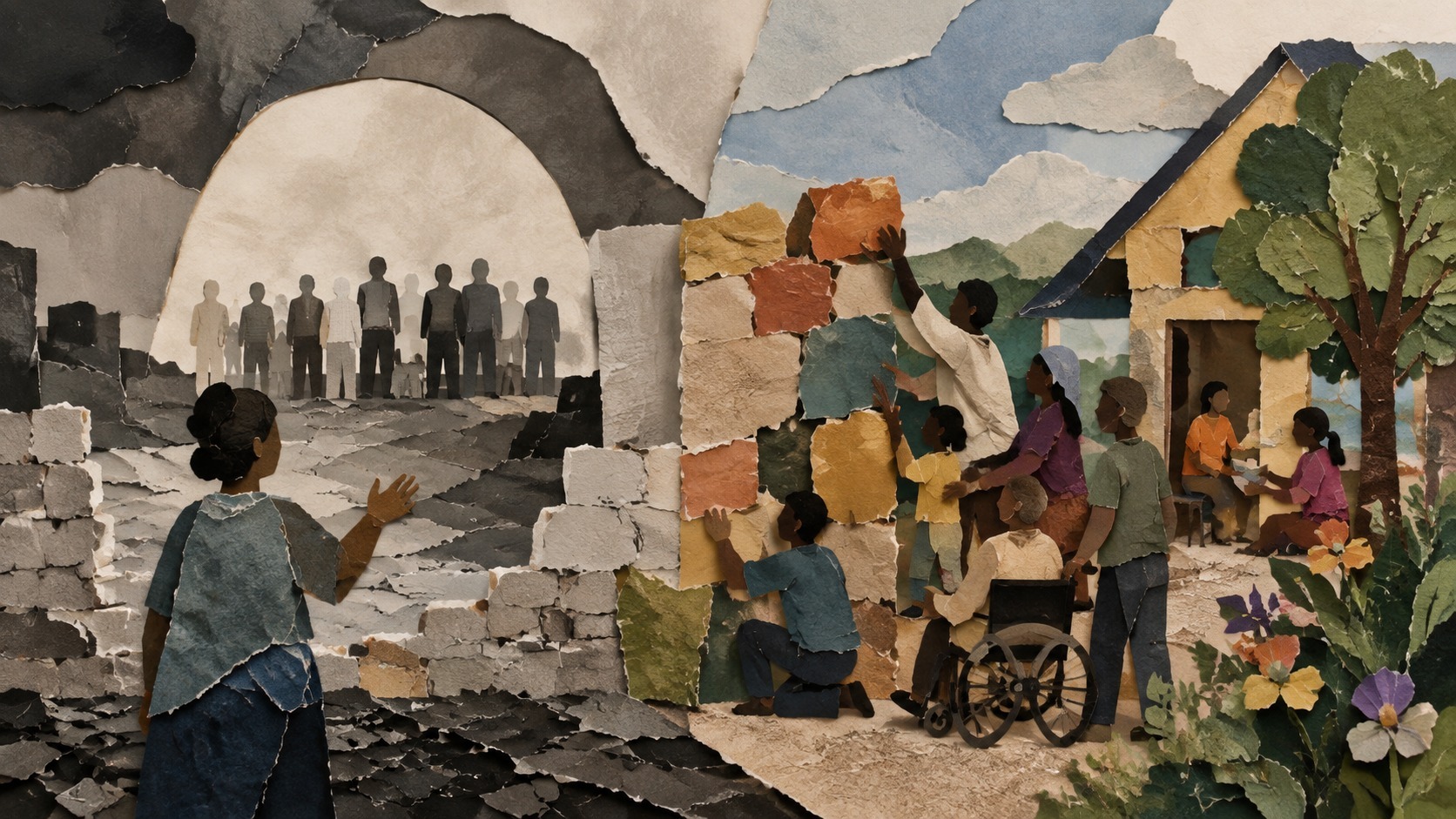
The governing group at a school receives a twelve-page report about a reading-support programme. It is reassuringly polished. Sections lead neatly into one another, percentages look precise, and every recommendation appears to follow from the last. The conclusion recommends closing the programme and moving its funding elsewhere. A teacher asks which record establishes that participation fell. No one can find it. A chart refers to “internal data”, a sentence invokes “families”, and a footnote leads to a folder that no longer opens. The report’s fault is not obscurity. Its smoothness has hidden the question that should come first: how do we know what it says we know?
That scene does not require deliberate deception to be risky. Someone may have condensed scattered notes in good faith; a software tool may have changed a tentative observation into a declarative sentence; a provisional number may have survived a change of term. Once the account arrives in a coherent form, readers encounter few visible reasons to pause. Ease of reading becomes a cue for authority even though it is not a cue for checking. A fluent explanation therefore does not deserve automatic suspicion. It deserves an additional obligation: it should reveal the route that connects each significant claim to the material that supports it.
Good prose is not a chain of custody#
Two qualities are often confused. One is intelligibility: whether a person can understand an idea without decoding jargon or opaque tables. The other is traceability: whether that person can, when needed, follow a conclusion back to the records, documents, observations, or conversations used to reach it. The school report may excel at the first and fail at the second. Indeed, very compressed writing can erase precisely the joins where dates, people responsible, doubts, and limits ought to appear.
Two qualities are often confused. One is intelligibility: whether a person can understand an idea without decoding jargon or opaque tables.
Traceability does not mean that every parent must complete an audit before forming a view. It means that an audit is possible and proportionate. If a report says attendance declined, a useful route identifies the system that recorded it, the period covered, who checked the count, and which gaps are known. If it says families prefer a different activity, readers should know whether that comes from a survey, messages received by one staff member, or an interpretation drawn from a few meetings. A route does not make a source sound merely by naming it. It lets readers judge what kind of support the source provides.
It also prevents a common shortcut: citing an institution as though the institution itself were evidence. “According to the school” might mean a collection of minutes, a statement by a headteacher, or a sentence circulating without an attached document. A broad origin can create the appearance of provenance while preventing any real review. A sufficiently specific route can still be short: the document’s name or location, date, responsible office, version, and an explanation of why that material bears on the claim. That is not ornamental administration when a decision will affect pupils, families, and staff.
Keep three layers in view#
The report contains three different kinds of statement. The first is a datum: “the loan register shows monthly loans falling from 184 to 151 between October and December.” A datum needs a source, a period, and a basic account of method. The second is an interpretation: “the reduction may be connected to the timetable change.” That may be a sensible thought, but it does not emerge automatically from the table; it links partial signs and should name alternatives it has not ruled out. The third is a proposal: “the programme should close and the money should fund conversation clubs.” A proposal brings in priorities, costs, and future consequences. It is not untrue because it is a proposal, but it must not be presented as an inevitable finding.
When these layers merge, quick reading turns a contestable option into a technical necessity. “Lower participation proves that we must close” looks like one sentence, but contains a count, a causal interpretation, and a budget decision. Separating them makes a more honest discussion possible. The count may be accurate; poor communication about a new timetable may be the main cause; closure may be worse than changing the schedule. Separation does not stop management. It tells the group whether an objection concerns data quality, reasoning, or the priority being chosen.
A practical document can label these layers without colour-coding every line. A “recorded data” box can give the route and degree of coverage. An “interpretation” section can explain what the material suggests and what it cannot establish. A “proposal” section can name its author, its objective, and what might be gained or lost by accepting it. Readers should not have to guess when the text has moved from description to inference, or from inference to a decision that will shape other people’s lives.
Evidence grades are not marks of shame#
The group could use a simple scale. Direct, verifiable evidence includes original records, accessible documents, and data gathered with a known method. Corroborated but incomplete evidence consists of independent sources that agree while leaving part of the period or affected group uncovered. Indicative evidence includes testimony, bounded observations, or patterns that open a hypothesis but do not settle it. Unlocated evidence describes claims for which the source was not retained or the route cannot be reconstructed. This scale does not rank people who contribute information. It describes how much weight a particular statement can carry.
Saying that evidence is unlocated can be uncomfortable because it acknowledges a gap. Concealing the gap does not remove it. Family comments may be highly valuable for identifying an access barrier, but they cannot alone estimate use across an entire pupil population. A broad administrative count may show a trend without explaining why it happened. Naming these differences allows materials to be combined without making one of them do work it cannot do. The report becomes more exact when it says: this has been measured; this is a plausible explanation; this remains to be checked.
The scale changes work before the meeting as well. A writer stops looking for sentences that end debate and starts asking what evidence would be adequate for each decision. Changing an afternoon slot may require only records and a brief consultation. Ending a programme should require more because the harm of a mistaken reading is harder to repair. The importance of a choice does not strengthen a weak source, but it helps set the time and comparison that checking deserves.
Build routes another reader can follow#
A route to a source should work for someone who was not in the room when the report was written. Instead of a generic label, it can give the document, date, responsible person or office, location for review, and relevant transformations. If a table was cleaned to remove duplicates, say so. If January figures are absent because a system changed, say that too. If an interview is summarised without publishing a transcript for privacy reasons, the report can still explain how many people took part, how they were selected, and what questions they were asked.
Routes do not require the exposure of personal information. Sound traceability distinguishes between making a process reviewable and making all its contents public. The group may retain a complete register under restricted access, publish an aggregated version, and explain who can inspect the original under which conditions. Privacy cannot become a phrase that ends every question. When no external reader can check a particular datum, the report should at least make clear who did check it, by what procedure, and with what accepted limitations.
This discipline becomes more important where automated tools are involved. A tool may summarise survey responses, yet the report should retain the questionnaire, the response universe, the rules used to group answers, and a sample that permits errors to be spotted. If the system proposes categories, that classification is a technical interpretation, not raw data. Showing its origin prevents a quickly produced label from becoming, through repetition, the official description of a community.
Review the decision, not just the spelling#
Before voting, the school could reserve thirty minutes for four questions. Which claim is central to the recommendation? Where is its primary source, or the explanation for why it cannot be located? Which part of the argument interprets that source, and which alternatives remain open? What decision is proposed, and who bears its costs if the assumption proves wrong? This is more useful than a decorative link check because it returns the architecture of the decision to the people making it.
If the central claim has no route, several careful responses are available. The report can remove certainty from its wording, delay closure while records are recovered, run a limited trial, or present options alongside their conditions. None is a failure. The error would be to keep an irreversible recommendation merely because the report is already circulating and its tone sounds final. Correcting a well-written but poorly supported sentence protects the people who would bear a hurried conclusion.
The person who identifies the gap needs a channel that does not punish the question. In many organisations, asking for a source is read as personal distrust or inconvenient delay. That response teaches people to stay silent precisely when correction is cheap. A culture of traceability treats the question as part of the work. It does not accuse the person who drafted under pressure; it strengthens a document assembled from many pieces. Quality does not come from pretending that uncertainty is absent. It comes from knowing where it is and deciding what to do about it.
An ending that keeps the reasoning open#
The revised report could conclude differently. Rather than announcing that the programme failed, it might explain that recorded loans declined during one term; that a timetable change coincides with the decline but does not prove its cause; that participation in unregistered activities remains unknown; and that a two-month pilot with alternative times is proposed. It can set a review date, publish the route to aggregated data, and name someone who will answer questions. This may sound less decisive, but it permits learning without turning a conjecture into an order.
Clarity remains valuable. A good report does not force readers through annexes before they can locate its main point. What changes is the bargain. Prose guides the reader but does not demand faith. Each important claim shows where it comes from, each interpretation acknowledges its reach, and each proposal declares itself to be a choice with consequences. When a source cannot be located, the document does not fill the empty space with an elegant sentence. It names the gap and adjusts the decision to the uncertainty.
That habit has a public benefit. A person reading after the meeting can understand not only what was decided, but what was known at the time, what was assumed, and what was promised for later checking. Whether the programme continues, changes, or ends, there is a starting point for correction. The most durable trust does not come from a voice that never hesitates. It comes from an institution that makes the path of its words visible and lets other people walk it.