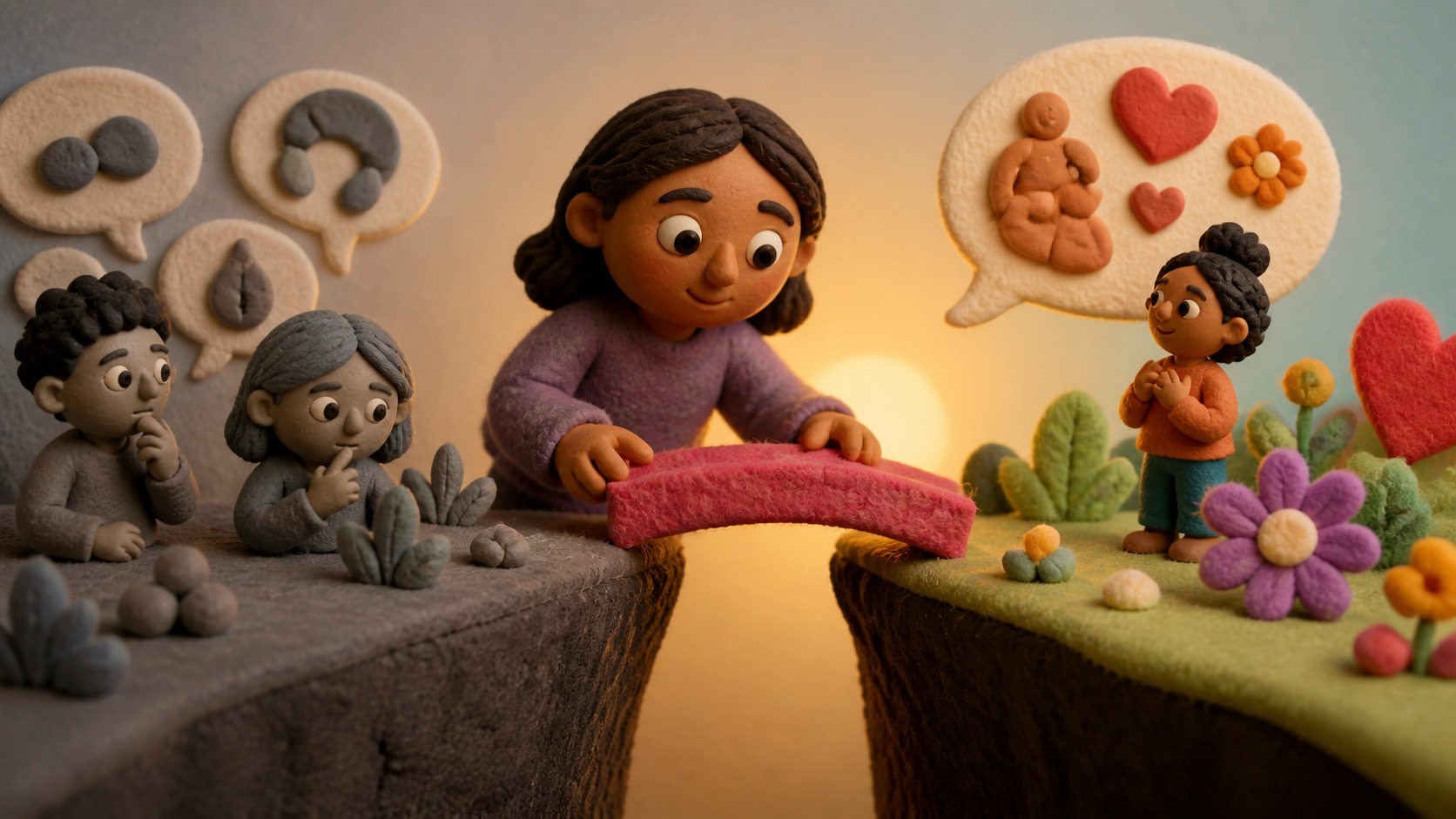
Concrete cases and review questions for learning from events, making repairs and adjusting the next step without blame.
Review progress without turning it into a test#
Reviewing neighbourhood play should be a way to learn, not a way to award marks. A family, children s group or local association can begin by noting for two weeks which places were used, at what times, and which conditions made staying easier or harder. Record what already helps as well: a neighbour who makes room for balls, welcome shade in summer, or an adult who explains a rule without shaming anyone. The useful measure is not the number of hours outside. It is whether children and teenagers could make choices, rest, move around and return home calmly. The Convention on the Rights of the Child recognises rights to rest, leisure and play. A careful review therefore asks what the place means to the people using it before comparing that experience with visible barriers. Replace statements such as you never look after anything with checkable descriptions: a swing was broken for three days, cars blocked a crossing, or the time clashed with family care. That makes progress understandable and changeable.
Reviewing neighbourhood play should be a way to learn, not a way to award marks. A family, children s group or local association can begin by noting for two weeks which places were used, at what times, and which conditions made staying easier or harder.
Build a review that includes the people who play#
A review becomes stronger when different people prepare it and the language is easy to use. A forty minute conversation can use a map, stickers and three prompts: what should we keep, what should we change, and what help do we need. Children s answers need a genuine chance to affect a decision; listening is not asking for views and then setting them aside. UNICEF s participation guidance stresses understandable information, safety and feedback about outcomes. An adult can help people take turns, but should not translate a wish to play into a childish whim. Teenagers may document a place with privacy-respecting photographs or make an accessibility walk. People with limited mobility, sensory differences or caring duties also need a practical route into the discussion. At the end, someone writes down the action, named lead, needed support and review date. One small agreement, such as reporting a broken fountain to the district, is more valuable than an ambitious list with no follow-through.
Concrete case: the blue bench in the square#
At the square with the blue bench, ten year old Mara said she did not want to go down because older boys always occupied the central table. Her father almost replied that she needed to stand up for herself. The discussion shifted when other girls said they also avoided the area because the bench was far from the visible part of the square. The residents group observed three afternoons. They found no direct conflict, but an unwelcoming layout: the only shaded table sat beside a narrow entrance and the play corner was isolated. They tested a movable table for a month, cooperative games one afternoon each week, and a simple sign saying that the square was shared. A nearby shop lent a box for chalk. Four weeks later Mara still preferred company, but she was suggesting games and approaching the bench. The progress was not forcing her to overcome fear. It was changing conditions and checking the effect. The case shows why a blame-free review looks for local causes before assigning personal flaws.
Separate place problems from personal blame#
When something does not work, separate four layers: safety, access, relationships and resources. Safety covers lighting, traffic, physical hazards and violence; immediate danger calls for the competent public services. Access covers distance, cost, timing, architectural barriers, language and connectivity. Relationships include teasing, exclusion, unclear rules and a lack of trusted adults. Resources include materials, time, shade, toilets and maintenance. The World Health Organization has explained that everyday environments influence physical activity and wellbeing, so asking for more individual effort cannot solve everything. This distinction stops one caregiver from carrying a repair that belongs to a council, school or organisation. It also makes priorities clearer. If a ramp is missing, record and report it, then seek an accessible alternative without pretending that a temporary solution is enough. If two groups argue, agree a mediated conversation with clear ground rules and check whether they hold. Naming the right layer turns a complaint into a workable task.
Concrete case: a route changed by rain#
Samir s route to the park looked simple until the rainy season arrived. Water collected beside a construction site on the usual path, and the group stopped going although nobody wanted to say they were worried about slipping. In a short review, a teenager drew three alternatives and marked where kerb cuts were missing. One parent contacted the municipal reporting service, while the youth worker offered to accompany the journey on Fridays for a month. The group also agreed to keep spare shoes in a shared bag and not cross the deep puddle. The point was not to prove bravery. It was to protect independence with a reasonable safety margin. After three weeks the building work installed a temporary walkway. The group kept the new route even on dry days because it passed a library where they could stop. UN-Habitat connects good public space with inclusion, proximity and diverse use; that perspective helps a group see more than one isolated incident.
Close the loop with repair and one next step#
Closing a review means returning what was learned to everyone who took part and setting the next experiment. A final sheet can have three columns: keep, repair and try. Keep records what already protects play, such as the caretaker s greeting or a time that avoids intense sun. Repair lists a broken bin, an excluding rule or an apology that is still needed. Try limits the action to something possible before the next date: request a meeting, test a different layout for equipment, or invite a specialist organisation. UNESCO notes that inclusive learning and community environments are built through sustained participation, not one-off events. It is equally important to say what could not yet be fixed and who needs to respond. Transparency reduces blame and prevents impossible promises. If a child says they do not want to return to a place, that decision deserves respect and careful exploration rather than pressure. Reviewing progress without blame protects dignity while a neighbourhood learns to care for its shared spaces.
A responsible review also protects privacy: it records situations and changes, not labels attached to a child, teenager or family. A shared notebook can hold the date, place and agreed action while disclosing only what people need to know. The facilitator should check that everyone understands the decision, knows how to disagree and knows who to approach if a problem appears. The next review can begin by reading those agreements and asking what was learned rather than who failed. This habit makes evaluation part of everyday care and means that neighbourhood improvements do not depend on one person s memory, energy or voice. A responsible review also protects privacy: it records situations and changes, not labels attached to a child, teenager or family. A shared notebook can hold the date, place and agreed action while disclosing only what people need to know. The facilitator should check that everyone understands the decision, knows how to disagree and knows who to approach if a problem appears. The next review can begin by reading those agreements and asking what was learned rather than who failed. This habit makes evaluation part of everyday care and means that neighbourhood improvements do not depend on one person s memory, energy or voice. A responsible review also protects privacy: it records situations and changes, not labels attached to a child, teenager or family. A shared notebook can hold the date, place and agreed action while disclosing only what people need to know. The facilitator should check that everyone understands the decision, knows how to disagree and knows who to approach if a problem appears. The next review can begin by reading those agreements and asking what was learned rather than who failed. This habit makes evaluation part of everyday care and means that neighbourhood improvements do not depend on one person s memory, energy or voice. A responsible review also protects privacy: it records situations and changes, not labels attached to a child, teenager or family. A shared notebook can hold the date, place and agreed action while disclosing only what people need to know. The facilitator should check that everyone understands the decision, knows how to disagree and knows who to approach if a problem appears. The next review can begin by reading those agreements and asking what was learned rather than who failed. This habit makes evaluation part of everyday care and means that neighbourhood improvements do not depend on one person s memory, energy or voice. A responsible review also protects privacy: it records situations and changes, not labels attached to a child, teenager or family. A shared notebook can hold the date, place and agreed action while disclosing only what people need to know. The facilitator should check that everyone understands the decision, knows how to disagree and knows who to approach if a problem appears. The next review can begin by reading those agreements and asking what was learned rather than who failed. This habit makes evaluation part of everyday care and means that neighbourhood improvements do not depend on one person s memory, energy or voice. A responsible review also protects privacy: it records situations and changes, not labels attached to a child, teenager or family. A shared notebook can hold the date, place and agreed action while disclosing only what people need to know. The facilitator should check that everyone understands the decision, knows how to disagree and knows who to approach if a problem appears. The next review can begin by reading those agreements and asking what was learned rather than who failed. This habit makes evaluation part of everyday care and means that neighbourhood improvements do not depend on one person s memory, energy or voice.