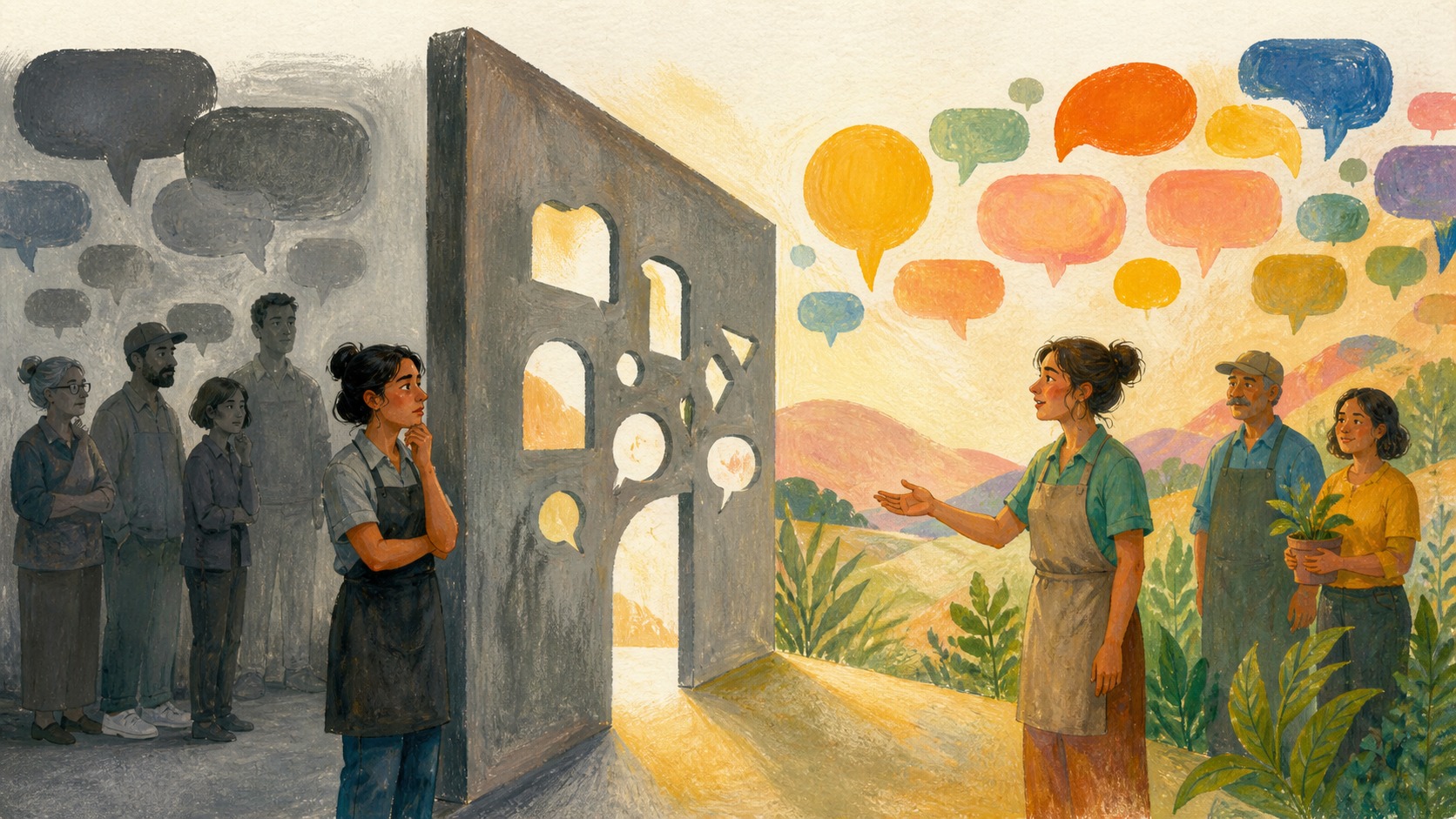
On a September Monday, before lessons begin, the caretaker sees two families talking over one another at the gate about a rain alert. One person thinks children must be collected immediately; another has read that the school remains open; nobody knows who will receive the official update. There is no emergency yet, but the scene already exposes the difficulty: when people fill information gaps with assumptions, anxiety travels faster than reliable news.
Preparation is not about imagining every possible disaster or collecting instructions. It is about deciding, in a calm moment, who checks a report, how a family communicates with a school, and what support a community can offer without taking over. A short agreement that people can use and revise turns a chain of confused messages into safer decisions.
Begin with a plausible situation#
Rather than write an enormous plan, a group can choose a nearby situation: a storm at collection time, a supply outage in the building, or an evacuation directed by public services. Each person describes what they would do in the first ten minutes. This focused question exposes useful gaps. A parent may work where phones are unavailable, a grandparent may not receive written messages easily, or a pupil's authorised contact may no longer be current.
Rather than write an enormous plan, a group can choose a nearby situation: a storm at collection time, a supply outage in the building, or an evacuation directed by public services.
The conversation needs people who are often excluded from decision-making. Younger people can explain which instructions make sense to them; someone with reduced mobility can identify an unusable route; a carer can say when they need relief. Listening to these experiences is not an inclusion ritual. It prevents a seemingly sound plan from failing the person who depends on it most.
Separate information from alarm#
An operational agreement begins with three named sources: the school's official channel, notices from competent authorities, and a shared family contact. Messaging groups can help confirm that a notice has arrived, but they should not turn rumours into instructions. When an unattributed screenshot appears, the task is not to forward it with dramatic commentary. It is to find its origin and wait for a verifiable direction.
Simple agreed phrases help. “I saw the school notice at 4:10 pm” informs. “They say everything is closing” creates confusion. The group should also remember the agreement's boundary: in immediate danger, follow the emergency instruction and contact the appropriate services. No family sheet can replace an evacuation, shelter instruction, or clinical response directed by professionals.
Give responsibilities a backup#
The instruction to “keep an eye on things” is not a real responsibility. Observable actions work better: Marta checks the school channel; Leo keeps a printed phone list; Amina sends the external contact one status message. Every action needs a second person and a handover condition. If Marta is driving, Leo checks the notice. If Amina has not replied after fifteen minutes, the agreed external contact is used instead of calling ten people in succession.
Boundaries protect people too. Nobody should promise to collect five children when they only have one free seat, or store someone else's medical information in a neighbourhood chat. A well-defined responsibility says what a person will not do and whom they will tell when they cannot carry it out. That clarity reduces guilt and makes it easier to ask for help before a complication becomes a crisis.
Agree how the school communicates#
Families and schools need to distinguish three moments: receiving an alert, confirming a measure, and closing the incident. During the first stage, families use the agreed channel and avoid overwhelming the switchboard. When the school communicates a decision, authorised people follow it rather than improvising journeys that may block access or expose children to danger. At the end, a short message confirms collection or continued attendance according to the school's process.
A household card can list authorised people, an alternative number, and a verification phrase that reveals no personal data. It should be reviewed when custody arrangements, phone numbers, schedules, or support needs change. The aim is not to invent a dramatic secret code. It is to avoid making an important decision depend on the memory of a tired person on a difficult afternoon.
Make accessibility visible#
A meeting point is useful only if everyone can reach it and understand the alert. The group can walk the route under ordinary conditions and ask what changes in rain, if a lift is out of service, or if someone uses a cane, wheelchair, hearing aid, or medication they cannot leave behind. They can also agree alternative formats: a text message, a call, a visual notice in the entrance, or a liaison who asks before assuming.
Offering help does not mean deciding for another person. The useful question is “How would you like us to support you if this happens?” rather than “We know what we will do with you.” This distinction preserves autonomy and reveals practical answers, such as keeping a copy of an accessible route or arranging a backup companion for someone who has requested one.
Protect data and resources#
A contact notebook should work offline and respect privacy. It can contain names, phone numbers, relationships, and necessary permissions, but not diagnoses, detailed addresses, or routines posted in open groups. A paper copy in a known place solves ordinary problems: an empty battery, unreliable coverage, or a changed device.
The same restraint applies to supplies. Before buying anything, a household can check torches, chargers, available water, document copies, and support items already in use. The date of the next check matters more than panic buying. Medicines should be prepared according to professional advice, not forwarded tips. The agreement identifies where things are and who can locate them, rather than creating an endless list of objects nobody will maintain.
Rehearse a message, not a catastrophe#
The most useful rehearsals are short. One afternoon, a family can pretend that an alert has arrived and see how long it takes to find the alternative number, identify the school contact, and send one message to the external contact. In an apartment building, residents can test whether a notice can be seen from the lift and whether the emergency number is legible. Learning does not require acting out distressing scenes.
After the rehearsal, each participant answers three questions: what was easy, what was unclear, and which detail was missing? Improvements are written down with a date and a person responsible. If the group discovers that nobody knows who holds the key to a shared cupboard, it fixes that detail. It does not add five pages about hypothetical risks. Small-step learning protects calm and makes it more likely that the agreement stays alive.
A case: heavy rain at school collection#
At 4:20 pm, the school says that pupils will remain inside until it receives a municipal update. Elena, who usually collects her nephew, is in a meeting and cannot leave. The family agreement already says she should not seek shortcuts. She checks the official message, alerts the backup person, and sends the external contact a single update: “He remains at school; we are following the direction received.” The backup person confirms that they can go only when the school authorises collection.
The important decision is not who reaches the gate first. It is who keeps the information consistent. Afterwards, Elena and her sister update the backup person's availability because they discover that it clashes with a medical appointment on that afternoon. The incident does not prove that their plan was perfect. It shows that a local failure can be corrected without blame.
A case: a community power cut#
In an apartment block, the lights go out at dusk. One resident proposes going down to the technical room, but the community had agreed that nobody would interfere with installations without competence or direction from the provider. Two people verify the distributor's notice; another calls a neighbour who asked to be notified by phone rather than through the chat. When that neighbour says that they depend on medical equipment and perceive a risk, the appropriate emergency service is contacted without turning a neighbourly conversation into a diagnosis.
While they wait, residents avoid lifts and unattended candles. The building chair does not promise a repair time that they do not know. The following day, the group finds that the entrance needs a clearer illuminated sign and that two printed phone numbers are outdated. Trust grows from telling the truth about what is known and acting within each person's responsibility.
Make review a habit#
Agreements age because people, schedules, and services change. A twenty-minute quarterly review can be enough. Choose one question: is this person still authorised, can everyone read the alert, do we know the meeting point, have we protected too much or too little information? Correct one thing and record the next review date.
A community can learn without taking ownership of each household's problems. Sharing a contact template, explaining the school process, or agreeing how to verify a notice benefits everyone. Demanding intimate details or pressuring somebody who does not want to participate weakens cooperation. Preparing fairly means offering clear structures while respecting personal decisions.
The next practical step#
This week, there is no need to solve every possible emergency. Bring the relevant people together for half an hour and write four lines: one official source, a primary and backup person for communication, an external contact, and a review date. Then give a copy to those who need it and check that it is understood.
The value of this act is not predicting fear. It is reducing the work that must be done under pressure. When families, schools, and communities know their limits, verify information, and leave room for autonomy, they can respond with more care. A small, honest, current agreement does not remove uncertainty, but it stops uncertainty from deciding for everyone.