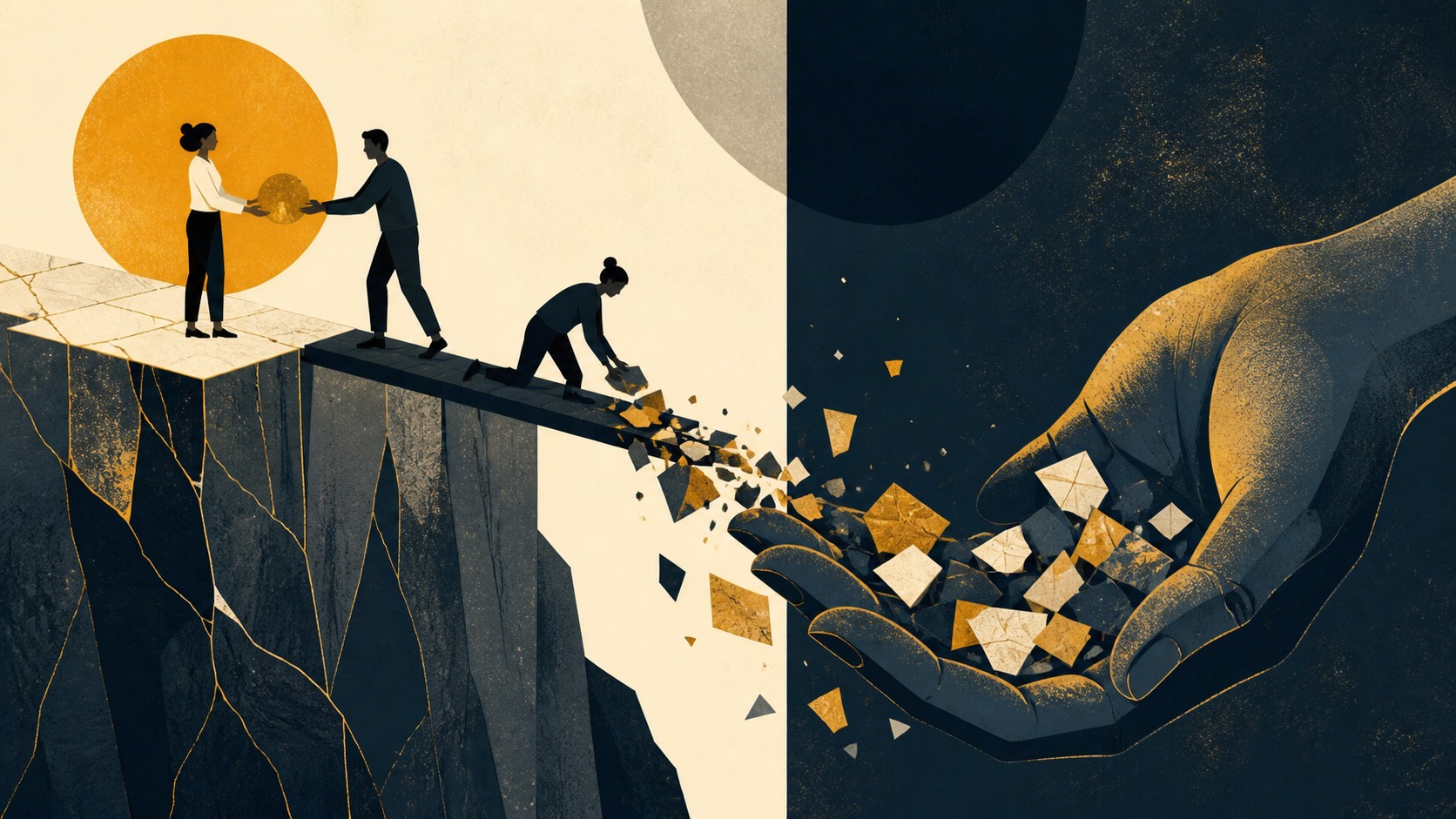
The useful question is not whether an AI tool "creates" by itself. It is what changes in the work once the tool enters the process. A team can make more drafts, images, or headlines while losing clarity about what it is trying to say. It can also use AI carefully and gain time to research, test, and edit with greater attention. The difference does not show up in a screenshot or in first-day excitement. It shows up in observable signs: the quality of decisions, the ability to explain why a piece took its final form, and the real room a person retains to correct course.
It helps to view the process as a workshop. In a healthy workshop, every tool leaves understandable traces: a brief, a selection of references, a version rejected because it missed the aim, an edit that sharpened the voice. AI can take part in several of those steps, but it should not erase the connection between brief, choice, and result. If nobody can say what problem the final text was solving, which parts were checked, or who chose the published version, the issue is not technical. It is a loss of operational authorship.
Making the context clear#
The first sign that collaboration is working is a more precise brief. Before requesting an output, the responsible person can name the audience, purpose, limits, available evidence, and rejection criteria. This does not require a ten-page manifesto. It only requires enough clarity for another teammate to understand what is being sought and notice an appealing result that does not fit. When AI use forces that frame into focus, it becomes a surface for thinking. When it replaces the frame with vague instructions repeated until something pleasant appears, it merely speeds up improvisation.
The first sign that collaboration is working is a more precise brief. Before requesting an output, the responsible person can name the audience, purpose, limits, available evidence, and rejection criteria.
A second sign is purposeful variety. Producing twenty options is not evidence of creativity; it may be a way to avoid choosing. Variety becomes valuable when the options test different decisions: one changes the point of view, another tries a new structure, another narrows an overbroad claim, another adds an objection. There should then be a reason to keep three and abandon seventeen. The reason can be short, but it needs to refer to the project's purpose rather than fascination with the tool. If every variation has the same rhythm, adjectives, and reassuring ending, a formula has been multiplied rather than a search conducted.
What changes in practice#
It also matters what happens to knowledge. AI can help organize an interview, turn a table into questions, or suggest routes for checking a claim. None of those useful roles turns an output into a reliable source. Real progress appears when the team keeps a list of statements that require verification and can distinguish confirmed facts, working hypotheses, and decorative details. That distinction is especially important in work about health, law, education, or a particular community. A smooth sentence can hide an unsupported inference. The healthy sign is not a guarantee of zero errors; it is a visible method for finding errors before they reach an audience.
Authorship is also visible in editing. Editing is not just fixing commas after automatic generation. It means accepting responsibility for the order of ideas, omissions, degree of certainty, and consequences of each sentence. A person who carries that responsibility can explain why an anecdote was removed, why an example was changed, or why a piece is not ready to publish. They can identify which material came from their own experience, what was requested from the tool, and what was added after outside verification. That account does not always need to be displayed to the public, but it should exist for the person accountable for the work.
Deciding with information#
There is a simple test for that responsibility: ask the author to reconstruct the decisive path without opening the chat. If the only answer is "the AI suggested it," a layer of judgment is missing. If they can point to the original brief, two options considered, the sources checked, and the change that made the result fit its context, there is a defensible practice. This test is not meant to turn every creative act into bureaucracy. It protects something more basic: the ability to learn from a success and to repair harm when it appears.
Another positive sign is that the tool expands participation without taking ownership of other people's voices. It can make a first outline easier for someone who is stuck, suggest ways to explain a technical concept, or help adapt material for a different audience. Yet accessibility, properly understood, calls for situated review. A community's expressions, a group's humor, or one person's experience do not become available for reuse simply because they appear in a dataset. Before using such material, ask who has standing to represent it, which simplifications would be unfair, and whether someone close to the context should review the result.
Reviewing and adjusting#
Problems usually announce themselves through small discomforts. One is loss of project memory: every request starts from scratch, nobody keeps decisions, and an important correction vanishes in the next version. Another is dependence on machine pace: pieces are published because the pipeline can make them, not because there is an editorial need. Confusing credits, an inability to locate the origin of an image, and the normalization of sentences nobody would defend in a meeting are warning signs too. None requires banning AI. Each requires pausing before speed turns a concern into a habit.
It is useful to set pause thresholds. If content affects a person's reputation, rights, or safety, it should not move ahead without identifiable human review. If personal data, recorded voices, recognizable styles, or material involving minors are used, the question is no longer only creative: it may require consent, an internal policy, and specialist advice. If a prompt repeats bias, stereotypes, or allegations that are hard to verify, the work needs someone who knows the subject and can reject the premise. Seeking help is not an admission of incompetence. It acknowledges that a general-purpose tool cannot assess situated harm on its own.
Professional support is also sensible when a team cannot answer basic questions about licensing, privacy, contracts, or transparency. Sometimes it is enough to consult a compliance lead, legal service, or accessibility specialist before a campaign launches. In other cases, an editor, researcher, or representative of the affected community should be invited in from the beginning. Help works best when requested around a concrete case: what will be published, what data enters the work, which decision is blocked, and what alternative is under consideration. Arriving with that preparation turns a defensive consultation into useful deliberation.
For everyday work, a short record can change a great deal. Before generating, note the aim, audience, what the tool must not invent, and the permitted sources or materials. During exploration, keep only versions that introduce a new decision and record why. Before publishing, check names, quotations, facts, permissions, tone, and foreseeable risks. Finally, note who approved the piece and what automated assistance was used when that information matters in context. The record is not meant to police every creative gesture. It prevents an important decision from depending on one person's memory.
The most valuable indicator may be the autonomy that remains after AI use. A process is working if the team understands its own judgment better, not if it needs to ask the tool about every future sentence. After several iterations, it should become easier to spot an excessive promise, a worn metaphor, or a gap in evidence. If the opposite happens, if vocabulary flattens and decisions are handed over through fatigue, the use needs redesigning. Reducing generation volume, separating research from drafting, and restoring a read-aloud stage are often more effective interventions than seeking a newer model.
Responsible creativity is not measured by hiding or celebrating AI. It is measured by the quality of decisions that remain human: defining purpose, selecting evidence, accepting effects, and listening to people who can reveal a blind spot. In the next project, try one concrete action. Choose one generated output and write five lines about what you would change even if the tool could not answer you. If no answer comes easily, do not publish yet: return to the brief, speak with someone who knows the context, or seek specialist review. If the answer is clear and can be supported with facts, the tool has served a valuable role without taking the place of the person whose name stands behind the work.