The conversation about artificial intelligence, images, texts and assignments is already entering many homes. It does not need to begin with an accusation or end in a blanket ban. It can help a family clarify what learning means, when assistance stops being support, and why crediting other people's work also protects one's own. Creativity does not vanish because a new tool exists; the responsibility to explain how it was used becomes more important.
Start with a specific situation#
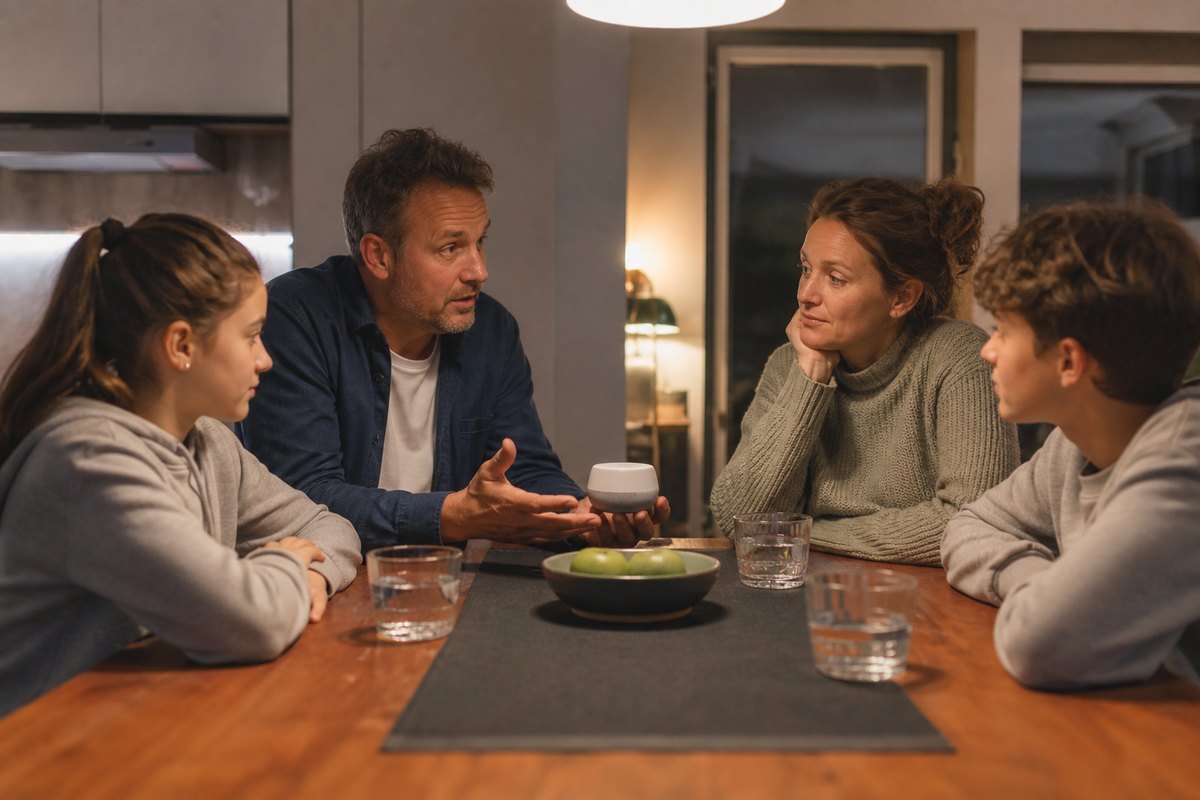
A useful conversation often starts with something small: an assignment drafted with an assistant, an image generated for a presentation, or a text shared without naming its creator. Starting there prevents absolute claims. Families can ask which decisions the young person made, which materials were consulted, what instructions were given, and what was checked afterwards. These questions are not meant to police every screen. They distinguish copying an answer from using resources to understand, organise ideas, test a draft, or improve a text.
A useful conversation often starts with something small: an assignment drafted with an assistant, an image generated for a presentation, or a text shared without naming its creator.
Authorship is a process. A student may have had the idea, selected examples, rejected errors, rewritten arguments, and checked sources even if a tool suggested an initial structure. The reverse can also happen: a person submits a result that cannot be explained. The difference is not visible only in the final file. It appears in the decisions, doubts and work that leave a trace along the way.
Assistance, substitution and deception#
Families do not need to settle every legal debate in order to set a clear household principle. Assistance is reasonable when it expands understanding and leaves the person able to explain what was done. Substitution occurs when a resource completes a task that was meant to show an individual's own capability. Deception begins when someone deliberately hides a use that a school, competition or collaboration required to be declared. This distinction supports responsibility without presenting technology as a mysterious threat.
Rules are more legitimate when they are expressed through reviewable examples. For a history assignment, asking for study questions may be acceptable while submitting generated text unread is not. For an image, experimenting from an original sketch may be legitimate, while generated elements should be disclosed. For an essay, clarity suggestions may help, but they do not replace reading sources or defending ideas. Clear examples make it easier to apply limits fairly.
Make room for listening#
The speed of new applications can make adults feel uncertain and make young people tired of being treated as dishonest before they are heard. A responsible conversation recognises both experiences. A family does not need to master every platform to ask respectfully what it offers, what data it requests, what limits it has, and why it was chosen. Nor does it need to accept that every use is unavoidable. Listening to the actual experience opens a path to agreement rather than interrogation.
Listening also includes asking about pressure around assignments. Opaque use sometimes comes from fear of falling behind, excessive workload, or the sense that only a grade matters. Understanding that context does not make deception acceptable, but it can lead to an educational response: planning, requesting teacher support, breaking down a complex activity, or accepting that a skill needs more time. Responsibility becomes more realistic when a practical alternative exists.
Authorship is more than a name#
Recognising authorship means identifying contributions, permissions and limits. Homes can build simple habits: save consulted links, note which images have licences, cite a relevant idea, distinguish original work from adaptation, and explain what received technical assistance. These habits apply to a school presentation, video, model or social post. They teach that culture is shared better when it does not erase the people who made it possible.
Not everything available online is free for any use. A visible image may have an author, licence conditions, image rights, or a context that makes reuse inappropriate. Intellectual property does not require creation to stop; it encourages people to look for authorised materials, request permission where appropriate, and provide clear attribution. WIPO and UNESCO offer helpful frameworks for understanding why creativity needs recognition as well as responsible access.
Data and privacy belong in the conversation#
Creating with an application often means handing over something: a text, voice, photograph, drawing, prompt history or information about other people. A family can agree on a protective rule: do not upload personal data, private conversations, classmates' work, or identifiable images without a clear reason and consent. Prudence is not permanent distrust. It is an understanding that an apparently free tool may store, analyse or reuse information.
It is useful to review privacy settings, age terms and a platform's policies together. When the explanation is unclear, choosing not to use it yet can be sensible. A creation does not lose value because a slower tool was chosen or because it was made without one. That message reduces pressure to join every novelty and protects the ability to choose.
Turn conflict into an agreement#
A short family agreement can include four questions before using a resource: what is being learned or created, which part will be completed personally, what information will not be shared, and how sources and assistance will be acknowledged. It is not a rigid contract. It is guidance that can change with age, task and experience. If an error occurs, the goal should be repair: review the work, inform the relevant person, remove improperly used material, and learn which warning sign was missed.
Repair is more educational than humiliation. Someone who learns that an image was used without permission or that an answer was not their own needs to understand the impact and have a concrete way to correct it. Families can support without doing the work for a young person. That combination of support and limit communicates something important: trust does not require perfection, but it does require willingness to answer for what is published or submitted.
Work with the school#
Household rules and school rules will not always match, so it is worth knowing the guidance for each activity. When a tool is allowed, simply declaring how it was used avoids misunderstandings. When it is not allowed, finding another approach is part of learning. If a rule is unclear, asking a teacher beforehand can prevent a later conflict. Conversation among family, student and school works better when nobody assumes bad faith.
Schools can also explain which competencies they want to assess: research, writing, problem-solving, oral presentation or collaboration. Families can then understand why assistance may be appropriate at one point and not another. Clarity protects both learners and evaluators. It also allows technology to support accessibility, practice or exploration without becoming a shortcut that hides a need for support.
A responsible culture of creation#
Discussing these matters does not turn a home into a monitoring office. It gives language to decisions already being made. A family that asks, listens and sets understandable limits helps creativity retain both curiosity and responsibility. Tools can expand possibilities, but they do not replace judgement about what is worth making, sharing or signing.
The most valuable conversation does not seek one final answer for every application. It seeks to ensure that each person can explain a process, recognise contributions, protect data and ask for help when a task exceeds available resources. That capacity accompanies young people and adults at school, at work and in cultural life. Responsible authorship does not reduce creativity; it gives it context, memory and trust.
Questions that keep the conversation open#
It also helps to reserve brief moments to review a decision after it has been made. A family can ask what worked, what felt uncomfortable, and what would change if the situation happened again. That review turns a rule into learning and prevents an agreement from feeling like a list of punishments. If a tool saved time but weakened understanding, the next attempt can limit it to one specific stage. If it enabled someone facing an access barrier to participate more fully, that experience deserves recognition and explanation. The standard is not technological purity; it is preserving agency, understanding and respect for other people.
A particularly useful question is whether the result can be defended without the tool present. Explaining an idea in one’s own words, showing sources, describing changes and admitting doubts strengthens trust. It also reveals when additional guidance is needed. In this way, families teach that learning includes asking for support, giving proper credit and changing a decision when better reasons appear. The conversation does not end when an assignment is submitted: it continues in the way people participate responsibly in shared culture.