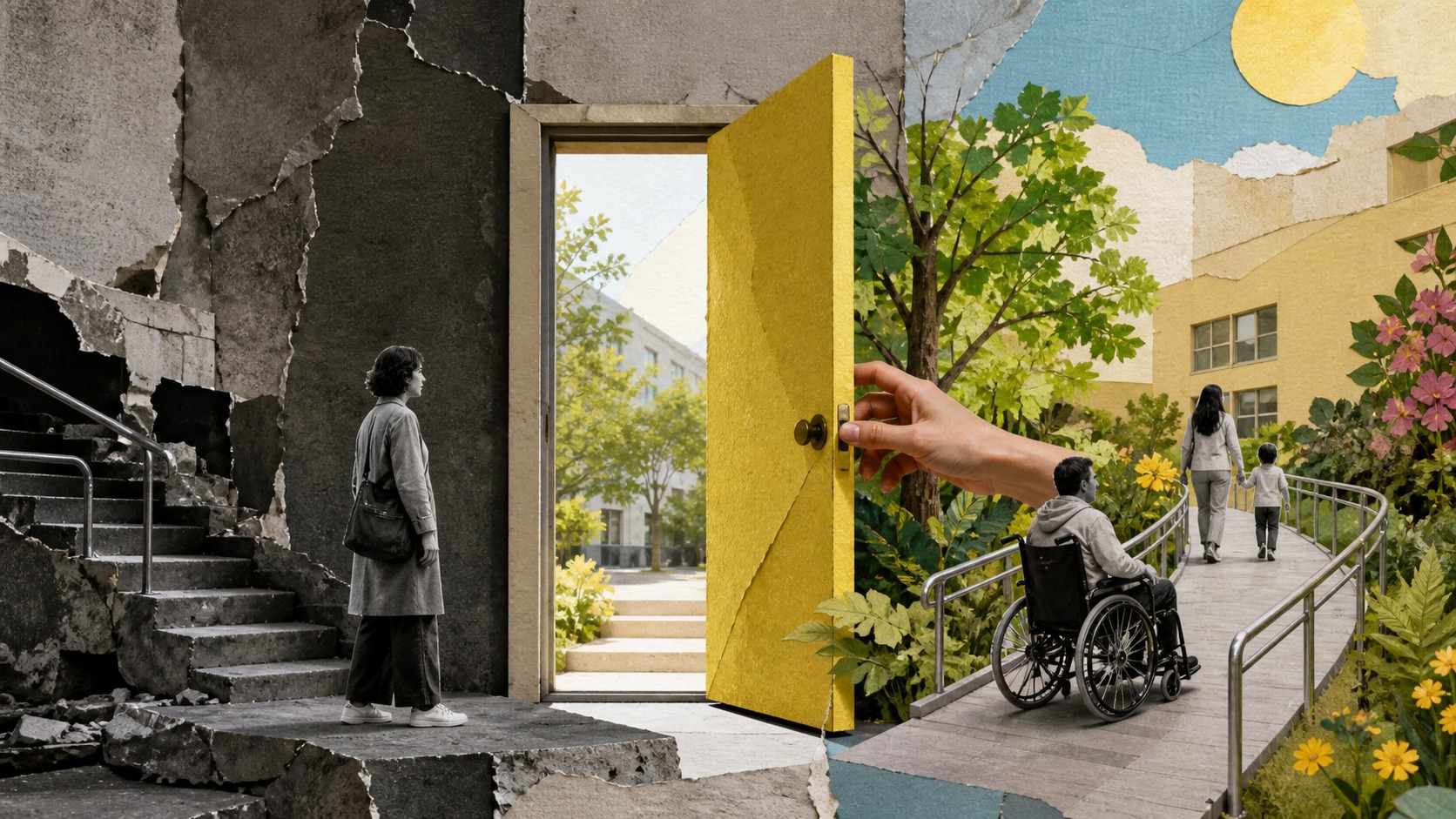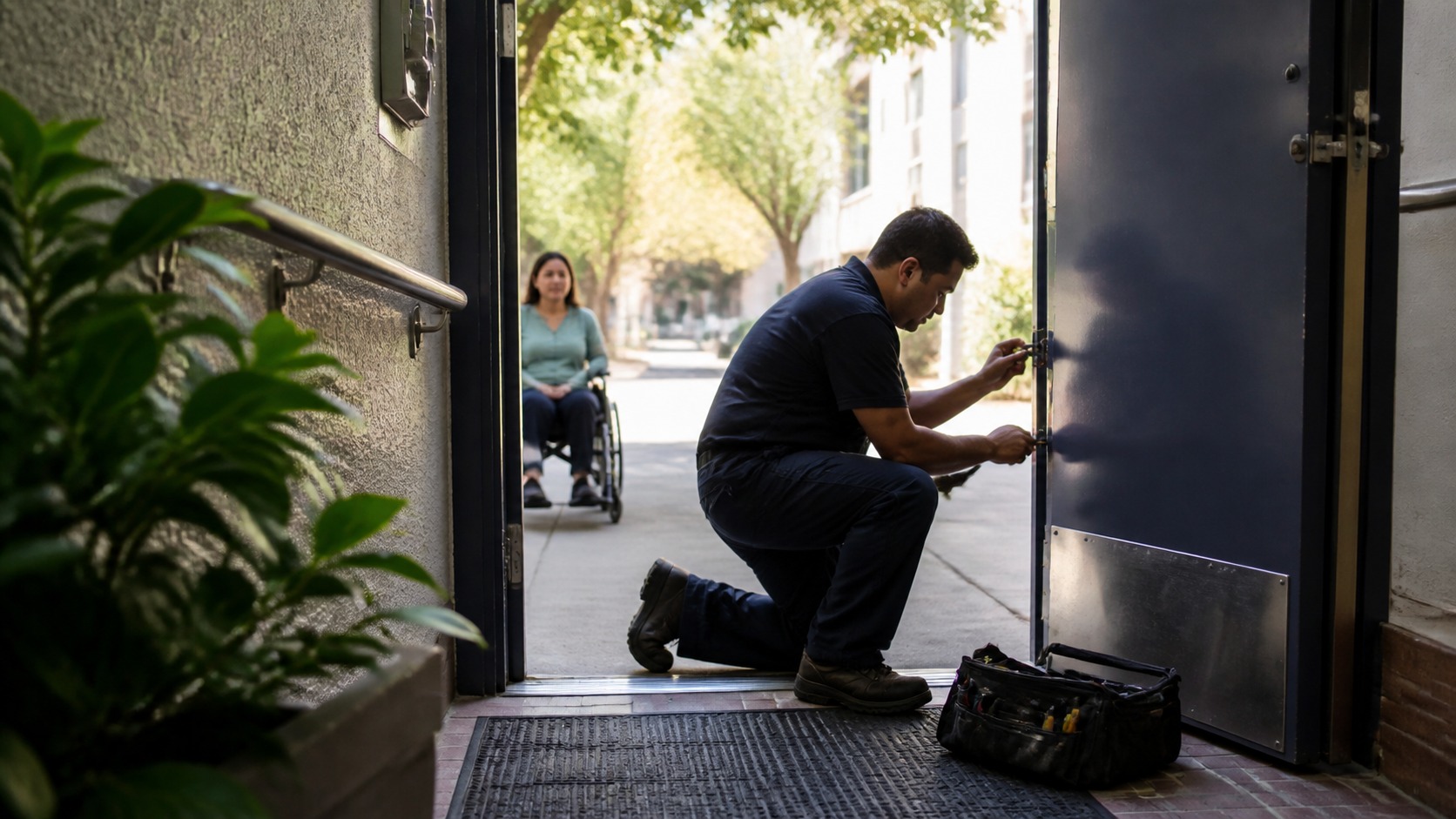
A mobility difficulty is not solved by asking a person to try harder. A short shared plan can identify the barrier, choose a reasonable adjustment, test it safely, and review what happened. These five steps offer a calm response when an activity, place, or rule is excluding someone from participation.
Participation means being present, making choices, and contributing to ordinary life. For many people with motor diversity, the obstacle is not the body but a heavy door, a route without an alternative, a rigid timetable, or information that arrives too late. This method does not replace medical, therapeutic, legal, or emergency advice. It organizes everyday conversations and decisions while respecting preferences, privacy, and the right to ask for support.
1. Pause and protect safety#
The first step is to pause before correcting, moving, or deciding for another person. Check for pain, fatigue, a fall risk, no access to an exit, or pressure to carry on. Where there is immediate danger, seek appropriate care; a participation plan must never delay an urgent response. In non-urgent situations, offering a pause, water, a seat, extra time, and the simple question “What do you need now?” often lowers tension. Safety includes consent: do not push a chair, grab a support, or handle a device without permission. Say what you notice and ask before acting. Record the place, event, and effect in brief; this is more useful than a rushed interpretation.
The first step is to pause before correcting, moving, or deciding for another person.
2. Describe the barrier precisely#
Saying that someone “cannot access” something is too vague to improve it. Describe the route and the task: three steps at the entrance, a broken lift, a table leaving a narrow passage, a meeting moved upstairs without notice, or a form that requires a painful posture. Separate facts from assumptions. Ask which part prevented participation and what alternative would be workable. Time matters too: a twenty-minute wait, a steep slope, or holding one position can be a barrier even when a venue looks accessible. Naming the exact barrier places responsibility on the environment and makes a clear request possible.
3. Listen to the personʼs priority#
The best solution cannot be guessed from outside. Ask what the dayʼs goal was: enter a building, arrive on time, speak without fatigue, use a toilet, join an activity, or return home safely. Then ask which option is preferred and which is not wanted. Some people choose physical support; others prefer an alternative route, advance information, a video call, or time to prepare. Needs are not always visible or constant. Listening does not mean transferring all responsibility to the person: the service organizer should offer real options and explain limits. A sound agreement states who will do what, when, and how it can be changed.
4. Choose a proportionate adjustment#
Choose an adjustment that addresses the barrier rather than a dramatic solution. It may mean reserving a step-free room, opening a side entrance, changing a table, sending materials early, allowing breaks, arranging agreed support, or rescheduling when accessible transport fails. Compare options: is it safe, does it enable genuine participation, does it respect the personʼs choice, and can it be maintained? Avoid arrangements that unnecessarily separate a person or demand disclosure of private details. If an organization says it cannot act, ask for a specific explanation and an equivalent alternative. The UN Convention on the Rights of Persons with Disabilities calls for removing barriers and providing reasonable accommodation.
5. Test the agreement in real life#
An agreement matters only when it works beyond paper. Test the adjustment in a visit, lesson, journey, or meeting. Decide in advance how success will be checked: time used, unplanned assistance, pain or fatigue afterward, ability to choose, and the personʼs satisfaction. During the test, one person can coordinate without speaking over the participant. If something fails, do not treat it as an ability test. Review the environment: perhaps a key was missing, notice came late, furniture moved, or nobody knew the agreement. Prompt correction prevents one poor first attempt from becoming an excuse to abandon an adjustment.
Concrete cases for practice#
Case 1: Lara reaches a municipal workshop and finds bins blocking the ramp. The goal is not to “get up somehow,” but to attend on time and with dignity. The coordinator clears the route and agrees a maintenance review. Case 2: Pau must sign in an office at a high table that causes pain. Staff offer a low table and a seated completion option, then add it to the procedure. Case 3: Amina uses adapted transport for a school meeting, but the time changes without notice. The school offers remote access and establishes advance alerts. In all three cases, the excluding condition changes; the expectation that a person should endure it does not.
Document without invading privacy#
Documentation is for learning and, where needed, making a complaint, but it must protect privacy. Keep the date, activity, barrier, requested adjustment, response, outcome, and next review. You do not need diagnoses, photographs, or clinical details to explain that a corridor was unusable. Ask permission before sharing the case and limit access to those who need to resolve it. A short record reveals patterns: lifts without maintenance, repeated timetable changes, unsigned routes, or meetings in inaccessible rooms. It also shows what works. When escalating a concern, retain communications and request a written reply, keeping the account factual and focused on the right to participate.
When specialist support is needed#
Seek specialist support for persistent pain, a fall, sudden mobility changes, severe fatigue, violence, repeated discrimination, or a technical need the setting cannot resolve. Health and rehabilitation professionals can assess risks; social services, disability organizations, and accessibility offices can advise on resources and rights. In Spain, the Real Patronato sobre Discapacidad and CERMI provide information and networks. In education, work, and community settings, early advice prevents an improvised adaptation from creating new barriers. The person chooses what information to share and with whom; expert support adds to, rather than replaces, their voice.
Sources for continued learning#
The World Health Organization explains disability through the interaction between health conditions and environmental barriers. The UN Convention recognizes accessibility and reasonable accommodation as conditions of equality. WHO and UNICEF offer inclusion resources, while the European Commission publishes guidance on accessibility and rights. Local rules and services matter as well: a general standard cannot replace knowledge of a particular building, transport system, or community. Naming sources does not turn the plan into bureaucracy. It lets decisions rest on checkable standards rather than occasional favors, and it gives organizers a credible starting point for sustained improvement.
A review that sustains participation#
Close the cycle with a short conversation: was the goal reached, what cost too much, what should remain, who will review the agreement, and when? Celebrate that an adjustment enabled participation, but do not assume accessibility is complete because one occasion went well. People change, spaces are rearranged, and teams are renewed. Adding the agreement to normal planning, naming responsible people, and preparing an alternative keeps the solution alive. The five steps work when they are repeated with respect: pause, describe, listen, adjust, and check. Participation then stops depending on improvisation or one personʼs goodwill.
Preparing the next occasion#
Before an important activity, prepare a one-page note with the chosen goal, known barrier, two alternatives, responsible contact, and review time. For a medical visit, agree a quieter appointment, a step-free entrance, and a phone number for reporting delayed transport. For training, reserve a table with space, share slides early, and identify a quiet place for a break. The note is shared memory, not control: it prevents repeated explanations and turns broad promises into observable decisions. Afterwards, ask what helped, what felt uncomfortable, and what should change next time.
Before an important activity, prepare a one-page note with the chosen goal, known barrier, two alternatives, responsible contact, and review time. For a medical visit, agree a quieter appointment, a step-free entrance, and a phone number for reporting delayed transport. For training, reserve a table with space, share slides early, and identify a quiet place for a break. The note is shared memory, not control: it prevents repeated explanations and turns broad promises into observable decisions. Afterwards, ask what helped, what felt uncomfortable, and what should change next time.
Before an important activity, prepare a one-page note with the chosen goal, known barrier, two alternatives, responsible contact, and review time. For a medical visit, agree a quieter appointment, a step-free entrance, and a phone number for reporting delayed transport. For training, reserve a table with space, share slides early, and identify a quiet place for a break. The note is shared memory, not control: it prevents repeated explanations and turns broad promises into observable decisions. Afterwards, ask what helped, what felt uncomfortable, and what should change next time.
Before an important activity, prepare a one-page note with the chosen goal, known barrier, two alternatives, responsible contact, and review time. For a medical visit, agree a quieter appointment, a step-free entrance, and a phone number for reporting delayed transport. For training, reserve a table with space, share slides early, and identify a quiet place for a break. The note is shared memory, not control: it prevents repeated explanations and turns broad promises into observable decisions. Afterwards, ask what helped, what felt uncomfortable, and what should change next time.
Before an important activity, prepare a one-page note with the chosen goal, known barrier, two alternatives, responsible contact, and review time. For a medical visit, agree a quieter appointment, a step-free entrance, and a phone number for reporting delayed transport. For training, reserve a table with space, share slides early, and identify a quiet place for a break. The note is shared memory, not control: it prevents repeated explanations and turns broad promises into observable decisions. Afterwards, ask what helped, what felt uncomfortable, and what should change next time.