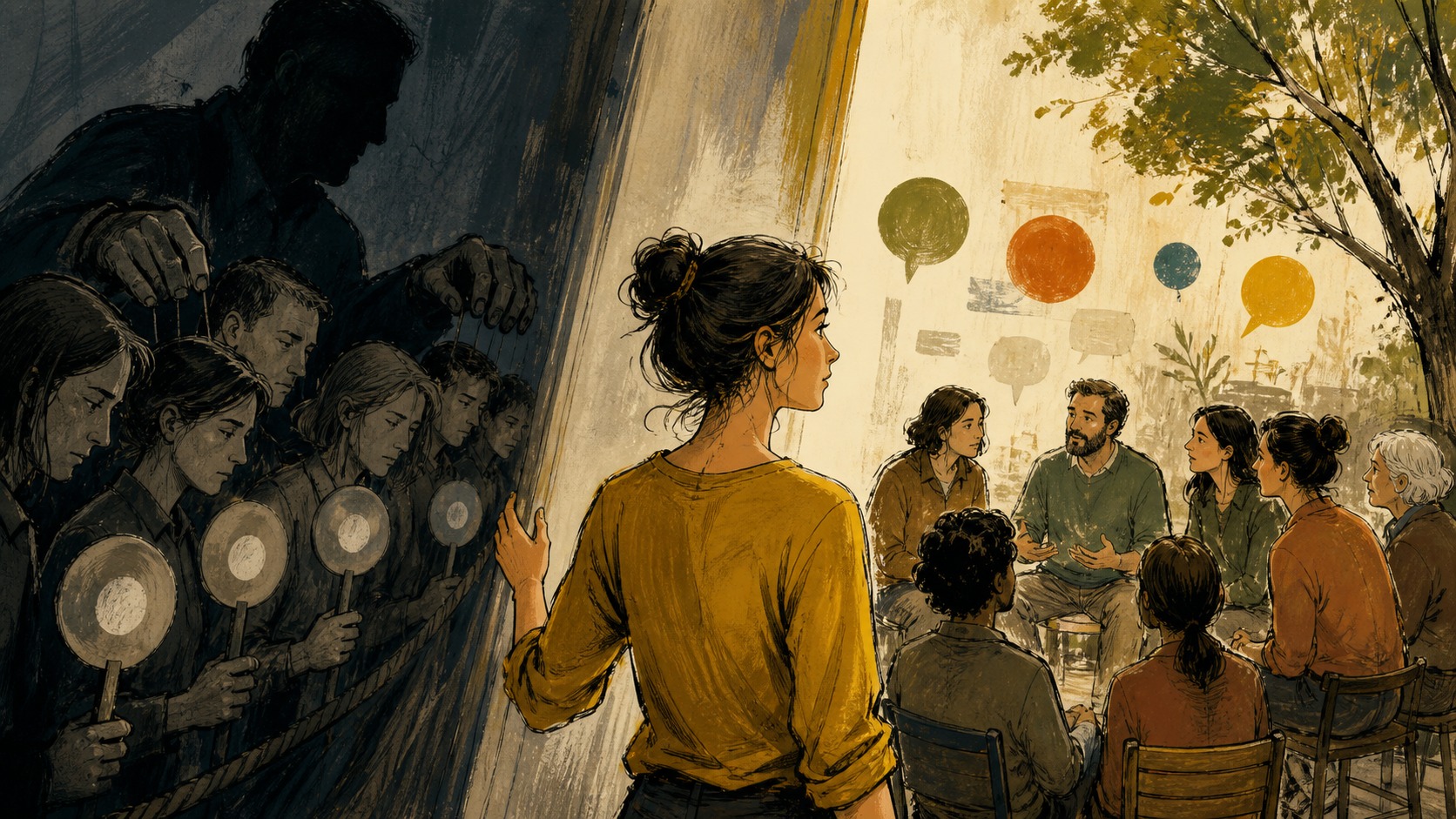
Care networks involving grandparents often fail at the handoff rather than in the relationship. A family changes a schedule, a school follows an older authorisation, or a community programme assumes transport exists. Practical agreements connect those separate systems without making a child carry messages or expecting a grandparent to solve every gap. This guide shows how to define a shared outcome, assign ownership, limit information, fund the work and review the effect. Its cases cover language access, an unexpected school closure and accessible transport to a club. Immediate danger, suspected abuse or neglect, or an acute health event requires the appropriate emergency, healthcare or safeguarding response.
Define one shared outcome before discussing solutions#
Partners coordinate better when they can describe what success looks like. “Support Maya” invites several interpretations. “Maya will attend the parent meeting with an accredited interpreter, while her grandfather receives the pickup instructions in Spanish by Tuesday” identifies people, action and time. The outcome should concern safety, participation, attendance, learning or caregiver sustainability. It should not demand that every institution solve every family difficulty.
Partners coordinate better when they can describe what success looks like. “Support Maya” invites several interpretations.
Children need a meaningful route into the decision. They can describe what confuses them, what feels safe and which explanation they want peers to hear. They do not arbitrate adult disagreements. UNICEF guidance on adolescent participation emphasises voluntary, safe and meaningful involvement. Adults therefore explain why information is requested, avoid promises they cannot keep and report back after the meeting.
Distinguish legal authority from practical contribution#
A grandparent may complete most daily tasks while a parent retains consent authority and a school controls access. A community provider may supervise an activity but not travel. Write each layer separately: who decides, who performs, who confirms and who substitutes. This prevents a familiar person being treated as automatically authorised and prevents professionals assuming that the person at the school gate can change a health or education plan.
Contribution also has conditions. A grandfather may collect in daylight but avoid night driving; a parent may answer at lunch but not during a shift; a club may offer a place but lack one-to-one support. The World Health Organization describes functional ability as an interaction between a person and the environment. Distance, stairs, timing, information and recovery matter alongside individual health.
Case 1: a child translating the adults' agreement#
Twelve-year-old Maya lived with her mother and spent afternoons with her grandfather Luis. School messages were in English, which Luis read slowly. Maya translated reminders and, during a meeting about attendance, was asked to explain the school's concern to him. She softened parts that sounded critical and omitted a proposed timetable because she feared upsetting him. The teacher believed the family had agreed; Luis thought the schedule was only a suggestion; Maya felt responsible when the next pickup was missed.
The school arranged an accredited interpreter and stopped using Maya for consequential communication. Her mother retained education decisions; Luis received a short translated schedule and confirmed pickups directly; the attendance lead owned follow-up. Maya attended the portion about her experience, then left while adults allocated tasks. For four weeks they tracked attendance and acknowledgements. The missed handoffs ended, and Maya no longer had to choose which adult message to alter.
Share the least information needed for the role#
Coordination is not permission for unlimited disclosure. A school may need authorised contacts and a relevant adjustment, not details of financial conflict. A transport provider may need mobility requirements and destination, not an entire clinical history. Before sharing, identify the purpose, recipient, source and expiry date. Remove obsolete documents so that a grandparent is not given two competing plans.
Health instructions should come from an authorised clinical plan, not relatives' summaries. Caregivers need warning signs, permitted actions and escalation routes. The American Academy of Pediatrics provides resources for grandfamilies, whose daily caregiving arrangements can create particular access and coordination questions. Clear documentation helps a caregiver act safely while respecting the boundary between carrying out and changing care.
Turn meetings into decisions with owners#
A thirty-minute meeting can be enough if the invitation contains one question and the right participants. Begin with the outcome, review verified facts and list constraints. Convert discussion into actions. “The community centre will assist” becomes “the coordinator will confirm a Tuesday place by 3 p.m. Friday.” “The family will arrange collection” becomes named primary and backup adults with an authorisation deadline.
One person facilitates and another records. At the end, read each action, owner, channel, date and fallback aloud. Everyone confirms capacity rather than agreeing from embarrassment. New issues go to a separate list. The child receives a plain-language summary and knows whom to contact. A half-page decision record is more dependable than a long message thread because missing ownership becomes visible.
Case 2: a school closure that exposed an imaginary backup#
Heavy snow closed Evan's school at noon. His mother worked in a secure laboratory and could not check her phone. Grandmother Joan was listed as the emergency contact, but buses had stopped and she lived across town. The school called an uncle whose number was outdated, then asked Joan to arrange someone nearby. She contacted several neighbours while Evan overheard staff say that nobody knew who was coming. He remained supervised, but the nominal plan had no usable person.
Afterwards the family mapped location and availability, not just kinship. A nearby parent became an authorised first backup; Joan remained the coordinator only when transport operated; the mother arranged a workplace emergency route; the school agreed which channel signalled closure. They rehearsed with a non-urgent early-finish day. Evan learned the waiting location and two names. The next alert was acknowledged within ten minutes, demonstrating that a backup must be reachable, authorised and physically able to act.
Connect community resources through verified commitments#
Libraries, clubs, faith groups, mutual-aid networks and municipal services can widen a care network. Before adding one to the plan, verify eligibility, supervision, cost, accessibility, safeguarding, hours and closures. Identify a contact and the limits of the offer. A homework club may support learning but not provide transport; a volunteer driver may require advance booking; a sports programme may not administer medication.
OECD work on long-term care examines interaction between formal and informal support. The principle applies here: affection cannot supply every specialist task, funded place or hour of respite. Formal resources provide defined capacity; relatives provide connection and practical care; public services retain professional duties. Effective coordination joins these contributions without pretending they are interchangeable.
Build ordinary and urgent communication routes#
Different messages need different channels. Planned schedule changes can use a portal or email; same-day disruption needs a call or acknowledged message; immediate danger uses emergency procedures. If every update goes to a large family chat, urgent content can disappear and privacy is weakened. The agreement says who initiates, who confirms and when silence triggers the next person.
Sending is not completing. A closed loop ends with a specific acknowledgement: “Received; Joan collects at 4:15 from reception.” Grandparents should not coordinate several adults while supervising a child. One designated adult consolidates updates. Children may know the simple plan, but they do not relay authorisations or conceal a caregiver's difficulty to keep arrangements running.
Make money, time and recovery visible#
Care agreements consume bus fares, meals, activity fees, mobile data, hours and physical recovery. When these remain invisible, a plan can appear successful while a grandparent uses debt or abandons healthcare. Record recurring child-related costs for a short period and decide what is reimbursed, prepaid or optional. Voluntary gifts remain possible, but routine provision should not depend on them.
The US Centers for Disease Control and Prevention describes physical and emotional effects of caregiving. Agreements therefore include rest and review triggers: persistent pain, disrupted sleep, missed appointments, irritability or repeated cancellation. Saying “I cannot do Thursday” should activate a named fallback rather than a test of devotion. Sustainable care protects the relationship by removing the need to hide strain.
Case 3: accessible transport that existed only on paper#
Grandfather Peter took his grandson Caleb, a wheelchair user, to a robotics club. The municipal booking system listed an accessible vehicle, but pickup windows varied by forty minutes. Peter waited outside because the building locked after the club ended, and transferring equipment increased his back pain. Caleb loved the programme and resisted discussing transport because he feared losing his place. The club saw regular attendance and assumed the arrangement worked.
The shared outcome was continued participation without unsafe waiting or lifting. The club provided indoor waiting and stored the equipment; the family booked transport earlier; another parent covered one return each month; Caleb's mother owned escalation when a vehicle exceeded the window. Peter continued accompanying twice monthly instead of weekly. They tracked delays, pain and missed sessions for six weeks. Attendance remained high and Peter recovered by the following day, so the plan was maintained with a revised winter pickup time.
Write a one-page, versioned agreement#
The page begins with outcome and trial period. A table lists action, owner, supporter, deadline and backup. A communication box lists channels and acknowledgement times. A safety box contains current contacts, relevant authorisations and stop rules. The footer has review date and version number. Vague language such as “as needed,” “someone” or “the family” is replaced by observable commitments.
The agreement should anticipate common failures: illness, closure, transport disruption and a missed message. Backups are consulted before being named. The group tests the plan with an ordinary event and corrects unrealistic travel times or permissions. Superseded versions are removed from school bags, phones and service records. Version control is mundane, but it prevents a familiar instruction from becoming an unsafe one.
Use stop rules before pressure changes judgement#
Stop rules identify when an assignment pauses or professional advice is needed: a second unexplained fall, contradictory medication instructions, sustained fear, two missed school days or fatigue without recovery. They are agreed during a calm period so nobody bargains during a crisis. Pausing one task does not automatically end contact. Another adult may supervise while assessment or redesign takes place.
A stop rule can also protect the child from adult conflict. If a disagreement becomes hostile, the meeting ends and a designated person communicates the temporary arrangement. If safeguarding information emerges, relatives do not conduct their own inquiry. They preserve the account and follow local duties. The agreement supports ordinary coordination; it never replaces emergency, clinical, legal or protection pathways.
Review outcomes, displaced burdens and the child's experience#
At the review, ask whether the stated outcome was achieved, what new burden appeared, whether the backup worked and what the child experienced. Use small facts: acknowledgements, attendance, costs, delays, pain and recovery. Data should invite questions, not grade generosity. A plan that meets the schedule because a grandmother silently pays every fare still needs revision.
The options are maintain, adapt or stop. The child receives a clear update; schools and services receive only the revised portion they need. Good coordination usually creates fewer messages, clearer boundaries and earlier requests for help. Families, schools and communities need not share every perspective. They need a common result, accountable owners, proportional information, a real fallback and permission to learn. Those elements turn trust from an assumption into a practice that can survive disruption.