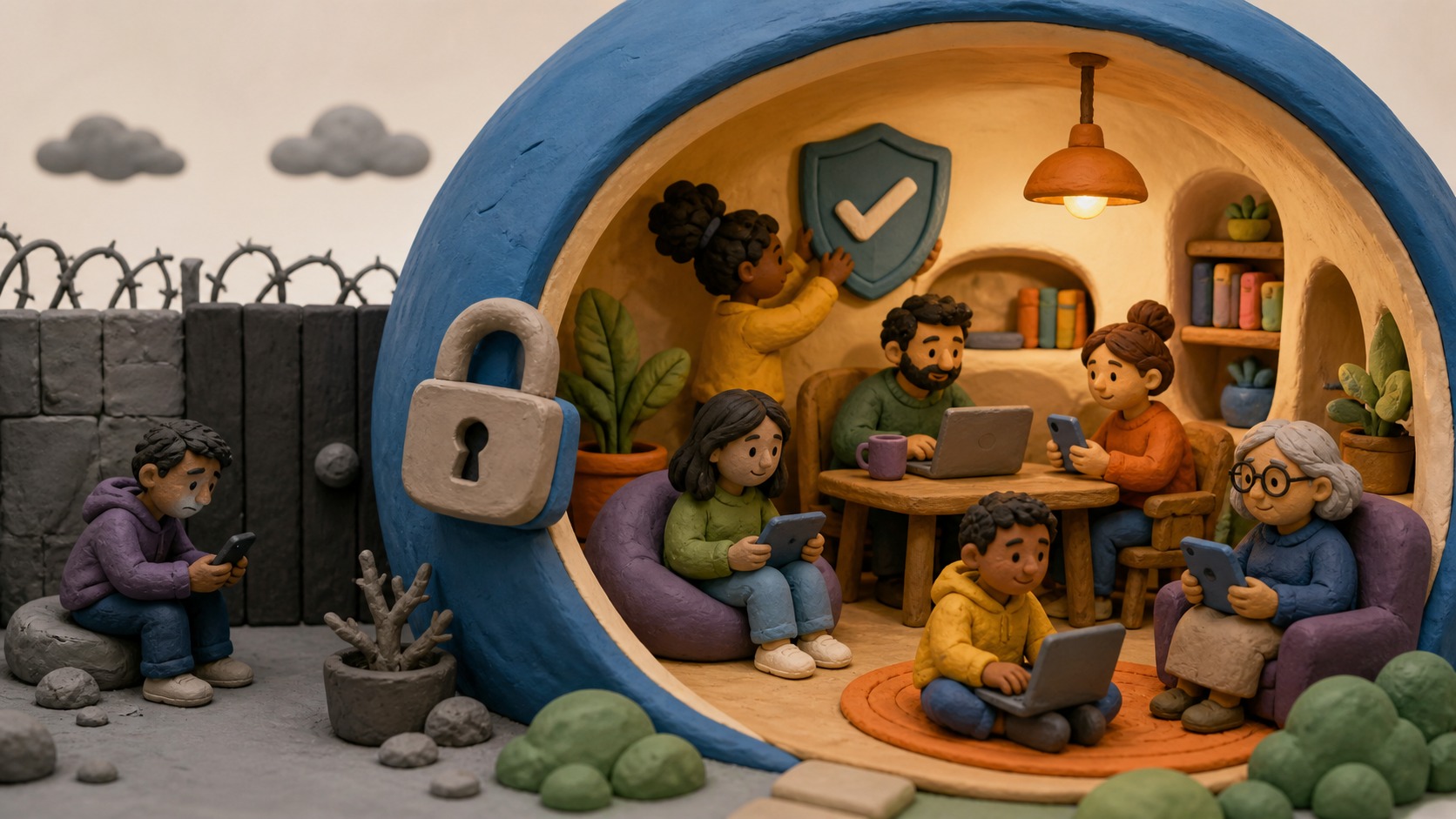
A useful preschool behavior agreement is not a demand that every home, classroom and community program become identical. It is a compact promise about safety, understandable communication, adult roles and review. Without that promise, a tantrum can trigger conflicting instructions, repeated phone calls and arguments about blame. With it, each setting keeps its character while the child encounters a recognizable path through a hard moment. This guide shows how to build practical coordination without turning the child into a diagnosis, sharing more private information than necessary or expecting a young child to manage the adults.
Choose one routine worth coordinating#
Start with a scene that different people can recognize: pickup, a shared-material activity, screen shutdown or entry into a vehicle. Describe what happens before, what the child does and what could be harmed. “Runs toward the parking area when pickup changes” supports planning; “has no boundaries” does not. A narrow routine also makes it possible to test whether the agreement helps rather than debating a child's whole personality.
Select an observable first goal, such as staying beside an adult, keeping objects below shoulder height or presenting a break card. Do not make cheerful compliance the outcome. Anger and crying can continue while safety improves. The World Health Organization frames responsive care and safety as foundations for early development. That supports goals based on participation, protection and learning rather than fear.
Map the people and their actual responsibilities#
List only people who have a role: a family contact, classroom lead, transport worker or program supervisor. Name who gives advance notice, who supports the child, who checks on anyone hurt and who contacts the family. “Everyone will be consistent” sounds reassuring but assigns nothing. Include substitutes and after-hours arrangements so the plan does not disappear when one trusted adult is absent.
The child is responsible for practicing an age-accessible skill, not for carrying messages between adults. A sibling is not a monitor. Adults arrange communication and keep sensitive conversation away from the child. One person holds the current version of the agreement; another can update it if needed. Obsolete copies are removed so a relief teacher does not follow instructions that the team abandoned months earlier.
Write a one-page working agreement#
The page can have seven boxes: routine, early signals, strengths, preventive support, safety boundary, replacement skill and review date. Add one lead contact for each setting. Use verbs and observable descriptions. A substitute should understand the page in two minutes without needing a complete case history. Clinical records and family narratives belong elsewhere and should be shared only when there is a defined need and appropriate consent.
Include what already works. Perhaps the child follows pictures, accepts help from a particular position or recovers through movement. A document containing only incidents primes adults to detect danger everywhere. Strengths point toward interventions and preserve a fuller view of the child. Date the page and label its version. A plan without an expiry or review point can become an enduring label long after the routine has changed.
Agree on a small communication kit#
Choose one protective phrase, one direction and one request the child can use. Examples are “I won't let bodies get hurt,” “walk beside me” and “break, please.” Words may vary slightly across settings, but the expected action should remain recognizable. Pair speech with a picture, sign or communication device when appropriate. The kit must be available during the difficult routine, not locked in an office.
The CDC guidance on effective directions recommends gaining attention, being specific, using a neutral tone and presenting one action at a time. Adults can rehearse their lines and remove false choices. Asking “Are you ready to leave?” invites a decision that may not exist. “We are leaving; carry your bag or hold my hand” states the boundary and offers two genuine routes through it.
Keep the first meeting short and evidence-minded#
A twenty-minute agenda can cover strengths, one recent example, a working hypothesis, one prevention, one response and assigned tasks. Separate observation from explanation. “The episodes occurred after three noisy lunches” is evidence; “she wants control” is an interpretation. Hypotheses can guide a trial, but they should not be written as facts or used to close off health, communication and environmental questions.
The Center on the Developing Child describes executive-function skills as capacities built through experience and support. Waiting, shifting attention and inhibiting an impulse therefore require practice, not just stronger adult commands. The meeting should finish with a small safe trial and a review date. It should not finish with a catalogue of every strategy anyone has ever heard of.
Plan for adult regulation and relief#
Coordination fails when it assumes that adults will always be calm. Include a relief signal and identify who can step in. In a classroom, one worker may support the child while another moves peers. At home, one caregiver may take over while the other drinks water and resets. If no relief is available, the plan prioritizes fewer words, greater distance from hazards and a call for support when safety is deteriorating.
Adult repair belongs in the agreement. If someone shouts, they can later say, “My voice was frightening. The boundary still matters, and I will state it more safely.” This does not surrender authority. It models accountability and separates a necessary limit from an unnecessary harm. The child is never asked to reassure the adult or accept blame for the adult's loss of control.
Case 1: an unpredictable preschool pickup#
Four-year-old Amir ran down the hallway whenever a different relative collected him. School thought the family needed firmer rules; relatives thought staff provided too little notice. They replaced blame with a sequence. Staff show a three-picture strip five minutes before pickup. The collector waits at one marked location. If Amir runs, the nearest adult blocks the exterior door and says, “We walk together.”
Amir can carry his folder or hold a hand. Crying does not cancel the boundary, and sweets are not offered for silence. The family practices the same picture sequence with toys. For two weeks, they record safe exit and a rough recovery band. Tears still occur, but access to the parking lot stops. At review, the team keeps the sequence and lets Amir place the final picture in his pocket.
Case 2: hitting at a neighborhood playgroup#
Three-year-old Rosa hit when another child touched her animal figures. Her parent returned the toy to end the conflict, while the playgroup leader removed the entire set. They agreed on one response: create space between bodies, say “safe hands,” briefly rest the item used to hit and offer “turn” or “help” cards. The playgroup added two work mats to clarify space without promising exclusive possession of all toys.
After recovery, Rosa helps check on the other child or restore the activity; she is not forced to apologize on command. Her parent carries copies of the cards. Staff note injuries and card use rather than reporting every complaint. Over three weeks, requests begin to occur before some hits. The result comes from accessible communication, clearer space and consistent protection, not from proving which adult's original response was correct.
Case 3: device endings across two homes#
Five-year-old Theo had different screen schedules in two homes. The schedules themselves were manageable; sudden endings and prolonged bargaining were not. Adults agreed on a visible timer, one announced final action and a docking place. Each household kept its own duration and next activity. The shared safety rule was that devices are not thrown, hidden or chased through the room.
At the timer, the adult says, “The program is finished; dock it or hand it to me.” Extra minutes are not exchanged for quiet. Later, Theo practices closing the app. The American Academy of Pediatrics offers guidance on screen-related tantrums and predictable media limits. Review shows that a common ending routine helps even though the two homes remain different.
Share the minimum information needed#
Coordination is not blanket permission to distribute diagnoses, videos or family circumstances. Each recipient should need the information for a defined task. “Poor sleep may lower capacity today” can be sufficient; details of an adult conflict may not be. Before health or educational records move between services, responsible adults review consent, applicable rules and purpose. Trust is a functional part of coordination, not merely courtesy.
Use neutral notes: “threw two blocks after cleanup was announced and returned after the break card” rather than “had an awful meltdown.” Do not record a crisis to prove wrongdoing. If observation is professionally required, establish a respectful process. Correct inaccurate records and retain notes only as long as they answer a current question. A child's hardest moments should not become a permanent informal archive.
Track enough to make a decision#
Four columns often suffice: routine, safety level, support used and recovery band. Add whether the planned prevention actually occurred. Otherwise, a team may declare a visual cue ineffective when nobody presented it. Short, medium and long estimates are usually more sustainable than exact timing. Count replacement attempts, even when the child still cries afterward. The purpose is to guide adjustment, not create a behavior score.
Review patterns weekly. Progress may mean fewer injuries, earlier requests, faster return or less adult strain, even if frequency rises during a stressful transition. Change one element at a time unless immediate danger requires more. Stop recording when the question is answered. Data should shorten uncertainty and support conversation; it should never replace the child's perspective or become a public chart among classmates.
Handle disagreement without an authority contest#
When family and school disagree, return to sequence and context: what happened, what preceded it, what each adult did and what safe outcome both want. “It never happens here” signals a useful environmental difference. Noise, group size, task complexity, hunger or relationship may change behavior. Variation does not prove that one setting is truthful and another incompetent. It creates a comparison that can improve the plan.
UNICEF's positive-discipline guidance emphasizes teaching, clear expectations and durable solutions. That common ground excludes humiliation, physical punishment and unrelated penalties. If two safe approaches remain plausible, test the simpler one for a defined period. End the meeting with a decision, named owner and date rather than a polite but unusable list of competing preferences.
Give the child voice without transferring the burden#
Invite participation during a calm time. The child can choose between two break symbols, identify a less overwhelming waiting place or act out the routine with figures. Their response informs accessibility. It does not make them responsible for deciding road safety or mediating adult disputes. Do not demand a promise to “never get angry again”; that is neither measurable nor within a preschooler's full control.
Keep augmentative communication available throughout conflict and never remove it as punishment. Acknowledge a specific attempt: “You showed help before pushing.” Do not display the tracking sheet to peers or compare siblings. The child needs a usable role in learning, not the roles of messenger, case manager or emotional caretaker. Dignity is part of whether an agreement works.
Know when the agreement needs more support#
Seek pediatric, developmental, mental-health or educational input when episodes cause repeated injury, last unusually long, involve lost skills, coincide with pain or sleep changes, or increasingly exclude the child from ordinary activities. Bring examples and tried supports without assigning a diagnosis. Assessment may consider communication, hearing, health, stress and environment. The coordination plan can continue while advice is pending if it remains safe.
The American Academy of Pediatrics recommends discipline that teaches through clear limits and calm consequences and rejects humiliating or violent methods. For serious injury, breathing difficulty, loss of consciousness or danger adults cannot contain, use local emergency services. The plan should say who calls and who stays with the child. Escalating appropriately is competent teamwork, not failure.
Review, simplify and eventually retire the planThe bridge does not erase their differences; it gives the child enough predictability to remain safe, learn a replacement skill and return to relationship.
#
The bridge does not erase their differences; it gives the child enough predictability to remain safe, learn a replacement skill and return to relationship.
At the review, retain supports that reduced risk, remove tasks nobody could perform and alter one component. When the skill appears across settings, reduce tracking and practice within ordinary routines. Do not keep a special plan active merely because paperwork exists. Archive old versions under applicable rules and tell the family about progress, not only incidents. Successful coordination should gradually require less coordination.
Five questions can test readiness: What are we protecting? What warning or prevention do we provide? Which phrase and alternative can the child recognize? Who acts and communicates? When do we review or call for more help? Clear answers create a bridge across family, school and community. The bridge does not erase their differences; it gives the child enough predictability to remain safe, learn a replacement skill and return to relationship.