The first question must come before the tool. Before the first click, define the purpose and ask who authored the material, what cultural meaning it retains, whether consent exists and how another persons work will be acknowledged. A tool may accelerate a draft, image or voice, but it cannot settle those duties by itself. Recording purpose, materials, restrictions, accountable person, attribution and a correction route supports professional judgment. A fast result does not make it acceptable to extract memory, identity or work without permission.
This issue of participation appears in formalities, classrooms, sports activities and jobs. Uniforms and schedules change, but the same tension is repeated: we seek to offer understandable routes and equivalent alternatives and we can end up weakening participation in dignified conditions.
In “Asking before creating protects purpose and recognition”, an improvement only counts if it retains voice, context and ability to correct.Applied to the accessibility of digital services from a participatory perspective, this criterion requires that you write the purpose before choosing the function and recognize from the beginning what damages would not be acceptable.
Asking before creating protects purpose and recognition#
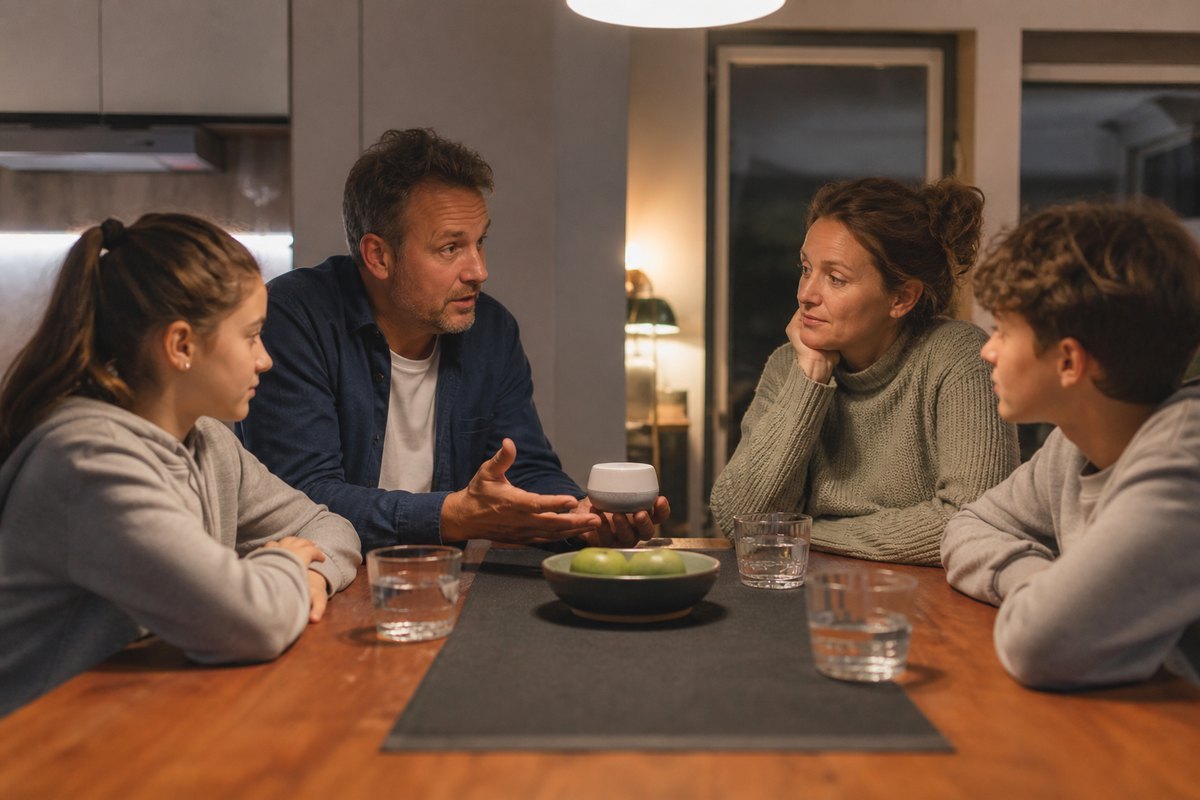
Imagine a scene of participation in Creativity, culture and authorship: the decision was almost closed when young people, families and professionals were invited to a meeting without the capacity to modify it. No need to seek absurd behavior.
Imagine a scene of participation in Creativity, culture and authorship: the decision was almost closed when young people, families and professionals were invited to a meeting without the capacity to modify it.
In Creativity, culture and authorship, the diagnosis of participation is that the consultation came late and turned valuable experiences into a formality. The last visible action rarely explains everything. The diagnosis improves by identifying decision, information gaps and real margin.
It is also important to separate intention, design and consequence when studying participation in the accessibility of digital services. The intention may be to offer understandable paths and equivalent alternatives; design can reward speed or comfort; and the consequence may result in abandonment, dependence and exclusion that does not appear in statistics.
The experiences of people with different capacities, ages, languages and resources provide different perspectives when analyzing participation. In Creativity, culture and authorship, use, maintenance, care and direction must provide their different evidence.
Before measuring the results of “Asking before creating protects purpose and recognition — when the journey does not serve everyone: Creativity, culture and authorship” we must define what counts as improvement. To “Participate changes the question and improves the answer”, I would observe time, errors, abandonments, differences and the exact point where someone was left out.
In Creativity, culture and authorship, the exception reports on the actual design limit; it is not a statistical nuisance.If the path of accessibility of digital services related to participation only works with good connection, calm, prior knowledge or help to family, that condition must be stated. Before “Asking before creating protects purpose and recognition”, a responsible organization distinguishes barrier resistance.
Practical test: Creativity, culture and authorship#
In terms of Creativity, culture and authorship, when reviewing participation, the priority intervention would be to incorporate people before choosing, compare alternatives and publish what inputs changed the decision. You can start in a small part of the proceedings, classrooms, sports activities and jobs, without turning the whole community into involuntary participants in a test.
To address participation in Creativity, culture and authorship, the first week would describe the current state. The third, to observe a common and difficult case. The fourth moment requires to continue with criteria, correct or stop.
The participation test must include a failure related to the accessibility of digital services. To test it calmly allows checking phones, permissions, language and times before abandonment, dependence and exclusion that does not appear in statistics becomes an urgency.
Addressing participation also requires a decent alternative. In Creativity, culture and authorship, having an alternative protects those with the least resources and offers an honest comparison of the real value of the main solution.
The communication of “Asking before creating protects purpose and recognition — when the journey does not serve everyone: Creativity, culture and authorship” can fit into one page: what it is used for, what it will not do, what information it intervenes, how long it will last, who responds and how to ask for revision.
Responsibility: Creativity, culture and authorship#
In Creativity, culture and authorship, monitoring requires authority to pause, explain and repair.In the case of accessibility of digital services and their dimension of participation, it is not enough to place a person at the end of an automatic chain. He needs access to evidence, time to listen and real ability to change the rule when it damages participation in dignified conditions.
For young people living in the accessibility of digital services, the message in addressing participation should not be “more careful” as the only defense.
When addressing participation, families, teachers, trainers and business leaders should remember that accompanying does not amount to controlling each movement. It means agreeing boundaries, explaining reasons, observing changes and accepting that autonomy must grow in relation to the accessibility of digital services.
Asking before creating protects purpose and recognition in Creativity, culture and authorship: a mature community does not promise absence of faults; it prepares an understandable way to detect them, limit damage and change what made them likely.
The final review of “Asking before creating protects purpose and recognition — when the journey does not serve everyone: Creativity, culture and authorship” can answer six questions: what we wanted to improve?, what changed?, who benefited?, who took up work or risk?, what happened with the exception? and who can stop it now? If “Asking before creating protects purpose and recognition” ends in “We will see” there is still a lack of an operational decision.
The analysis of “Asking before creating protects purpose and recognition — when the journey does not serve everyone: Creativity, culture and authorship” leaves a practical conclusion: start with a shared need, try on a human scale and preserve exit. Thus, technology can help offer understandable routes and equivalent alternatives without assuming as a silent price to advance this damage: abandonment, dependence and exclusion that does not appear in statistics.
Co-design before deciding#
Useful participation begins before a solution has a supplier, name, or fixed timetable. People who will use the service, those who provide support, front-line staff, and those who maintain it should take part. The brief must state which decision remains open, which limits are legal or budgetary, and what evidence could change direction. This prevents people being invited merely to validate an option already chosen. Accessible participation includes easy-read invitations, interpretation, reasonable schedules, care support, transparent payment, and confidential options. Not every barrier can be explained in public; an individual test often produces safer and more precise information.
Case 1: municipal enrolment. Screen-reader users, people with low vision, people sharing phones, and counter staff test a portal. They find that the deadline exists only in a visual calendar and the receipt is incompatible. Clear text, an accessible format, equivalent support, and a review are added. Case 2: health appointment. Text-only confirmation excludes people and reveals data on shared devices; an optional call, accessible reminder, and control over visible content are agreed. Case 3: employment training. A mandatory camera confuses presence with learning for someone with fatigue, anxiety, or no private space. Breaks, downloadable materials, and different ways to demonstrate participation are introduced.
Lived experience does not provide a universal recipe; it reveals consequences, hidden costs, and conditions invisible from a project table. The sample must therefore be diverse and paid when it demands time or knowledge. Listening does not relieve an organization of deciding: it requires alternatives to be documented, the choice to be explained, and a route to correct an individual case to remain open. Informed disagreement is a quality signal, not an obstacle to erase from the record.
Informed decisions and shared evaluation#
Informing people is not handing them a long notice. A decision is informed when its purpose, alternatives, consequences, duration, responsible person, and review route are understood. Before consent for a trial is requested, people need to know what will be observed, who will see data, and what happens if they do not continue. Declining a tool cannot reduce access: an alternative requiring repeated data, far longer waits, or special favours is not equivalent. Evaluation combines time, abandonment, requests for help, errors, group differences, and accounts of why each person left.
Results must return to people in accessible language: what was tested, what changed, what harm appeared, and what remains unresolved. Four institutional sources provide a testable framework: the United Nations Convention on the Rights of Persons with Disabilities, the W3C WCAG guidelines, the World Health Organization on assistive technology, and Spain’s General Law on the rights of persons with disabilities and social inclusion. They do not replace listening to each case, but prevent organizational convenience being presented as inevitable necessity. The final commitment must allow pausing, repair, and publication of harms as well as improvements.
Review does not end on publication day. It needs a date, named responsibilities, and an accessible way to receive incidents. Each change should check whether the equivalent alternative remains, whether a new dependency has been created, and whether the explanation is still understandable for someone arriving for the first time. When a problem appears, a proportionate response is not to defend the original intention, but to acknowledge the effect, communicate the correction, and offer repair. Participation retains value after design because it can reveal barriers that appear only in everyday use. Recording those observations, responding to them, and explaining the decision again turns learning into public responsibility. Inclusion matures when a procedure admits it may be wrong and retains resources to change without requiring anyone to prove, again and again, that they deserve access.
That safeguard sustains dignity, autonomy, and trust for every person involved throughout each journey and future review.