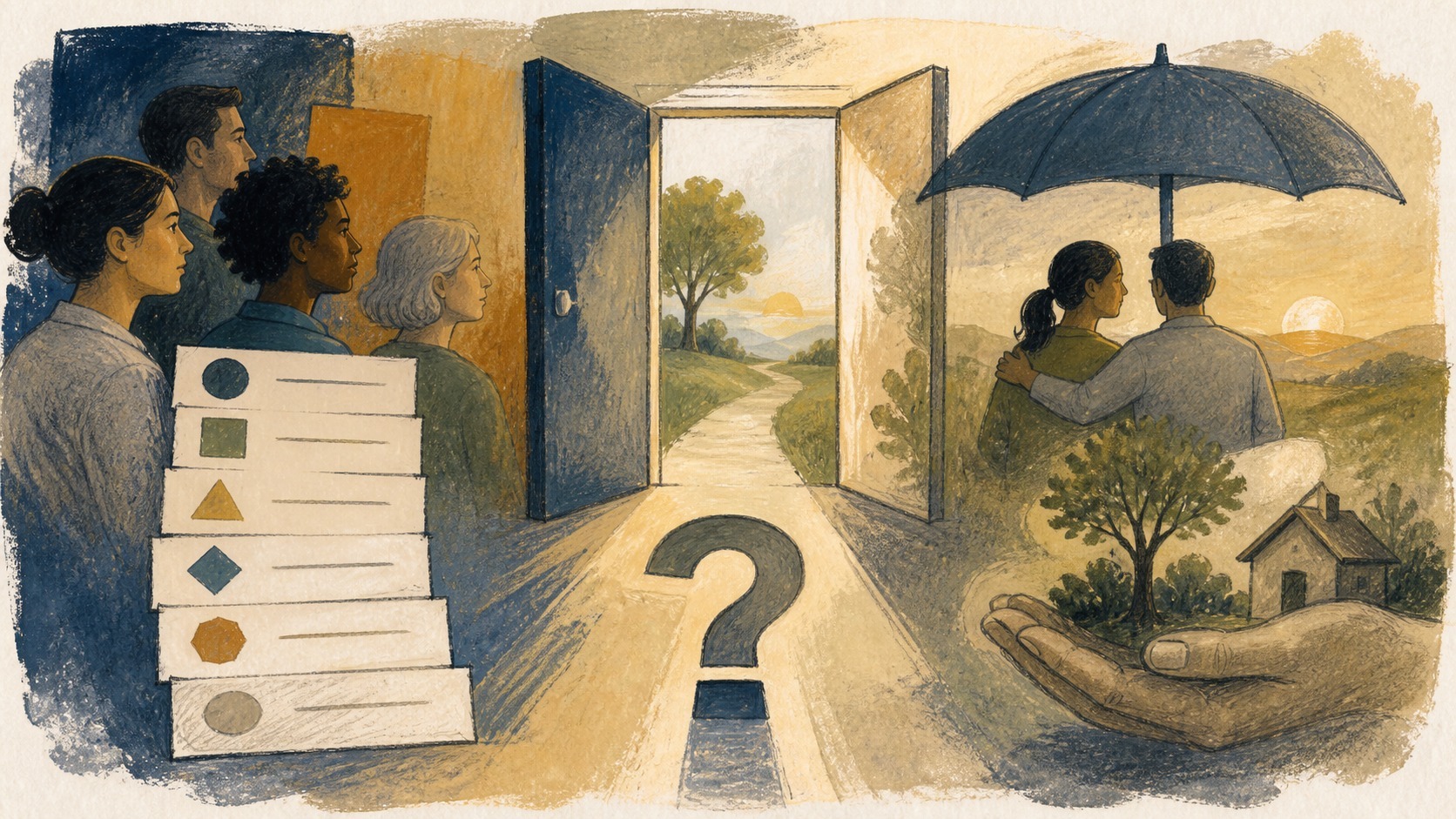
In the advice team, the yellow button was not hard to find. It said “mandatory review” and stopped a suggested answer from being sent until someone checked the data. Clara pressed it after noticing that a rent-support calculation used an old address. She spent eight minutes rebuilding the case, corrected the recommendation, and prevented a refusal. At the end of the shift, the dashboard did not record the correction as quality. It only showed that Clara had closed fewer files than her colleagues. Her manager congratulated the team on recovering speed and said they needed to “use judgement without blocking the flow.”
The scene exposes a common contradiction. An organisation installs a safeguard and then designs the working day so that activating it feels like personal failure. Review exists, but time to review does not; the option to stop exists, but the person who stops sees their indicator fall; reporting exists, but recognition goes to those who did not need it. In those conditions, accepting an automated answer quickly is not an individual lack of care. It is the behaviour the work system makes rational.
Culture is not a matter of blaming people’s character or asking them to be brave. It is visible in schedules, targets, meetings, promotions, and the phrases repeated when a problem appears. If every closure is celebrated and every doubt is treated as delay, the employer has decided what kind of judgement it wants. No interface improvement will solve that decision. A safeguard is effective when using it fits inside an ordinary shift, not when it depends on someone sacrificing rest, reputation, or variable pay.
The incentive that empties a safeguard#
The first task is to look at the whole metric. Counting files closed per hour may identify an exceptional backlog, but it cannot be the sole criterion for work that involves interpreting documents, hearing a circumstance, and correcting information. A single figure cannot distinguish a simple reply from a case requiring coordination with two services. When it distributes rewards or flags delay, it pushes people to close what is visible and let complex mistakes return later through another channel.
The first task is to look at the whole metric. Counting files closed per hour may identify an exceptional backlog, but it cannot be the sole criterion for work that involves interpreting documents, hearing a circumstance, and correcting information.
Review needs explicit value. A dashboard can record that it was activated, what kind of issue was found, what reasonable time it required, and what outcome it produced. This is not to watch the reviewer; it is to show work that currently vanishes from the measure. A correction preventing an improper refusal, a second call, or a lengthy appeal is not lost time. It is service that initial speed cannot count. The information should be read by team and process, not as a ranking rewarding people who received fewer difficult cases.
Informal incentives matter too. If the daily meeting asks only about volume, the fastest person always gets the best rota, or a manager answers a doubt with irony, the written rule has no force. Leaders need to change the language of recognition: name well-founded reviews, explain learning, and thank reasonable pauses. Making that gesture visible does not romanticise error. It teaches that finding an error before sending a decision is professional competence.
A fair incentive has boundaries. Not every case requires stopping the flow, and review cannot become an excuse never to decide. The team should therefore agree clear thresholds: contradictory data, hard-to-reverse consequences, signs of bias, missing decisive documentation, or a recommendation contradicting the known account. Thresholds guide without replacing judgement. They also show whether they are applied unevenly or whether the system generates too many alerts for staff to handle.
Giving reasonable doubt real time#
A policy saying “review when necessary” does not allocate minutes. The schedule must reserve review capacity before it sets a production target. That may mean a protected daily period, available cover, or a caseload calculated with margin. What matters is that Clara does not have to choose between checking a recommendation and ending her shift on time. When the cost of doubt falls only on the person who spots it, the organisation has pushed risk downward.
Protected time needs a simple operating rule. A person activates review, classifies the reason at a minimal level, and receives a response or cover within a deadline. They should not write a long report to justify a few minutes or wait for permission through a chain of management. Where a review needs more time, the case moves to a clear queue with assigned responsibility and communication for the person affected. This prevents the button becoming a way to postpone indefinitely whatever feels inconvenient.
Planning must recognise peaks. During a benefits campaign, data migration, or a week of absences, situations increase in which automated advice fails through missing context. Cutting review time precisely then creates a paradox: the moment of greatest uncertainty receives less judgement. The team can agree conditions for slowing down, such as crossing a correction rate or detecting a source-data change. A temporary reduction in speed is not lost productivity; it stops a repair debt accumulating without measure.
Rest is part of this architecture. Reviewing sensitive decisions for hours without relief is exhausting and normalises mechanical acceptance. Breaks are not a reward for finishing; they are a condition for retaining attention. A system assigning time for oversight must include sufficient rota, training, and support to exercise it. Otherwise an employer calls it “human supervision” when a tired person confirms in sequence what a machine has already proposed.
Correction must count as recognised work#
A useful correction leaves learning behind. If several people find that an address field arrives out of date, the answer cannot stop at praising those who noticed. It should trigger a source review, a rule change, and communication of the adjustment. Individual recognition matters, but it is not enough: the aim is that the same error should not require heroism every week. The organisation must distinguish between attention that repairs one case and responsibility for changing the condition that produced it.
A short review-incident record can support this: observed pattern, potential effect, immediate solution, owner of the change, and checking date. It need not preserve intimate detail from every file. It needs to connect an alert to a response. At a regular meeting, the team can see which corrections recur, how long the organisation takes to resolve them, and which measures reduced recurrence. This turns one person’s judgement into collective improvement without using it as a disciplinary instrument.
Recognition must extend to people who teach others how to review. Someone explaining an exception, supporting a new colleague, or documenting a difficult doubt is producing quality infrastructure. If that work does not count, it will always fall to the same people and vanish when pressure rises. Including it in workload, professional development, and assessment prevents shared knowledge being treated as invisible volunteering.
Stopping the flow without exposure#
The most important protection is being able to say “I am not sure” without that sentence becoming a mark of incompetence. Policy should explicitly prohibit retaliation for activating a good-faith safeguard: worse shifts, loss of an allowance, degrading comments, or negative assessment based only on the number of pauses. That prohibition needs a confidential route and authority able to intervene. If the complaint returns to the same person pressing for volume, the protection is decorative.
The decision to stop must be reviewable, not lonely. A second role can confirm, adjust, or resume the flow and should leave understandable reasons. This protects Clara from carrying all responsibility and stops the pause being used arbitrarily. Reviewing a pause should ask whether the threshold worked, whether time was enough, and whether the person had support, rather than only whether the file ended quickly. What is evaluated determines the next decision.
There must also be an exit for persistent disagreement. If a manager orders continuation despite a reasonable risk, the team needs to escalate to a quality unit, labour representation, or governance committee with power to suspend a rule. Escalation needs a deadline and a response to the group; it cannot disappear into an inbox. Protection is credible when it can change a decision, not when it merely records that someone was concerned.
The next time Clara presses the yellow button, the system should recognise two facts: she will spend time reviewing and that review may improve the service. Her rota should not worsen, her assessment should not fall, and her manager should be able to learn from the pattern she found. Automation does not fail because a pause exists. It fails when work makes that pause impossible to use. Turning review into time, recognition, and protection is the cultural change that allows a safeguard to become a practice instead of a promise.