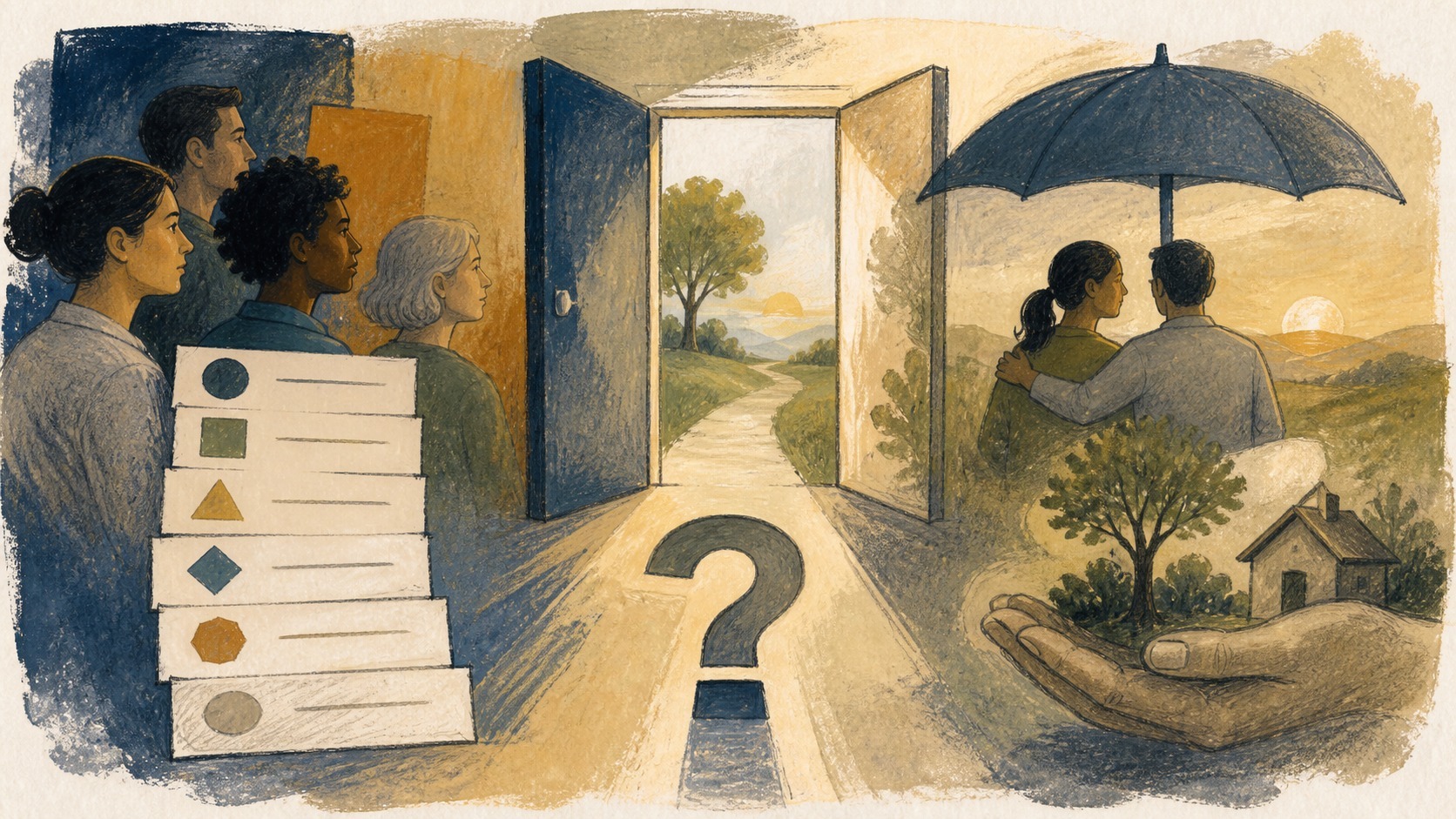
Late on a Thursday afternoon, the chatbot for a support line had answered dozens of questions about hours, documents, and contact numbers. The dashboard described this as a notable reduction in volume. When the automated shift closed, three conversations reached Nadia, the only human available, that could not accept a standard reply: a family about to lose housing, a woman unable to speak safely from home, and a man who had just reported his brother's death. Each account required listening, careful information, and a decision about the next step. The system had reduced the number of messages, but it had concentrated the weight of those left behind.
That concentration is not a minor side effect. A filter that removes routine work changes the composition of human work. Someone who once alternated a simple question with a difficult conversation can spend hours handling only crisis situations. The fatigue this creates cannot be measured by counting closed messages or calculating average first-response time. It appears in the attention that becomes hard to sustain, the difficulty of returning to administrative work, and the urge to resolve too quickly just to breathe. If a service calls that transfer efficiency, it treats care as a silent resource to consume without a plan.
Complexity needs distribution, not heroism#
The first step is to see what the chatbot refers and when. Knowing that a case was escalated is not enough. With privacy protected, the organization should record the kind of situation, time of day, approximate duration, need for consultation, and whether one person handled it alone. This record should not preserve a full intimate story or label a help-seeker as a problem. It should reveal service patterns: perhaps violence-related referrals arrive at the end of the day; perhaps housing crises accumulate when another local resource closes; perhaps the bot treats as routine a phrase that signals risk to a professional.
The first step is to see what the chatbot refers and when. Knowing that a case was escalated is not enough.
With that information, complexity can be distributed. A support line should not depend on Nadia being able to absorb every hard conversation because her name appears on the rota. It can organize paired duty, second-listener shifts, support between organizations, and a handover rule when a case exceeds a defined time or intensity. Distribution does not mean passing the user from hand to hand. It means the person who starts support keeps the thread while another professional helps think, finds resources, or takes a defined part of the follow-up. Continuity for the person receiving help and protection for the team are the same design decision.
The highest-pressure period must also be anticipated. If data show that crises arrive late in the day, it is not responsible to schedule one person then without cover. The organization can stagger human presence, maintain an external duty arrangement, or clearly limit what the chatbot promises when immediate response capacity does not exist. A message saying “we are here to help” is harmful if the only real option is waiting until tomorrow without urgent information. Matching the system's language to available resources is a concrete way not to delegate an impossible promise.
A protected pause is not spare time#
After a conversation about violence, bereavement, or eviction, Nadia should not move directly into routine emails or another crisis. She needs a protected pause: time not filled with overdue tasks, not counted against her evaluation, and available without explaining private details. A pause can include minutes away from the screen, a minimal note that leaves the case ready, and, when appropriate, a brief check with another person. It is not a reward for having endured. It is a safety condition so that subsequent work is not done with fragmented attention.
Protecting that pause requires real coverage. If every break grows a queue Nadia must recover later, the right exists only on paper. Scheduling has to reserve capacity, define which cases are taken during that interval, and make clear to the team that a pause is not a signal of poor efficiency. It must not become the only solution either. The answer to a week of peaks cannot be to request more breaks from each person while the organization keeps the same number of shifts. When intensity rises consistently, more resources or a narrower scope are needed. That staffing decision should be reviewed before the next rota is published, not left to an exhausted worker to negotiate during a crisis.
Supervision accompanies judgment; it does not monitor emotion#
Professional supervision offers a space different from performance assessment. There, Nadia can examine a difficult case, a safety doubt, or the feeling of having arrived too late without the discussion becoming a score. A supervisor helps distinguish what belonged to the service, which external resource was necessary, and which part of a reaction is understandable in the face of a serious account. This space needs an agreed frequency and rapid access after a particularly hard incident. A quarterly meeting cannot carry everything that happened across three months of work.
Supervision also reveals chatbot failures. If several professionals explain that the bot refers eviction threats too late, that information cannot remain a personal note. It must trigger a review of detection rules, exit wording, and human availability. People who handle crises recognize signals a technical list cannot capture: silences, language changes, a seemingly administrative sentence that conceals fear. Bringing in that knowledge does not mean turning them into unpaid system trainers. It requires paid time, recognition, and authority to stop a route that is leaving someone without adequate help.
Measure without punishing those who receive the hardest cases#
Metrics should describe service intensity without comparing people emotionally. The organization can count the share of escalated conversations, time to human contact, number of handovers, pauses that could not occur, and incidents requiring supervision. These data support decisions about coverage, training, and design changes. They must not be used to conclude that someone “creates too many cases” or “takes too long,” because people receiving the most complex situations can appear less productive precisely because they performed work that protects others.
Qualitative questions matter just as much. At the end of a week, the team can answer collectively: what kind of conversation left us without tools, where did the bot promise more than we could offer, which handover worked, and which made someone repeat a story? Answers should become dated actions, not a box for release. The service may need an emergency option, a changed overnight message, a referral agreement, or the removal of one chatbot category. A non-punitive metric is valuable for what it allows the team to change, not for how well it decorates a dashboard.
The next duty shift should not depend on Nadia being able to reopen three unbearable accounts the next day as though nothing happened. Before the chatbot is switched on, the line can set a simple rule: no human shift receives complex crises without available cover, a protected pause, and accessible supervision; if one condition fails, the bot narrows its scope and communicates a safe alternative. That rule does not remove the harshness of the situations. It does prevent a tool built to save time from making the most painful part of care the solitary responsibility of the person least able to step away.