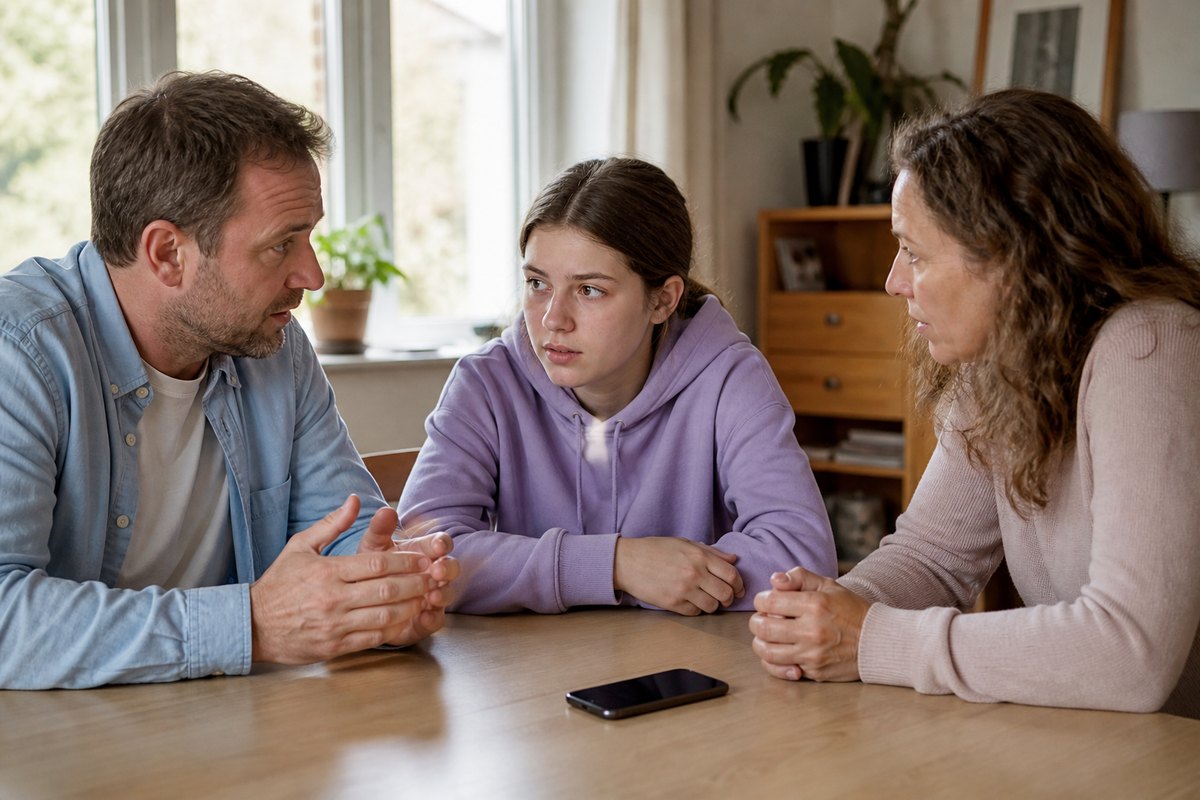
Families need a protocol that does not increase fear. That is the entry point to understand “The conversation families are already having: The digital fraud that talks like us” without staying on the surface. In digital fraud that speaks like us, the interest is not only in what a tool does, but in how it alters decisions, dependencies and response possibilities for specific people.
There is a simple way to improve the discussion about families need a protocol that doesn't increase fear: drop the general promise for a moment and describe the actual process. Who provides information, what system transforms it, who receives the result and what happens when someone disagrees.
“Families need a protocol that does not increase fear” deserves its own analysis, not an interchangeable paragraph about technology. Its context, those affected and its type of damage determine what measure is proportionate. A useful recommendation should be able to point out the exact place where the route changes and the evidence that will allow that change to be reviewed.
The specific case behind the trend
Let's consider a possible and close situation: a mother received a distressed audio that simulated her daughter and blocked her ability to check. The value of the example does not depend on whether exactly this happened in a single organization. It summarizes recognizable conditions that appear daily and allows us to ask how our own process would respond before suffering a real consequence.
The main lesson is that emotional fraud takes advantage of the impulse to protect before thinking. It is not about removing all responsibility from people, but about preventing the last gesture or click from hiding previous design decisions. A professional system reduces foreseeable errors and offers a way out when reality does not match your standard case.
To understand, families need a protocol that does not increase fear, it is advisable to follow the information from beginning to end. It is necessary to distinguish what is collected directly, what is deduced, the rule that is applied and the consequence that someone receives. This chain reveals control points that disappear when everything is summarized in a single label or score.
“Families need a protocol that does not increase fear”, the scale changes the nature of the problem. An individual mistake can be corrected with a conversation; the same rule applied thousands of times requires systematic searches, supervision and repair. Automating scope without automating collateral multiplies risk as effectively as service.
Possible damage must be evaluated before the promised comfort. Families need a protocol that does not increase fear; it is interesting to measure severity, reversibility and especially exposed people. An annoying and fixable error admits a different test of a decision that affects health, income, identity, education or access to a right.
A practical response that does not depend on heroics
The priority measure is to agree on a verification phrase, a second contact and simple steps that can be remembered under pressure. The proposal can be tested in a limited scope and with visible criteria. It needs someone responsible, a date, resources and a threshold to stop it. If its operation depends on someone remembering every exception under pressure, it is still not a reliable procedure.
Before applying the change to families who need a protocol that does not increase fear, I would record a few reference data: frequency, resolution time, errors, complaints and differences between groups. I would add a sample of cases explained by those who lived them. The figure shows scope; experience shows why it happened.
The test must incorporate a deliberate interruption. A piece of information may be missing, a supplier may fail, or a person may appear who does not accept the tour. Watching what happens allows you to see if agreeing on a check phrase, a second contact, and simple steps that can be remembered under pressure still protects the target when conditions are no longer ideal.
For families who need a protocol that does not increase fear, a clear alternative serves two functions. It serves those who cannot use the main road and limits dependence on the system. It must lead to an equivalent result, have reasonable deadlines and be attended by someone with the ability to resolve, not just record incidents.
It is also advisable to set expiration. Data, threats and capabilities change; A temporary measure can become permanent infrastructure by simple inertia. Reviewing families need a protocol that does not increase fear with a date requires checking whether it continues to be necessary, effective and proportionate compared to less invasive options.
Explain, correct and learn without hiding the error
The responsibility on families needs a protocol that does not increase fear, it needs a name and authority. A person or team must access records, listen to context, correct a result, and suspend the function. Human oversight without time, knowledge, or material power is just a promise placed at the end of the document.
The explanation must adapt to the consequence. Whoever is affected by the families needs a protocol that does not increase fear, needs to know what happened, what elements influenced it, how long it will last and how to request a review. The organization can protect legitimate security details without turning the entire decision into a black box.
Communicating an error early is more protective than defending an appearance of perfection. It allows you to reduce damage, receive new evidence and avoid repetitions. In the area of families, they need a protocol that does not increase fear, recognizing uncertainty does not weaken trust: it shows that there is a process capable of learning and accountability.
“Families need a protocol that does not increase fear”: the professional response is not to promise that there will never be failures, but to design who detects them, how the damage is limited, and what changes next.
The final check returns to the initial case. If we had applied this measure—agreeing on a check phrase, a second contact, and simple steps that can be remembered under pressure—what part of the outcome would have changed and what part would remain unresolved? The question avoids adding decorative controls and discovers when it is necessary to act on incentives, contracts or resources instead of adding another screen.
“Families need a protocol that does not increase fear” leaves a useful conclusion: digital criteria are built following consequences, not accumulating functions. Describing the case, protecting the exception, measuring the outcome, and preserving a way out produces more humane and sound decisions than any promise of certainty, speed, or complete convenience.