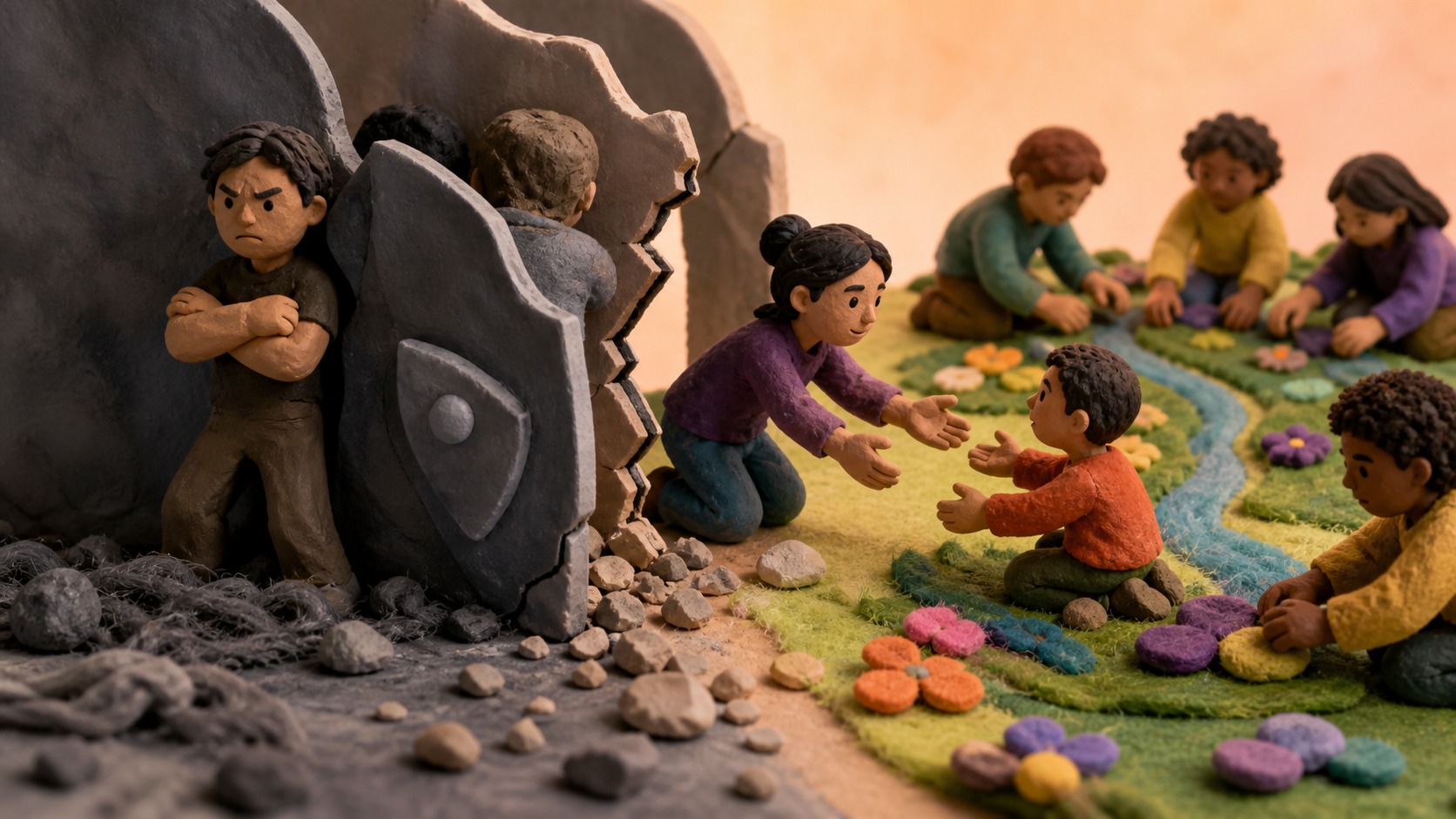
The first independent outing does not need to feel like a test of courage. It can be a very specific decision: buying bread, reaching a library, or walking down to a familiar square. Safety is not created by forcing a long journey. It comes from turning an ordinary route into something that can be noticed, rehearsed, and adjusted. That change matters. Rather than asking whether someone is “ready” to go out alone, ask which conditions would make this particular outing understandable, chosen, and easy to reverse.
The goal is not to collect kilometres#
Independence does not mean having no support. A person can travel autonomously while using a cane, checking a map, telling someone they have arrived, or choosing company for an unfamiliar section. What matters is that they understand the support, take part in the decision, and can say whether it helps. Measuring progress only by distance encourages unrealistic targets. Measuring it by decision quality reveals more useful progress: noticing road works before leaving, declining a street that feels unsafe, asking for a break, or changing a plan without treating it as failure.
Independence does not mean having no support. A person can travel autonomously while using a cane, checking a map, telling someone they have arrived, or choosing company for an unfamiliar section.
Start with an activity that has its own purpose. “Practise mobility” is too abstract; “collect a prescription from the neighbourhood pharmacy” gives a time, a destination, and a reason. That reason makes the next questions clearer. Perhaps the person needs to understand one crossing, know the bus fare, or prepare a sentence for asking for directions. The activity should be capable of being postponed when conditions change. A safe plan includes the right to return home and try again another day.
A ninety-second audit before leaving#
Before putting on shoes, spend a minute and a half on five questions. There is no need for complicated apps or a long checklist. First: where exactly am I going? Second: what may be different today, such as rain, works, rush hour, or low battery? Third: which point on the route needs the most attention? Fourth: what acceptable alternative do I have if that point becomes difficult? Fifth: who needs to know the plan, and only as much as they need to know? This short review turns vague worry into visible decisions.
The alternative question is especially valuable. An alternative may be waiting for the next bus, entering a quiet café, returning by the main street, or calling an agreed contact. An alternative is not evidence of incapacity. It is a control tool. It also reduces the risk of pushing ahead out of embarrassment when the body or the environment is clearly saying that a pause is needed.
Keep information proportionate to the journey. A small card can include the destination, a chosen contact number, and a simple sentence such as, “I need help finding this stop.” If a phone is used, check battery, sound, data access, and accessibility settings before leaving. Live location sharing should not become an automatic rule. It is better to decide when it adds safety and when it invades privacy. Helpful support stays alongside the person’s choice; it does not replace choice with permanent surveillance.
Draw the route from experience, not only from a map#
Maps show streets. Experience shows noise, slopes, shade, benches, waiting times, and confusing crossings. A route should therefore be described with human landmarks too. Instead of “turn right at the third street,” try, “after the greengrocer, cross when the signal is audible, and wait beside the kiosk if you need a rest.” Those references are easier to remember and let a person check their location without relying entirely on a screen.
Make the first observation without rushing. When possible, travel at an hour close to the one that will later be used. Notice where the pavement narrows, whether dropped kerbs work in practice, how long the crossing phase lasts, and what rain changes. For public transport, identify the waiting place, the ticket process, the name of the stop for getting off, and a second option if the vehicle is full or inaccessible. Information from operators and councils is useful, but direct observation supplies details that general service notices cannot provide.
Not every barrier is physical. A station may be technically accessible but still difficult if signs conflict, announcements cannot be understood, or staff cannot answer a straightforward question. Record these frictions in specific words. “I got lost” is not very actionable. “I could not see the exit arrow because it was behind a column” identifies a problem that can be avoided next time. Notes are not an examination of the traveller. They are a record for redesigning the conditions of that outing.
Rehearse without turning rehearsal into dependence#
Initial accompaniment works best when its role is agreed. On a first trip, the companion may explain landmarks and observe quietly. On a second trip, they may walk several metres behind and answer only when asked. On a third trip, they may wait at the destination or remain available by phone. The sequence is not rigid. Some routes need more practice and others less. What matters is agreeing which decisions belong to the traveller and which intervention belongs to the supporter.
After each rehearsal, avoid the overall verdict that it “went well” or “went badly.” Ask instead: when did you feel safest, what information was missing, which help felt intrusive, and what would you do differently? An unexpected stop may show that the estimated time was too short. A wrong turn may show that the landmark was unclear. Turning an incident into information protects motivation and improves the next attempt.
Practise the return journey as well. Many routes appear simple until the light changes, an entrance closes, or tiredness arrives. Before a route is treated as learned, review how to return, where it is possible to wait, and how to communicate that the plan has changed. Independence grows when the person can safely begin an outing and safely bring it to an end.
Practical case: the Wednesday library visit#
Nerea wants to visit a library twelve minutes from home every Wednesday. The journey looks short, but it includes a crossing beside recent road works and a bus stop that is sometimes blocked by badly parked vehicles. Rather than beginning with a goal of travelling alone, Nerea and her sister create a one-page route card. It includes a departure time with spare minutes, a photo of the library entrance, the bus number as an alternative, and the name of a café where she can wait if heavy rain begins.
On the first walk, Nerea notices that the problem is not the crossing itself but the construction noise. It makes the pedestrian signal hard to hear. They choose to change pavements two streets earlier and use a longer but calmer crossing. On the second walk, her sister does not set the pace. She waits for Nerea to decide when to cross. Nerea chooses to carry switched-off headphones in her pocket, using them to reduce noise only after checking that she does not need to hear signals. The decision is not imposed. It is tested and reviewed.
On the third Wednesday, the bus does not arrive. Nerea follows the agreed alternative: she calls to say that she will be late, walks to the café, and waits for fifteen minutes. She does not complete the route exactly as written, but she acts safely and keeps her activity. The later review adds a new rule: if the operator’s app predicts a delay of more than ten minutes, she will choose the walking route straight away. The plan becomes more realistic because it has learned from the environment.
Support that respects privacy and decision making#
Families, friends, teachers, and professionals can be highly useful when they distinguish necessary information from unnecessary control. Before sharing data, agree why it is needed, for how long, and who can see it. “Tell me when you arrive” is different from maintaining permanent tracking. When there is a specific need for intensive support, it should still be explained in understandable language and reviewed regularly. A person’s circumstances change, and support systems should not remain fixed simply because that is convenient for others.
One well-formed supportive sentence can open more space than ten instructions. “Would you like to review the crossing, or would you rather try it and discuss it afterwards?” recognises competence and offers a choice. By contrast, “do not go out until I can come with you” can turn a legitimate concern into a blanket ban. If a real risk appears, it is appropriate to pause the plan and seek specific guidance. The decision should name the risk, the temporary measure, and the condition for reviewing it.
Community resources matter too. A civic centre, library, pharmacy, or trusted shop can become a reference point without needing to know a person’s private life. It is enough that someone can answer a specific question or offer a quiet space. The most useful network is not the largest one. It is the one that is defined, reliable, and easy to activate.
When adjustment is wiser than persistence#
Some days an outing needs to change. Severe fatigue, an anxiety episode, a road closure, poor visibility, or a transport breakdown are not tests that must be overcome through pride. A realistic plan includes recognising those signals. A personal traffic-light system can help: green means continue normally, amber means pause and consult the alternative, and red means cancel without a long explanation. This tool prevents an unclear feeling from becoming an argument.
Adjustment may also be small: leave ten minutes earlier, choose a quieter street, carry water, repeat one section with a companion, or exchange the activity for an equivalent one. The key is to record what was adjusted and what effect it had. After several outings, patterns emerge. Perhaps difficulty happens only after dark, with certain crowds, or after a long day. That knowledge makes anticipation possible instead of imposing broad restrictions.
A brief review that keeps the learning#
On returning, reserve five minutes to note the date, destination, one thing that worked, one barrier, and one possible improvement. Mobility does not need to become bureaucracy. A three-line note is enough if it is read before the next outing. Over time, the person gathers evidence of what they already know how to do and which conditions help them. This practical memory is more useful than an abstract promise of independence.
The next action can be very small. Choose a destination that you genuinely want to visit, complete the ninety-second audit, and agree one concrete alternative. Afterwards, describe what changed. Safe mobility is not about never needing anyone. It is about being able to decide, ask for the right support, and return with enough information to make the next outing more truly your own.