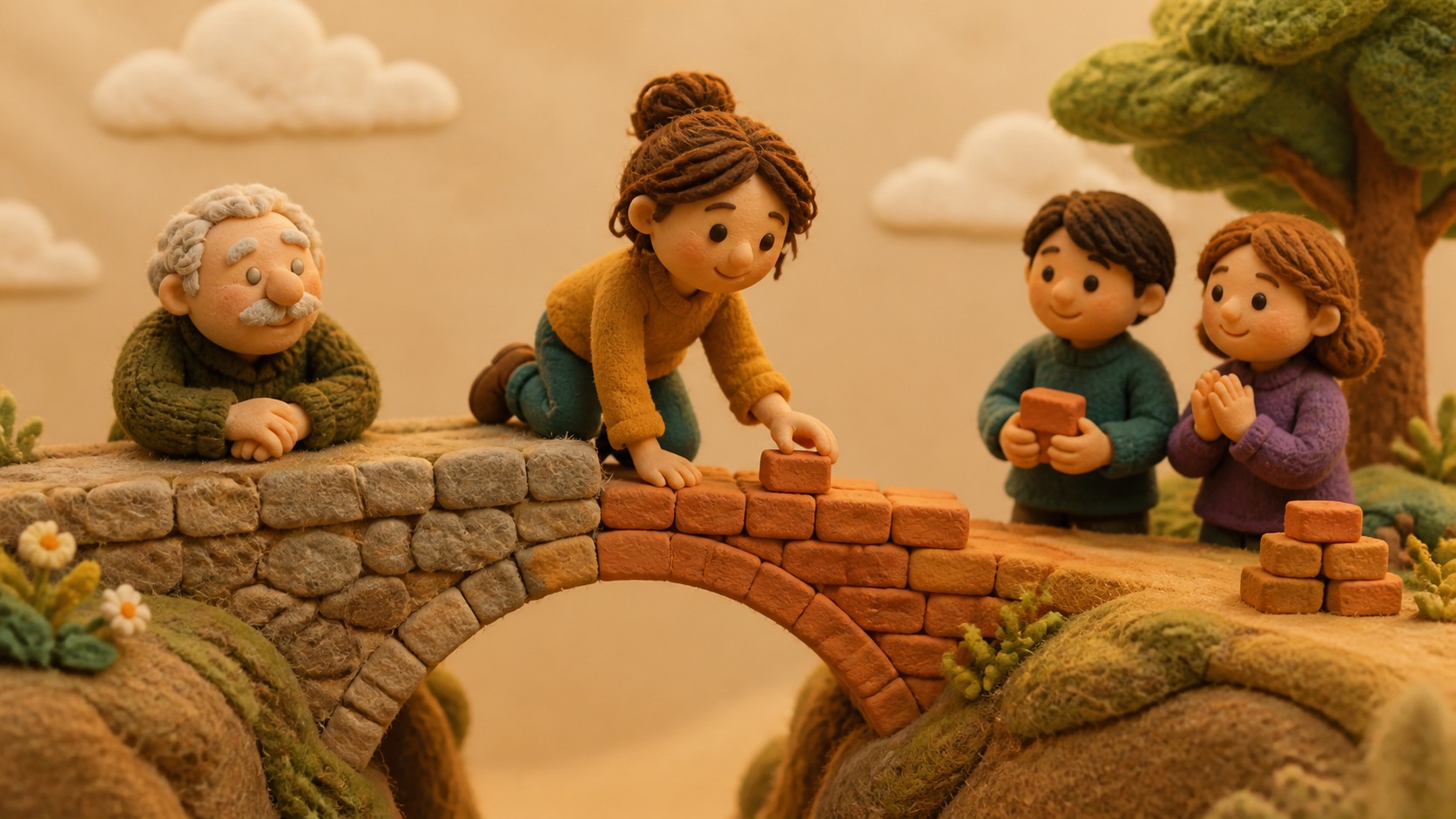
A science question, a doubtful news item, or an everyday observation can connect families, schools, and communities when everyone knows what they contribute, what must be protected, and when an agreement should be reviewed. Coordination is not surveillance. It is a predictable, safe response that remains open to evidence.
Begin with one observable question#
Before assigning work, write one specific question: what do we want to check, what information is missing, and which decision depends on it? “We want to do more science” is too broad. “We want to check the authorship of a source for our water presentation” makes a next step possible. In a short conversation, each person can say what they noticed before anyone interprets it. Keeping observation, hypothesis, and conclusion separate reduces blame and makes the agreement reviewable.
Before assigning work, write one specific question: what do we want to check, what information is missing, and which decision depends on it?
The goal needs boundaries. If a question involves health, chemicals, electricity, fire, animals, personal data, or a possible emergency, the agreement does not permit a home experiment. Stop, tell a responsible adult, and contact the appropriate professional or public service. The World Health Organization explains why decisions should account for evidence and uncertainty; caution is part of critical thinking.
Share responsibility fairly#
A useful allocation names a small task, a contact person, a reasonable time, and a way to ask for help. A family can reserve ten minutes to listen; a classroom can offer a recording method; a library can point to public sources; the investigator can write what they found and what remains unclear. Nobody should need prior expertise to take part. A person who is not writing yet can draw an observation; a multilingual family member can help read a source; an experienced neighbour can explain a safety limit.
UNESCO links scientific and media literacy to informed participation. UNICEF calls for participation that is safe, respectful, and meaningful. Together these principles change the tone of an agreement: adults are not handing over a final answer; they are creating conditions in which people can ask, compare, and revise without shame.
Keep a short shared record#
A shared notebook, on paper or in a protected document, keeps an agreement from relying on memory. It can have six fields: question, date, source or condition, observation, doubt, and next step. It is not a long report. It allows someone who was absent to understand why a decision was made. The record should also name limits: an undated image, an unsigned source, or one measurement cannot support a general conclusion.
The European Commission supports science education and civic participation on the principle that data need context. That is why an agreement should say how links, dates, and authorship are saved, and how privacy is protected. Names, images, and conversations involving children should not be shared without permission. Sharing learning does not require sharing personal data.
Elena's case: an alert in the family group#
Elena received a screenshot saying that neighbourhood water contained a dangerous substance. Her father wanted to forward it, but her teacher reminded them of the agreement. Elena saved the date and image; the family looked for the notice from the responsible public body; the class asked which unit, measuring location, and period were missing. A librarian helped them locate the municipal report. They found that the screenshot combined an old value with advice that had already been addressed.
The outcome was not “Elena was wrong.” It was a better agreement: when an environmental alert appears, do not forward it first; find the responsible source, compare date and location, and ask the public service if a doubt remains. The family felt heard and the class gained a real example of how incomplete evidence can create alarm.
Rachid's case: a plant and conflicting advice#
Rachid was caring for a plant for school and found videos giving opposite instructions. His sister suggested comparing two dated sources with named authors; his teacher helped design a safe check without changing every condition at once. For a week they recorded light, watering, and leaf appearance. The school community lent a simple tool while explaining that it did not replace observation or a reliable botany source.
The agreement gave every contribution a place. Rachid kept the record, the family maintained the routine, the class checked whether the comparison was fair, and an institutional source explained the limits. They did not find a universal recipe, but they learned that coordination means keeping the question visible and correcting the plan when new evidence appears.
Nora's case: a health claim at break time#
Nora heard that an energy drink improved everyone's concentration. Rather than trying it or arguing, the group followed the protocol: identify the claim, do not give medical advice to peers, look for public-health information, and consult an adult. Her family checked the label and the school recalled its wellbeing rules. Their conclusion was cautious: effects and risks are not the same for every person, and health decisions require authorised sources.
This case shows why kind coordination needs a safe exit. Sometimes the next step is not to investigate more but to stop and seek qualified support. Trust grows when people can name a limit without being mocked.
Review progress that can be seen#
Agreements last when they review modest indicators: a more precise question, a source with checked authorship, a completed record, a timely request for help, or a conversation that avoided spreading doubtful information. There is no need to score people. Ask which condition helped progress and which barrier should change. A fifteen-minute monthly meeting can review the notebook, remove data that are no longer needed, and adapt responsibilities.
The WHO, UNESCO, UNICEF, and educational authorities approach different fields, yet all stress that information needs context, care, and participation. A family-school-community agreement turns those principles into daily actions: listen, record, compare, protect, and review.
A sentence for the next conversation#
Next time, this may be enough: “Our question is…; the person recording is…; we will check these sources or conditions…; we will not do… because it is unsafe; we will speak again on…”. If the plan creates tension, make it smaller. If it excludes someone, redistribute it. If the evidence changes, change the conclusion. That flexibility does not weaken an agreement; it shows that the agreement serves people and facts.
Curiosity then becomes a shared practice. Families, schools, and communities do not need identical opinions to collaborate. They need a common language for separating data from impressions, a respectful way to ask for help, and a commitment to care for everyone involved. That is the most practical agreement: learn together without rushing, humiliating, or abandoning responsibility.
Prepare a conversation that does not depend on speed#
Before an activity, a family and a school can agree on one simple pause signal: a card, a sentence, or a note in the notebook. It can be used when someone does not understand a source, when the conversation becomes rushed, or when a person starts to feel tested. A pause does not abandon the question. It makes room to describe what was observed again, separate what is known from what is assumed, and select one small next step. When a video promises a dramatic result, for example, a family can record the channel name and date; the class can look for who signed the explanation; and a library can suggest a catalogue or scientific institution. Each action leaves a trace that another person can review without accepting an opinion simply because they trust the speaker.
The conversation also needs to be accessible. One person may prefer to explain orally, while another may use drawings, pictograms, a short list, or translation. The agreement should offer these choices from the beginning, rather than only after a barrier appears. If digital tools are used, decide which account is used, who can view it, and how long the record is kept. Spain's data-protection authority advises data minimisation and limited access. In a science question, that means saving the sources and observations that are needed, while not turning learning into a record of anyone's private life.
Compare sources without turning it into a test#
A practical check can use four questions: who publishes this, what evidence is offered, when was it updated, and in which context is it useful? No one person has to answer all four alone. A child can identify the date; an adult can open the institutional page; and the group can compare a claim with public-health guidance or a research centre. When sources disagree, record the disagreement instead of choosing the one that feels most convenient. The Royal Society and many scientific institutions stress that conclusions change when data change. Treating that shift as a normal correction protects curiosity and keeps revision from looking like failure.
It is equally important to distinguish an authoritative source from a link that merely refers to one. A screenshot, generated summary, or headline does not replace the original document. The agreement can ask people, before sharing an important claim, to find the responsible page, save the consultation date, and explain in one sentence which part supports the conclusion. This habit matters especially for messages about health, the environment, or safety. If a source cannot be found or understood, the responsible response is to say so and ask for help, rather than fill the gap with apparent certainty.
Review the agreement and repair a misunderstanding#
At the end of a small inquiry, a ten-minute review can ask what worked, what information was missing, who was left out, and what should change next time. Choose evidence about the process, not a rating of a person: the record included a date, the question became more precise, or the group avoided forwarding a doubtful message. If someone shared inaccurate information, repair should be proportionate: correct it in the same place where it circulated, explain the new information, and thank the person for putting the doubt on the table. Humiliation encourages people to hide mistakes; a clear and kind correction makes it more likely that they will check again.
Finally, an agreement should recognise that a community has different resources. An environmental association, museum, health centre, library, or municipal service can offer a reliable source or a safe place to ask. Their role is not to replace families or schools, but to widen access. Good coordination means knowing when a doubt can be addressed in a conversation and when it needs a competent institution. With small goals, protected records, traceable sources, and reviews without blame, everyday science stops being an isolated task and becomes a practice of collective care.