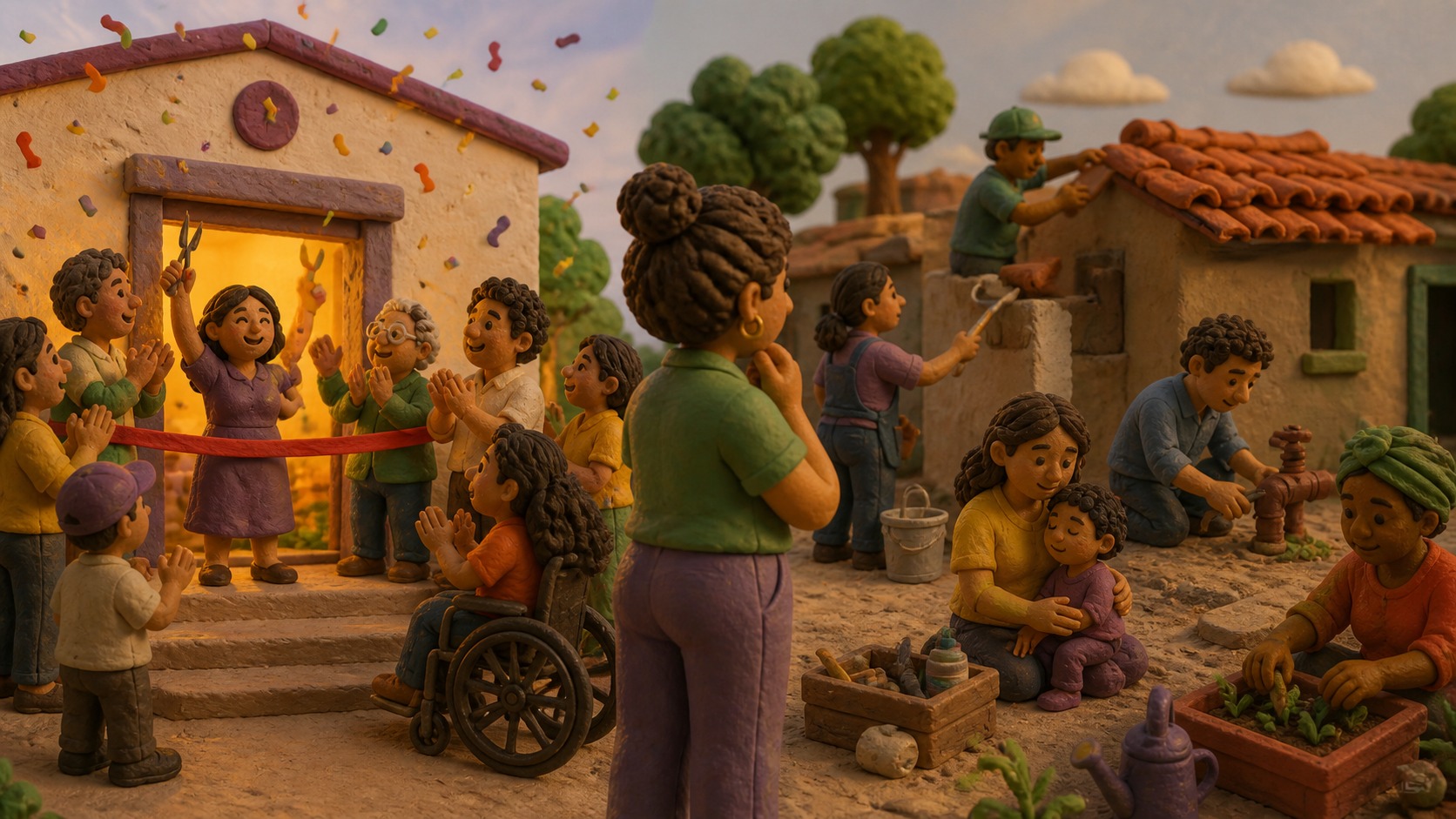
Families, schools and community programs often care about the same child's movement and play while operating with different schedules, language and responsibilities. Coordination works when it turns concern into a small number of visible agreements: the participation to protect, the support to try, the person responsible and the signal for review. It should not make every setting identical or turn childhood into continuous assessment. A practical compact can reduce conflicting prompts, preserve choice and bring better evidence to professional conversations when everyday adjustments are not enough.
Define success as access to meaningful participation#
“Improve coordination” sounds precise but gives adults no shared action. A functional aim might be: during the after-school obstacle course, the child can select an entry point, complete one section with an agreed support and leave without losing membership in the group. The same aim at home may involve choosing materials and setting them up. The movement differs, but agency, safety and social access remain common. A completed task is not successful if it depends on pain, restraint or humiliation.
The WHO, UNICEF and World Bank nurturing care framework places health, safety, responsive care and learning opportunities together. A coordination plan should do the same. It includes a positive condition, such as voluntary re-entry or communication of a break, rather than counting performance alone. This keeps the plan connected to ordinary life and prevents one highly visible motor skill from becoming the sole measure of the child's development.
Build a shared observation language#
Different settings can contribute comparable evidence without using identical forms. Each note answers five questions: where and when, what the activity required, what the child attempted, what support changed, and how the episode ended. “After lunch, she caught a large ball twice from one partner and withdrew when three players joined” is useful. “She was uncooperative” is not. Concrete verbs allow the team to examine demand instead of debating personality.
Concrete verbs allow the team to examine demand instead of debating personality.
The CDC overview of child development includes movement, play, learning, communication and behavior. Records therefore include strategies and communication, not merely whether a milestone-like action occurred. Two short examples each week may reveal more than constant filming. Observation stops if an activity is painful or unsafe, and records are stored only as long as they serve a defined decision. The child's privacy is part of sound coordination.
Map the handoffs between people and places#
Difficulty often appears at the seam between settings: getting from transport to class, changing clothes before a club, or moving from free play to a group routine. The team draws a simple sequence and marks who is responsible at each handoff. This can reveal duplicated instructions, missing equipment or an abrupt demand that no one sees in isolation. Improving the handoff may be more effective than asking the child to practice the final skill repeatedly.
One named coordinator maintains the current agreement and confirms changes. This role does not make that person the sole caregiver or decision maker. Tasks remain distributed: a parent reports sleep-related context, a teacher arranges an accessible starting position, and a program leader prepares a predictable transition. Each task has a date and a limit. The child never carries confidential notes, chases adult replies or becomes responsible for explaining why the plan was not followed.
Include the child through more than spoken answers#
A child can identify a preferred role, an unwanted form of help or a signal for stopping. Questions are short and tied to experience: “show me where it becomes hard,” “watch first or start with Alex?” Images, objects, gesture and demonstration support communication. Approach, withdrawal, tension and sustained attention also provide information, but adults check their interpretation over time. A single refusal is neither a diagnosis nor permission to abandon access; it is a reason to inspect the demand.
Article 12 of the Convention on the Rights of the Child supports giving due weight to children's views according to age and maturity. Participation does not transfer adult responsibility for health and safety. It means explaining who will help, what will change and how the child can influence review. An adult records the answer and reports back later, demonstrating that consultation affected something real rather than serving as a ceremonial question.
Agree on a principle, then tailor the environment#
A shared principle might be to wait, offer one cue and provide physical assistance only when needed and accepted. At school, the cue could be a floor marker; at home, a stable stool; at a community garden, a lighter watering can. These are not inconsistent interventions. They apply the same goal—meaningful contribution with the least intrusive support—to different demands. Existing clinical or educational guidance takes priority and should be translated accurately into each context.
Test one principal adjustment for a defined period. Simultaneous changes in group size, reward, equipment and instruction produce an impressive package but little usable knowledge. Harvard's account of serve-and-return interaction emphasizes noticing a child's focus and responding contingently. Coordination needs that flexibility. The written agreement gives adults a common starting point; the child's response determines whether they continue, simplify, pause or seek advice.
Case 1: the morning arrival that consumed play#
Five-year-old Olivia arrived late to classroom play and pushed materials away. At home she built complex structures. School staff suspected separation difficulty, while her father focused on fine-motor frustration. A handoff map showed a heavy bag, two flights of stairs, a crowded coat area and three rapid instructions before play began. Olivia could manipulate the same pieces later in the day. The team chose to address the transition rather than intensify construction practice.
Her family packed the bag the night before, the school provided a low hook and one adult offered a picture showing coat, bag and activity choice. Olivia selected blocks or books for five quiet minutes, then joined the room. The coordinator recorded arrival and voluntary entry twice weekly. Within three weeks she joined sooner on most days. The plan retained the low hook because it improved access, while recognizing that tired or busy mornings could still require additional time.
Case 2: a swimming lesson with incompatible help#
Nine-year-old Isaac enjoyed water but resisted leaving the pool steps. One instructor pulled both hands, another gave repeated verbal directions, and his aunt stood behind him to prevent retreat. Observation showed that he entered chest-deep water when holding a rail and could kick while supported. He became distressed when assistance removed his exit and when several adults spoke at once. The common priority became safe control over entry, not reaching the center of the pool quickly.
The program assigned one instructor, preserved contact with the rail and used a single cue before waiting. His aunt watched from a consistent place rather than coaching. Isaac chose between kicking at the rail and moving one hand to a float. Over four sessions he tried both and ended calmly. Staff documented choice, depth and recovery instead of labeling courage. They agreed that pain, unusual weakness or breathing concerns would stop the lesson and require appropriate health action.
Case 3: belonging in a neighborhood performance#
Eleven-year-old Grace wanted to join a neighborhood performance but could not sustain the repeated turns in its dance. The organizer offered an audience seat, the school recommended more rehearsal and family members considered withdrawing. Grace proposed operating a simple light cue and taking part in the opening formation. The team reframed success from identical choreography to a visible, chosen contribution that still carried responsibility to the group.
The community center marked an accessible station and rehearsed entry and exit. School supported the timing sequence without grading movement, and the family planned transport and rest. Grace completed both roles and later chose one additional movement. The adjustment did not lower the event's social meaning; it made contribution possible. Had dizziness or balance loss occurred in other activities, the family would have brought those examples to primary care rather than treating the performance solution as medical reassurance.
Establish a shared safety and escalation ladder#
A shared plan needs a plainly written emergency rule. Stop the session and use local urgent services if a child suddenly loses an ability, develops weakness, becomes less alert, struggles to breathe, has intense pain or suffers a clear injury. Other observations—recurring falls, one-sided movement, unusual tiredness, repeated pain or difficulty in several settings—should be logged for a scheduled clinical conversation. The handoff sheet identifies the caller, the person collecting examples and the adult who keeps participation safe while advice is awaited.
The American Academy of Pediatrics provides developmental surveillance and screening resources. Everyday observations can inform that process but cannot produce a diagnosis. A concise account includes onset, frequency, contexts, impact, preserved abilities and adjustments attempted. Families can ask what to monitor, when follow-up should happen and what would change urgency. Clear escalation responsibilities prevent both indefinite waiting and unnecessary alarm.
Protect confidentiality and dignity across the network#
Coordination creates information, and information needs boundaries. The agreement identifies recipients, purpose and retention. A sports volunteer may need to know the stop signal and equipment adaptation, not the child's complete medical history. Videos of failed attempts are rarely necessary and can be humiliating. Written examples use neutral actions: “requested a break after two turns” instead of “cannot cope.” The distinction changes how future adults approach the child.
Siblings and peers may help voluntarily, but they should not become interpreters, physical assistants or monitors by default. When staff change, the newcomer receives the current goal, active support and safety ladder rather than years of old concerns. The child receives an understandable explanation of what is shared. A useful test is whether each detail enables a specific safety, access or communication decision. Information that serves only curiosity stays out of the handoff.
Measure benefit, burden and generalization#
Teams often count completed actions because they are easy to see. They should also examine initiation, choice, requests for help, peer connection, recovery and the support required. Burden matters: a successful session followed by exhaustion that removes the child from family life is not a neutral result. Generalization does not mean identical performance everywhere. It means the principle remains useful with different people and the child can recognize how to access support.
UNICEF's discussion of child-led free play is a reminder to protect time that is not measured. If every recreational moment becomes a trial, spontaneous exploration may shrink. Review uses a small sample, the child's view and adult feasibility. The team then chooses one of four directions: maintain, fade, change one feature or consult. Each decision includes the next review date so support does not persist or disappear through inertia.
Handle disagreement as a testable question#
A child may perform differently at home and school because noise, time, relationship, equipment or meaning differ. Variation does not show that one observer is wrong. The group identifies the smallest contrasting condition and, when safe, tests a comparable setup. Perhaps both settings offer the same processing time while keeping their usual materials. Results refine the plan. If disagreement concerns medical risk, legal entitlement or formal educational support, the relevant professional procedure replaces informal experimentation.
Meetings finish by reading back decisions, owners and dates. They also name prohibited actions, such as forcing movement, removing a support to test motivation or practicing through exhaustion. Resource constraints are stated honestly; an unavailable ideal support is redesigned into a feasible option. Cooperation becomes trustworthy when people report missed actions without blame and repair the process. A modest agreement followed consistently produces better learning than an elaborate document no one can use during real transitions.
Use a one-page coordination compact#
The page contains the priority scene, present abilities, the child's view, a provisional barrier, a functional aim, common support, setting-specific variations, task owners, frequency, stop rules, two indicators and a review date. Contact details and links to formal plans appear only when necessary. The format lets a substitute or community leader find the active decision quickly. It supplements, rather than replaces, clinical assessments and legally required educational documents.
Good coordination creates continuity without flattening the child's world. Home, school and community each offer distinct relationships, rhythms and reasons to play. A practical agreement helps adults notice effects, makes support predictable and exposes the point at which ordinary adaptation needs professional knowledge. Most importantly, it treats psychomotor development as more than a sequence of skills. Movement is connected to communication, autonomy, curiosity and the right to belong in shared activity.