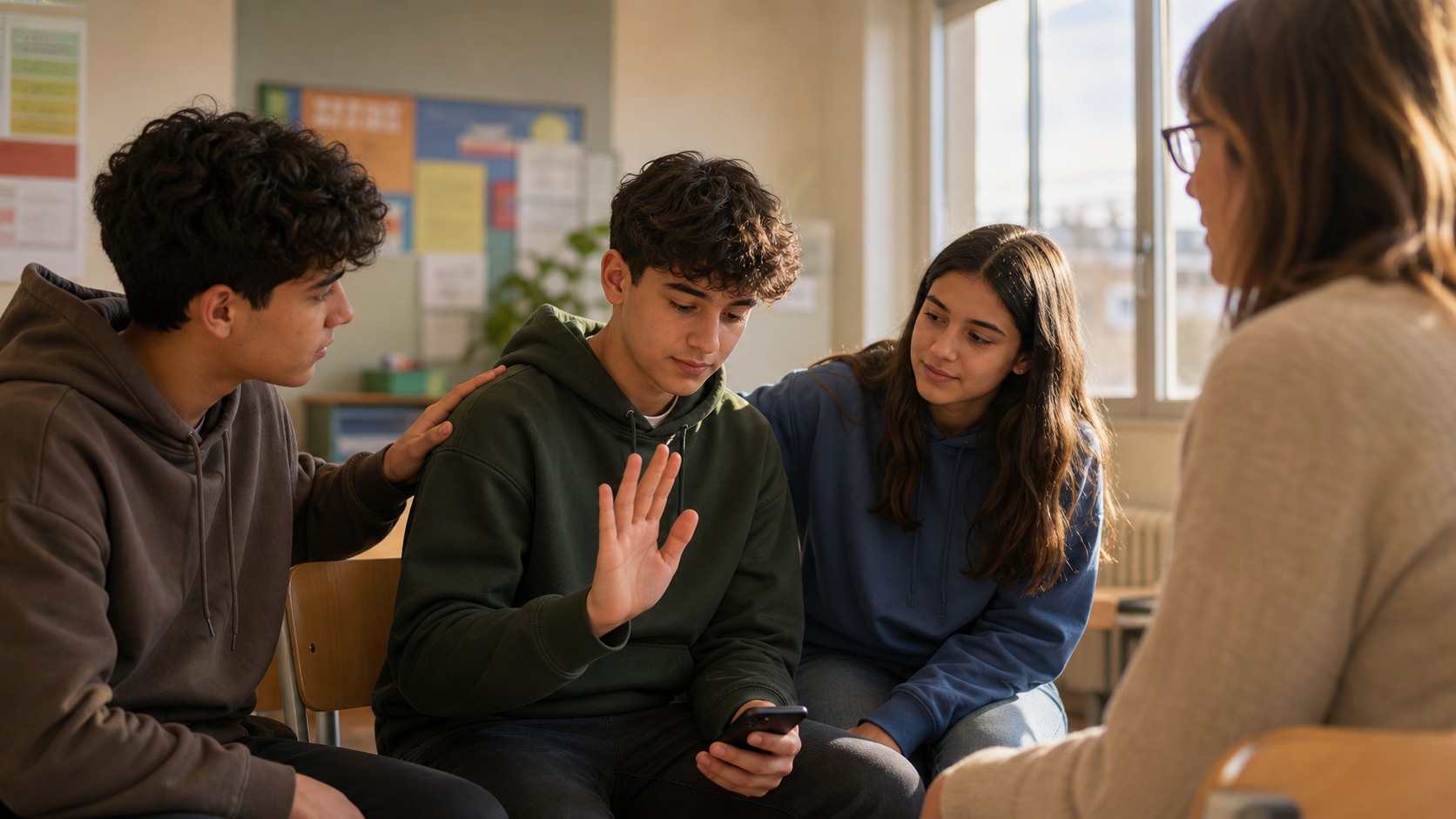
A difficult conversation can prevent a major problem when it happens before fatigue, shame, or conflict turns a manageable concern into a crisis. In digital life, such conversations often concern disrupted sleep, relentless messages, public exposure, pressure to respond, impulsive spending, or lost concentration. A professional response does not demonize screens or place every responsibility on the person using them. It gathers facts, listens to different experiences, and establishes limits that restore each person's practical ability to decide when to connect, when to stop, and what deserves attention.
The difficulty often arises from an apparent contradiction. Screens enable learning, work, creativity, and relationships, yet the same tools can introduce interruptions, surveillance, or expectations of permanent availability. If a family, school, or company discusses only benefits, signs of distress remain unnamed. If it discusses only dangers, it loses credibility with people who know the benefits firsthand. A mature conversation holds both truths together and asks what conditions make an activity worthwhile. Its purpose is not to win an argument, but to identify what needs protection and who has the authority to change the rules.
Silence is rarely neutral. It may protect a relationship for a few hours, but it can also prolong an arrangement that distributes costs unfairly. A teenager may conceal harassment for fear of losing a phone; an employee may answer at night to avoid appearing uncommitted; a teacher may tolerate an intrusive platform because no alternative is available. In each situation, apparent politeness protects the existing process and isolates the exposed person. A useful conversation creates a setting in which describing the problem does not trigger automatic punishment and any measures adopted are proportionate, understandable, and open to review.
Preparing dialogue without turning it into an interrogation#
Responsible preparation separates observations, interpretations, and decisions. Observation records specific facts: schedules, interruptions, errors, changes in mood, or abandoned tasks. Interpretation develops hypotheses while acknowledging uncertainty. A decision follows only after the people living with the situation have been heard. This sequence reduces accusations and allows mistaken impressions to be corrected. It also prevents a single figure, such as total screen time, from replacing context. Two hours might represent a class, a meaningful conversation, or a chain of unchosen stimuli; the quality of an experience cannot fit inside a counter.
Responsible preparation separates observations, interpretations, and decisions. Observation records specific facts: schedules, interruptions, errors, changes in mood, or abandoned tasks.
Place and timing matter. A discussion about attention should not begin during an argument, in front of an audience, or when someone depends on an immediate answer. Participants need adequate time, a stated purpose, and reassurance that no improvised penalty will follow. In professional settings, everyone should know who will receive information and how agreements will be documented. At home, adults need to place their own habits under the same scrutiny. Symmetry does not erase differences in responsibility, but it demonstrates that care is not surveillance directed solely at the person with less power.
Open questions produce more knowledge than labels. Asking what a person intended to do, when control of the journey was lost, and what change would help is more useful than calling that person addicted or irresponsible. It is also important to ask what positive function a behavior serves: belonging, relief, information, or safety. If that need is ignored, a ban may relocate the problem without resolving it. Professional language describes observable behavior, distinguishes risk from diagnosis, and offers specialized resources when persistent anxiety, violence, isolation, or sleep deterioration appears.
The knowledge contributed by each participant#
No participant holds the complete picture. A user understands daily experience; a family notices changes in routines; teachers identify effects on learning; a technical team understands settings and data flows; management controls resources and policy. Combining these perspectives requires attention to asymmetry. The voice of someone who may be punished is not as free as the voice of the person who can impose that punishment. Some processes therefore need confidential channels, independent facilitation, or collective representation so that disagreement does not lead to retaliation.
Intellectual humility is crucial. A hypothesis should state what evidence would support it and what finding would require it to change. If notifications are suspected of harming concentration, a group can record a baseline and test different settings for a limited period. If outcomes do not improve, it should explore other causes instead of blaming the person. This approach turns conflict into shared learning. It also prevents the adoption of impressive solutions that merely move the burden onto people with fewer resources, limited connectivity, or accessibility needs.
Cooperation becomes concrete when every agreement assigns responsibility. Asking someone to use a screen less is insufficient if a school continues to send notices at any hour or a company rewards immediate replies. Those who design an environment must remove unnecessary demands, consolidate communications, and provide equivalent alternatives. Participants can report difficulties and respect agreed limits. Institutions must measure consequences, protect exceptions, and repair harm. Distributed responsibility does not dilute obligations; it locates them where effective power to act exists.
Case 1: a family addresses nighttime connection#
In an illustrative case, a family notices that a young person arrives tired at school and continues conversations late into the night. The first reaction might be to confiscate the device, but the adults schedule a discussion at a calm time. They present observations without reading private messages and learn that the friendship group uses late hours because several members care for relatives during the day. A genuine concern also emerges: being excluded from social decisions. The problem is no longer defined as disobedience, but as tension between belonging, rest, and incompatible schedules.
The family agrees to a four-week trial. The friendship group receives a proposal to concentrate decisions before a specified hour; the phone remains outside the bedroom except on justified nights; an independent alarm clock and an emergency route are provided. The adults also disable work notifications overnight. Perceived rest, punctuality, and mood are recorded, not private content. At the end, the young person reports what worked and which exceptions were needed. The rule is adjusted without turning every deviation into a moral suspicion.
The case shows that an early conversation offers better protection than sudden confiscation. Sleep improves, but the central lesson is relational: the young person can request help without anticipating a total loss of autonomy. The family discovers that some digital obligations came from collective expectations rather than individual choice. By changing schedules, devices, and social rules together, it reduces the burden of self-control. The agreement includes a review date because calendars, friendships, and needs evolve.
Case 2: a school responds to public exposure#
In another case, several students avoid participation after classroom extracts appear outside the school. The institution could treat the incident as an isolated breach, but a facilitated conversation reveals that nobody clearly understood when recording occurred, where files were stored, or who could share them. Some families valued recordings for revision; others feared exposure. The team separates educational usefulness from permission to distribute and acknowledges that consent collected at enrollment did not settle every specific situation.
The school temporarily suspends publication, preserves private access to necessary materials, and brings together students, families, teachers, and the data protection lead. A new protocol requires visible notice, a defined purpose, a deletion period, and an equivalent alternative for anyone who does not appear. Incidents can be reported without confronting the person who circulated the content. Digital citizenship is taught, but the institution does not transfer the entire duty to students: it reviews permissions, suppliers, and default settings.
After one term, the school measures participation, removal requests, and comprehension of the rules. Recordings decline while educational access continues through material prepared for that purpose. Repair includes removing discoverable copies, acknowledging the impact, and offering support to affected people. The difficult conversation prevents fear from becoming normal. Above all, it establishes a principle: participation in education should not require acceptance of indefinite exposure, and any technology used must preserve a dignified way out.
Case 3: a company challenges permanent availability#
A service company detects increasing errors and messages sent after midnight. Management initially attributes the problem to personal organization, but a confidential consultation reveals another cause: supervisors post priorities across different channels, and quick replies informally influence evaluations. People with caring responsibilities face a particular disadvantage. The organization accepts that its culture contradicts its written disconnection policy and opens a conversation involving employee representatives, occupational risk specialists, and team leaders.
The plan defines availability windows, a paid emergency rota, and a single channel governed by strict urgency criteria. Ordinary messages are scheduled for the next working day, and every request identifies a deadline, context, and responsible person. Performance assessment stops using presence indicators. For eight weeks, the company compares errors, overtime, resolution times, and perceived control. Data is analyzed by working pattern so an average improvement cannot conceal harm to a particular group.
Nighttime activity falls without worsening client support. Some incidents take longer to receive an initial reply, but they are resolved more effectively because they reach the appropriate team. Management publishes what it learned and retains a process for challenging false urgency. The change demonstrates that the conversation was not a superficial wellbeing exercise: it altered incentives, resources, and authority. When an institution stops manufacturing availability, individual attention no longer depends on resisting pressure created by the system itself.
Agreeing on limits that can actually work#
A useful limit specifies behavior, context, exception, and review. “Use the phone less” provides no testable change; “consolidate non-urgent alerts and review them in two windows” does. A limit also needs an alternative. If a platform is restricted, a person must be able to access the essential service through another route without delay, expense, or shame. Exceptions are not defects in an agreement; they reveal diverse needs. They should be protected without forcing individuals to disclose intimate information to an entire group.
Proportionality prevents responses that cause more harm than the original risk. Removing all connectivity after an episode of excessive use may cut off social support or educational access. A warning alone may be inadequate after a privacy breach. Decisions should consider severity, frequency, capacity for recovery, and power. Whenever possible, a measure is tested for a defined period and evaluated through human outcomes: rest, comprehension, autonomy, relationship quality, and ability to complete the intended task, alongside operational metrics.
Every agreement needs a route to repair. An affected person should know whom to approach, what will happen next, and how long a response will take. Repair may require removing content, correcting a record, restoring access, compensating a loss, or changing a policy. An apology without modification leaves the cause untouched. Transparency does not mean publishing personal detail; it means reporting in aggregate what problems appeared, what decisions followed, and when effectiveness will be checked.
Signs that require specialized support#
Everyday conversation has limits. When threats, extortion, sexual violence, self-harm, severe sleep deprivation, or sustained deterioration appear, safety and access to competent professionals take priority. Participants should not improvise diagnoses or promise absolute confidentiality when serious danger exists. They should explain clearly what information will be shared, with whom, and for what purpose. When minors are involved, protection should preserve their participation in decisions as far as the situation permits, avoiding the transformation of help into another experience of lost control.
Health, education, data protection, and safety services contribute different expertise. Their involvement should be coordinated and limited to what is necessary. Automatic reporting is not always the only route, just as an informal conversation is insufficient when a crime or immediate danger is present. Professional assessment considers context, evidence, and the affected person's preferences. Recording dates, channels, and measures taken supports continuity without collecting more intimate data than necessary.
A culture in which speaking early is normal#
The strongest prevention does not depend on one exceptional conversation, but on a culture that welcomes questions before a crisis. Families can review agreements periodically; schools can teach how recommendations and permissions work; companies can assess interruptions and digital workload alongside other occupational risks. In every setting, leaders must show that a reasoned objection will not be punished. If people are invited to speak only after damage occurs, the system has surrendered an essential source of available knowledge.
A difficult conversation restores ownership of attention when it combines knowledge, humility, and cooperation. Knowledge names facts and mechanisms; humility acknowledges uncertainty and corrects hypotheses; cooperation changes conditions that no individual can transform alone. Success is not silence, obedience, or complete disconnection. It is the ability to understand a situation, retain options, request help, and participate in rules that shape personal time. Speaking early cannot remove every conflict, but it prevents apparent politeness from continuing to protect a process at the expense of those carrying the risk.
Institutional sources#
- World Health Organization, adolescent mental health: https://www.who.int/news-room/fact-sheets/detail/adolescent-mental-health
- UNICEF, guidance on children in a digital world: https://www.unicef.org/reports/state-worlds-children-2017
- European Data Protection Board, children's data protection: https://www.edpb.europa.eu/our-work-tools/our-documents/guidelines/guidelines-12024-processing-personal-data-based-article-6_en
- International Labour Organization, working time and work-life balance: https://www.ilo.org/publications/working-time-and-work-life-balance-around-world