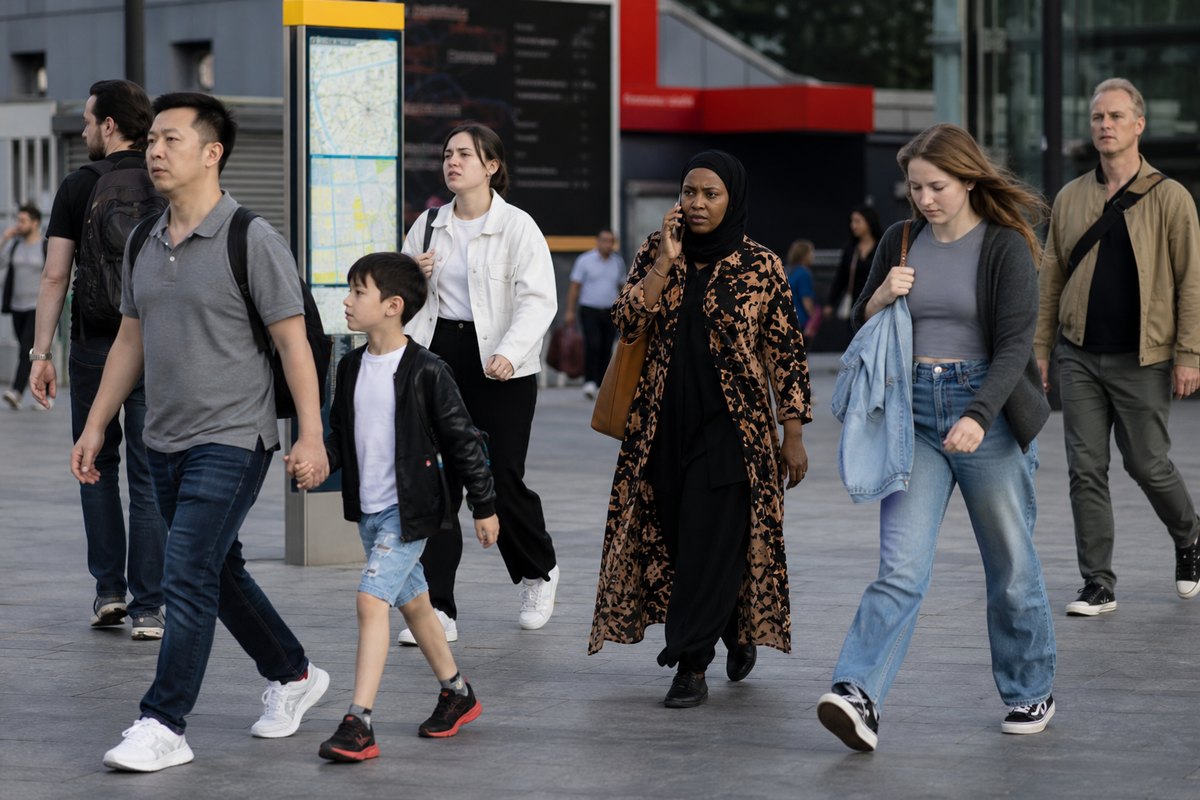
Inequality often hides inside the average because an aggregate figure can improve while part of a community loses access, time, safety, or the power to decide. A neighbourhood may reduce energy consumption while leaving vulnerable households cold; a digital service may raise overall satisfaction while excluding people who cannot use the channel; a renewed square may attract more visitors while making some journeys impossible. Communities that test the future do not reject shared indicators, but they refuse to mistake them for the whole experience. They ask who benefits, who pays, who is missing from the measurement, and which correction would make progress genuinely shared.
The future as a common practice is not a finished innovation displayed before a passive audience. It is a limited change, tested openly, whose distributive effects are observed and whose direction the community retains the power to alter. This discipline combines disaggregated data with testimony, maps, waiting times, incident records, and routes for complaint. It also recognises that equality and equity are not synonyms: offering everyone the same thing can perpetuate disadvantage when starting conditions differ. The professional question is not merely whether the average rises. It is whether the minimum outcome improves and avoidable gaps narrow without transferring harm to another group.
An average summarises, but it also erases#
A mean converts many experiences into a single value. That operation is useful for comparing periods, detecting trends, and communicating scale, but it loses the shape of the distribution. Two communities can report the same average income, travel time, or satisfaction while containing opposite realities. In one, most people may be close to the central result; in another, a minority holds nearly all resources while many remain far behind. The number does not lie, but it answers a question that is too narrow. When it becomes the only definition of success, what it cannot represent stops receiving institutional attention.
A mean converts many experiences into a single value. That operation is useful for comparing periods, detecting trends, and communicating scale, but it loses the shape of the distribution.
A community trial should therefore establish at the start which forms of disaggregation are relevant and legitimate. Age, gender, disability, income, location, household type, or access channel may reveal barriers, although collecting all of them is rarely justified. The selection must serve the purpose, protect privacy, and avoid labels that expose small groups. Sometimes comparing deciles, ranges, or areas will be enough; sometimes qualitative inquiry will be indispensable. The central lesson is not to wait until the end to discover that the winning indicator concealed a concentrated loss. Measurement design is part of intervention design.
From formal equality to verifiable equity#
Formal equality asks whether every person received the same offer. Verifiable equity asks whether people could turn that offer into a comparable opportunity. A call published only online may be open to everyone and remain inaccessible to someone without a connection, fluent reading, spare time, or support. An identical fee may look neutral while consuming radically different proportions of household income. A common schedule may suit office workers and exclude carers, shift workers, or people dependent on infrequent transport. Conditions of use matter as much as nominal availability.
Measuring equity requires a threshold of sufficiency, not only the pursuit of maximum aggregate performance. It might mean that no household loses a safe temperature, every resident retains an in-person channel, an accessible route stays within an agreed distance, or no complaint remains unanswered beyond a deadline. The team can then observe both gaps between groups and the intensity of burdens. A small percentage difference may conceal severe harm when an essential need is involved. Analysis must combine scale and severity, giving priority to harms that compromise rights, dignity, or participation.
Case 1: energy efficiency that leaves particular homes cold#
A housing cooperative installed sensors and automated heating to reduce energy use. After three months, average consumption had fallen by twelve per cent, and the project was presented as a success. Yet complaints came mainly from corner flats, ground-floor homes, and households with older residents. The building's mean temperature met the target, but its spatial distribution showed persistent differences. The incident form was also digital, and several residents reported the problem to relatives rather than recording it, so the dashboard underestimated the harm.
The cooperative paused expansion and measured temperatures by housing type, with consent and short retention periods. Technicians and residents walked through the spaces, identified weak insulation, and tested simple manual controls. Final savings were smaller, but no household fell below the agreed thermal threshold. A telephone channel was added, renovation prioritised the most exposed homes, and the board published the range and number of unsafe hours alongside the mean. The case showed that addressing inequality need not abandon efficiency. It requires refusing to finance efficiency with the invisible discomfort of people whose starting conditions are worse.
Case 2: a digital counter with rising satisfaction#
A municipality moved several procedures onto a single platform. Average processing time fell and digital surveys showed high satisfaction. Missing from those surveys were people who abandoned the process, repeatedly visited a library for help, or paid an intermediary to exercise a simple right. By comparing anonymous start and completion records across devices and postal areas, the team found much higher abandonment in certain neighbourhoods. Interviews revealed administrative language, incompatibility with older phones, and an identity system that was difficult to recover.
The municipality treated these signals as service defects, not deficits in citizens' ability. It retained the in-person route, opened assisted appointments in neighbourhood centres, simplified instructions, and tested the journey with first-time users. Its principal indicator expanded from the duration of completed applications to include completion, cost borne by the applicant, number of attempts, and resolution at first contact. A monthly barrier review was also established. Average satisfaction remained useful, but no longer spoke on behalf of absences the survey could not reach. The service improved because failed access became design evidence.
Case 3: a busier square that becomes less accessible#
A neighbourhood association and municipality tested seating, plants, and activities in an underused square. Counts showed more visitors and longer stays. The initial assessment celebrated the increase, although several people with reduced mobility avoided the place because planters and terraces narrowed the route. Families with young children appreciated the atmosphere, while night workers experienced more noise. Total uses did not reveal who had lost a previous possibility or which hours concentrated the burden.
The team organised accessibility walks, observations at different times, and a meeting with residents, businesses, and users. It redrew continuous routes, reserved backed seating, moved noisy activities, and established verifiable time limits. It also documented conflicts without reducing them to votes: a majority could not cancel an access need, but no individual interest was automatically beyond discussion. Six weeks later, the square retained much of the added activity and recovered safe journeys. The important learning was not a perfect configuration. It was a method for detecting concentrated costs and correcting them before the intervention became permanent.
What to measure when a mean is not enough#
A responsible dashboard can combine four layers. The first describes volume: people served, energy saved, visits, or time. The second shows distribution: percentiles, ranges, geographical differences, and the proportion below a minimum. The third records friction: abandonment, travel, extra tasks, complaints, and exceptions. The fourth captures experience through brief interviews, diaries, observation, and deliberative spaces. No layer replaces the others. Stories without scale may overrepresent available cases; numbers without context may classify as choice what was actually a barrier.
Absence must also be measured. Who did not reach the meeting? Who started a procedure and disappeared? Who stopped using the space? Who depends on another person to participate? Non-response is not merely statistical noise when it concentrates within one group. The team can use alternative channels, trusted intermediaries, or deliberate samples without turning listening into surveillance. It should publish limits, uncertainty, and changes in definitions. When a category includes very few people, privacy takes precedence over detail; the organisation can group results or present qualitative findings without identification.
Participation with the power to change the test#
Inviting comment after objectives, metrics, and budgets have been fixed turns participation into decoration. For the trial to be common, affected people must enter earlier: helping formulate the problem, identifying outcomes that matter, and defining stop conditions. This does not mean that every decision requires unanimity. It means the authority discloses constraints, answers objections, and leaves a trace of what changed and why. Participation needs payment or support when it demands time, care arrangements, translation, or travel; otherwise it preferentially hears those who already possess resources.
A small and plural monitoring group can review data during the pilot. It should include frequent users, people at risk of exclusion, operational professionals, and accountable owners with power to correct. Its rules should prevent any single organisation from speaking for an entire group. Sessions can alternate indicator analysis with walk-throughs, demonstrations, and complaint review. Every agreement receives an owner and deadline. When a proposal cannot be adopted, the reason is recorded in understandable language. Consultation then stops being a collection of opinions and becomes infrastructure for shared learning.
Four institutional references for seeing distribution#
The United Nations Development Programme examines inequalities beyond national averages and stresses that human capabilities are unevenly distributed. Through its well-being and inclusion frameworks, the OECD encourages comparison of outcomes across groups rather than aggregate growth alone. The World Bank maintains resources on poverty, shared prosperity, and equity that help identify who participates in economic progress. UN-Habitat places spatial inclusion, accessibility, and participation at the centre of urban planning. These institutions use distinct approaches, but all show why a general indicator needs distributive interpretation.
A community should not copy an international index as though it were a local recipe. It can use these frameworks to improve its questions: which dimension matters, which threshold protects a dignified life, which groups encounter barriers, and what evidence will trigger review. Institutional sources provide concepts, series, and methodological cautions; situated knowledge contributes experiences that no aggregate database contains. Combining them is more demanding than selecting one number, but it is also more honest. It allows the authority to explain both progress and limits and prevents it from choosing only favourable evidence.
Governance, privacy, and responsibility for correction#
Disaggregation is not permission to collect every piece of information. Before asking about a personal characteristic, the team must justify its relationship to a potential inequality, restrict access, define retention, and explain use. Sensitive data should not circulate through improvised spreadsheets or appear in reports that permit reidentification. Where possible, broad categories, voluntary responses, and independent analysis should be used. People must be able to correct data, withdraw consent where applicable, and participate through a channel that does not demand more disclosure than necessary.
Responsibility must sit with someone able to change budget, rules, or design. A report that documents a gap without assigning a response can normalise it. The protocol should distinguish immediate alerts —physical harm, loss of a right, discrimination— from improvements that can be scheduled. It also needs an appeal route and decision record. If a correction reduces the aggregate indicator, the organisation should explain why it accepts that apparent loss: reducing speed, reach, or savings can be the legitimate price of removing an unfair burden. Transparency prevents equity from becoming a slogan without operational consequences.
Testing the future means sharing the power to correct it#
Before starting a pilot, the community can write a short charter covering purpose, duration, potentially affected groups, thresholds, minimum data, participation channels, and authority to stop. During the test it compares general and distributed results, searches for absences, and publishes changes. At closure it decides whether to retain, adapt, or withdraw the intervention, stating how harm will be repaired and learning preserved. A later review checks whether gaps have returned or moved elsewhere. This cycle turns experimentation into a practice of government rather than a technological demonstration.
The average will remain valuable: it offers a common view and prevents isolated cases from becoming the entire picture. But it should be an entrance, not a verdict. A future-facing community asks who remains below the line, who bears variability, and who was not counted. It then provides resources and authority for correction. Shared progress does not require identical experiences; it requires that no avoidable disadvantage disappear for statistical convenience. When measurement preserves meaningful differences and participation can change decisions, the future stops being a spectacle and becomes genuinely common work.