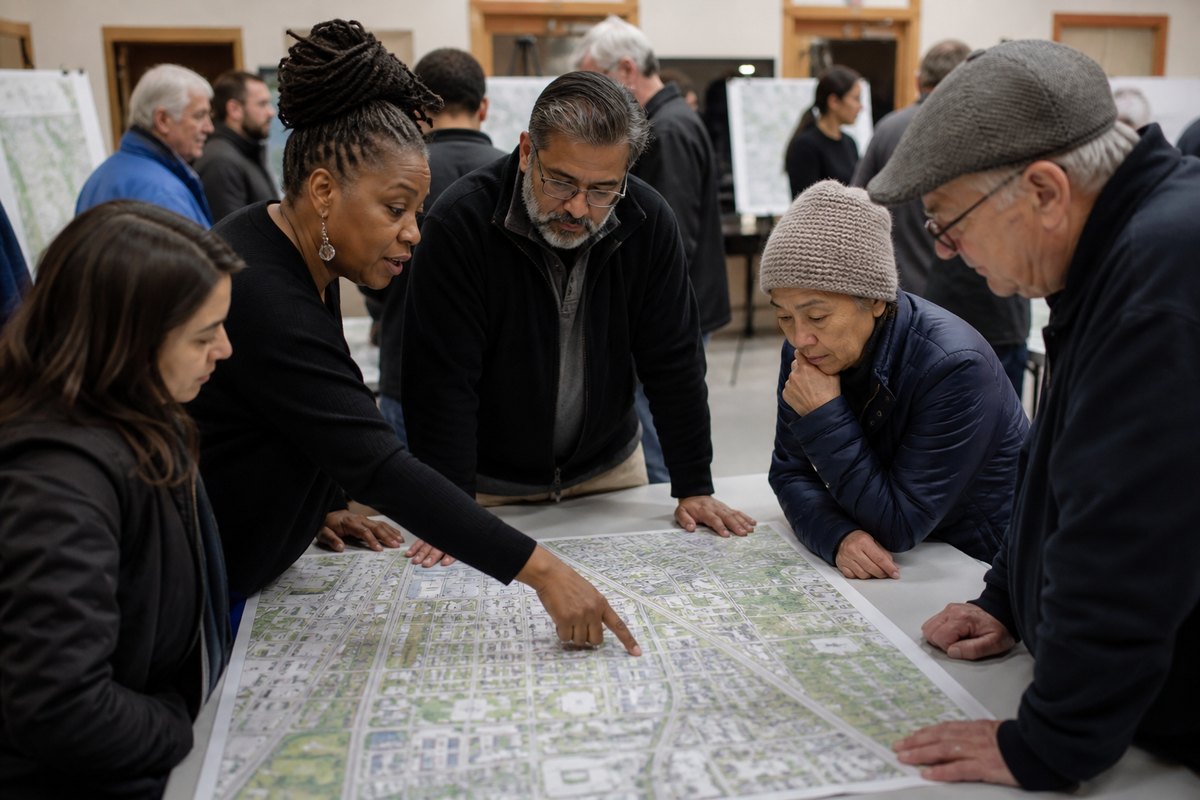
Participating before changes decisions, then only decorates them. A consultation held after the contract has been signed, the budget allocated, and the tool selected may fill a room, generate surveys, and produce an immaculate report, yet it can hardly alter the direction. Democratic participation becomes meaningful when people know what remains open, receive enough information, and can exercise influence before the alternatives disappear. Across networks, media, classrooms, neighbourhoods, and institutions, that distinction determines whether truth is built as common infrastructure or administered as an official version to which comments may merely be attached. A community does not need every proposal to be accepted. It needs evidence that its knowledge arrived in time, was examined against public criteria, and received a response capable of changing a decision.
Early participation is not a ceremony of courtesy. It is a method for discovering needs, conflicts, and consequences that no central team can see completely. A service user knows its everyday friction; a maintainer understands technical dependencies; a caregiver notices time costs absent from the budget; and a person who experiences discrimination recognises barriers invisible to the majority. Bringing those perspectives together before a choice is made improves the information and distributes power. Collecting them afterwards turns valuable experience into observations with nowhere to go.
The principle also protects trust. When an institution asks a question and then proceeds exactly as planned without explaining why, it teaches people that speaking consumes energy but produces no consequences. The next invitation attracts fewer responses, greater cynicism, and even less representative participation. Decorative engagement is not neutral. It weakens the relationship, rewards those able to persist for months, and allows the fatigue of those who withdrew to be presented as consensus.
The difference between listening and allowing influence#
Listening is essential, but it is not sufficient. A person may be received politely and still have no ability to change the problem being described. Influence requires at least one genuinely open decision: selecting among alternatives, changing criteria, establishing safeguards, ordering priorities, reserving resources, or stopping a trial. If nothing can change, the event should be called an information session rather than a participatory process. Accurate naming prevents false expectations.
Listening is essential, but it is not sufficient. A person may be received politely and still have no ability to change the problem being described.
Before opening a consultation, an organisation needs to publish its scope. It should explain who will decide, which legal or budgetary constraints apply, what timetable will be followed, and which matters are outside scope for a verifiable reason. It should also say how conflicting contributions will be handled. Democracy is not a matter of adding preferences as if they were interchangeable votes when rights, evidence, and impacts differ. It is a comprehensible procedure in which reasons can be tested and the authority remains answerable for the final choice.
The quality of the process also depends on the information available. Asking for views on an algorithmic system without explaining which data it uses, what errors have been observed, and what alternatives exist transfers every advantage to the vendor. Asking about an urban plan without accessible maps, costs, or scenarios forces participants to decide blindly. The institution has a duty to translate complexity without concealing uncertainty. A clear summary, complete documents, question sessions, and accessible formats ensure that participation does not depend on specialist status.
Feedback closes the loop. Not every contribution can receive an individual ruling, but a final report can group proposals, identify agreements and disagreements, and explain what changed. It should also show what did not change and why. Vague statements that views will be considered do not demonstrate influence. Useful traceability connects the problem, evidence, alternative, decision, accountable owner, and review date. Common truth grows stronger when disagreement is documented instead of deleted to manufacture unanimity.
The point of entry distributes power#
Timing appears administrative, but it determines who can act. At the beginning of a project there is more uncertainty and there are also more options. Near the end there is greater detail, while the financial and reputational cost of change has multiplied. Inviting the public only in the last phase demands precision when no room remains. Responsible participation combines moments: it identifies needs before design, compares alternatives during development, tests with diverse people, and evaluates after implementation.
Early involvement does not require the community to draft a complete solution. The public authority or company retains its professional duty. Its role is to frame honest questions, provide technical knowledge, protect rights, and make a reasoned decision. Participants contribute situated experience, priorities, and warnings; they should not carry responsibility for resolving legal conflicts or financing the proposal. Shifting that burden privileges organisations with specialist staff and excludes people whose principal resource is lived experience.
Anticipation can even change the definition of the problem. A council may believe it needs an app for reporting street faults while residents explain that the real obstacle is the absence of a response, not the channel. A school may seek a tool for monitoring devices while students and families identify contradictory rules and a lack of trusted spaces. If the technology has already been purchased, those observations become interface adjustments. If they arrive earlier, they can prevent an investment that never addressed the need.
Some urgent decisions cannot accommodate a lengthy consultation. Urgency, however, does not remove the duties to explain, limit, and review. An institution can adopt a temporary measure, publish the available evidence, open an accessible channel, and set a near review date. An exceptional measure becomes undemocratic when it silently turns permanent. Later participation is valuable when it can correct, revoke, or repair. It ceases to be decorative when a real exit remains.
Who participates and who is converted into an absence#
An open invitation does not guarantee fair representation. Participation is easier for people who understand institutional language, have time, command the technology, and trust that speaking will not produce retaliation. People with rigid shifts, caring responsibilities, disabilities, limited connectivity, language barriers, or prior experiences of contempt are more likely to be missing. If the institution reads that absence as indifference, it reproduces inequality under an appearance of neutrality.
Design therefore needs several doors: in-person and remote meetings, oral and written contributions, different hours, easy-read materials, interpretation, expense support, and cooperation with trusted organisations. Not every issue requires every measure, but each barrier warrants examination. Paying travel or care costs does not purchase opinions; it prevents the right to participate from depending on the ability to absorb a private cost. Accessibility is not a marginal adjustment. It is a condition for knowing reality.
Who frames the questions matters too. A survey that offers only two products prevents participants from proposing that neither is needed. A meeting that opens by describing one option as inevitable conditions the discussion. Facilitation should admit objections, minority proposals, and questions about the original assumptions. Listening should be separated from commercial advocacy, conflicts of interest should be documented, and safe channels should be available when public intervention could expose a participant.
Deliberative selection can complement an open call. Civic lotteries, demographically diverse panels, interviews with affected groups, and sector forums provide different forms of knowledge. No single mechanism represents an entire community. Combining methods helps identify which voices repeat, which silences persist, and where an apparent majority might impose disproportionate harm. Fundamental rights are not subject to popularity; participation helps institutions understand how to protect them in practice.
Three cases in which timing changed the outcome#
Case 1: a school platform before procurement#
A school district prepares to procure a platform combining grades, messaging, and attendance tracking. Instead of presenting a final demonstration, it first publishes the problems it wants to solve and invites students, families, teachers, administrative staff, and data protection officers. Families with shared custody explain that a single household account could disclose information or prevent access. Students warn that constant alerts turn every delay into exposure. Teachers note that duplicate records would increase workload and errors.
Those contributions change the tender: granular permissions, independent accounts, notification limits, data export, an accessibility assessment, and an equivalent non-digital route become requirements. Two popular products no longer qualify, and the district runs a pilot with an exit option. Participation does not select a vendor by acclamation. It changes the criteria before price and contract close the decision. The feedback report shows which requirements emerged from each group and which legal limits were not open to negotiation.
Case 2: the square whose plan was already complete#
In another municipality, the design for a public square is presented after construction has been awarded. The meeting allows people to choose the colour of the benches and the name of the space, but shopkeepers, teenagers, and older residents discover that the layout cannot change. They identify insufficient shade, an inaccessible route, and the loss of an informal play area. The council calls the session co-creation and publishes photographs of attendance. Months later, the square attracts visitors on opening day and remains empty during hot hours.
The evaluation acknowledges that the consultation merely decorated the outcome. For the next phase, the council opens a study of uses before preliminary design, installs temporary elements, and observes the site at different times. Tests show where shade is needed, which route avoids gradients, and how rest, play, and economic activity can coexist. Repair cannot recover the entire earlier budget, but it changes furniture and planting, publishes the cost of the error, and adopts a rule: no future project will be called participatory unless contributions can alter location, programme, or criteria.
Case 3: content moderation with those carrying the harm#
A social network plans stricter harassment filters. Before deployment, it consults rights organisations, moderators, researchers, and communities exposed to coordinated violence. People who document abuse explain that systems often remove their reports for repeating offensive terms, while hostile campaigns learn to use coded language. Moderators describe quotas that prevent contextual reading. The platform shares protected error data and permits several rules to be tested with simulated content.
The process leads to distinctions among attack, quotation, and reporting; creates a rapid appeal for serious consequences; improves moderator support; and sets language-specific reviews. The company retains the final decision and refuses to publish details that would facilitate evasion, but it explains that limit and documents the changes. Six months later, an independent audit compares false positives, repair time, and the distribution of harm. Early participation does not abolish conflict, but it prevents safety for the majority from silencing the very people seeking protection.
How to design participation that can be verified#
A credible process begins with a short public charter. It states the purpose, open decisions, accountable authorities, affected participants, starting information, methods, timetable, resources, and feedback route. It adds success criteria: reasonable diversity, comprehension of materials, changes attributable to contributions, quality of reasons, and access to challenge. Counting attendees or comments is useful, but does not prove influence. One hundred identical responses may contribute less knowledge than a well-supported warning about serious harm.
Data governance needs particular care. A consultation may collect political views, location, age, or sensitive experiences. It should request only what is necessary, explain its use, restrict access, and set deletion periods. Publication must prevent combinations of details from identifying vulnerable participants. If private tools are used, the institution remains responsible for their terms, security, and accessibility. Participation should not require acceptance of commercial tracking unrelated to the stated purpose.
Evaluation should happen during the process, not only at the end. If a key group is absent, the materials are misunderstood, or a decision overtakes the announced timetable, correction is still possible. A monitoring committee with sufficient independence can review incidents and require changes. Minutes should capture arguments, not merely names. Where disagreement remains, preserving a minority note improves institutional memory and allows a later review to determine whether a dismissed warning proved correct.
Final responsibility is not dissolved among participants. The person or body with authority should sign the decision, explain how evidence, rights, costs, and contributions were weighed, and set a review. Participation is not a shield for claiming that the community decided. If a measure causes harm, the institution must investigate and repair it even if a majority supported the choice. It may likewise reject a popular proposal that violates rights, provided that it offers clear reasons and alternatives.
Institutional sources for moving from consultation to influence#
The following public frameworks help assess the quality of a process. They come from institutions with different mandates, yet converge on the need to open decisions, provide information, include affected groups, return results, and accept responsibility.
- OECD, Guidelines for Citizen Participation Processes. They present a ten-step path for designing, implementing, and evaluating participation, with attention to purpose, selection of methods, and accountability. Institutional publication.
- Council of Europe, Code of Good Practice for Civil Participation in the Decision-Making Process. It distinguishes information, consultation, dialogue, and partnership, linking each level to commitments by public authorities and civil society. Official resource.
- UNESCO, Guidelines for the Governance of Digital Platforms. They place multistakeholder participation, human rights, transparency, and due diligence at the centre of governance in digital environments. Institutional guidelines.
- European Commission, Better Regulation Guidelines and Toolbox. They integrate consultation, evidence, impact assessment, and review into the policy-making cycle. Official portal.
These sources do not supply a universal template or turn every view into a command. Their value lies in testable questions: whether the decision remained open, whether information made it understandable, whether barriers were identified, whether authority responded, and whether review exists. Context determines the method, but does not remove the duty of honesty. An institution may consult narrowly and well when it explains the limit; it loses legitimacy when it promises influence and organises only an audience.
Common truth needs decisions that remember who spoke#
Early participation produces more than better projects. It builds democratic memory. It records which risks were raised, which alternatives were rejected, and which reasons supported the choice. That memory enables correction without rewriting the past. It also reduces dependence on rumours because the community can compare the official narrative with documents, responses, and observable changes.
Curiosity prompts the question of what knowledge is missing. Responsibility identifies who decides and who repairs. Care recognises that intervention has costs and that not everyone can endure the same exposure. Together, those values turn consultation into infrastructure: a system where information circulates, power answers, and disagreement retains dignity.
Participation does not mean speaking in front of a closed decision; it means finding an open door and knowing who will answer when it is crossed.
When an invitation arrives early, it can still change the problem, budget, contract, rule, and evaluation. When it arrives later, it is valuable only if it retains the capacity to review or repair. The decisive test is not the number of workshops or the polish of the final report. It is a simple question: what decision was different because those people were present? If there is a concrete answer, participation left a trace. If there is none, the decoration may be attractive, but common truth is still waiting for a place at the table.