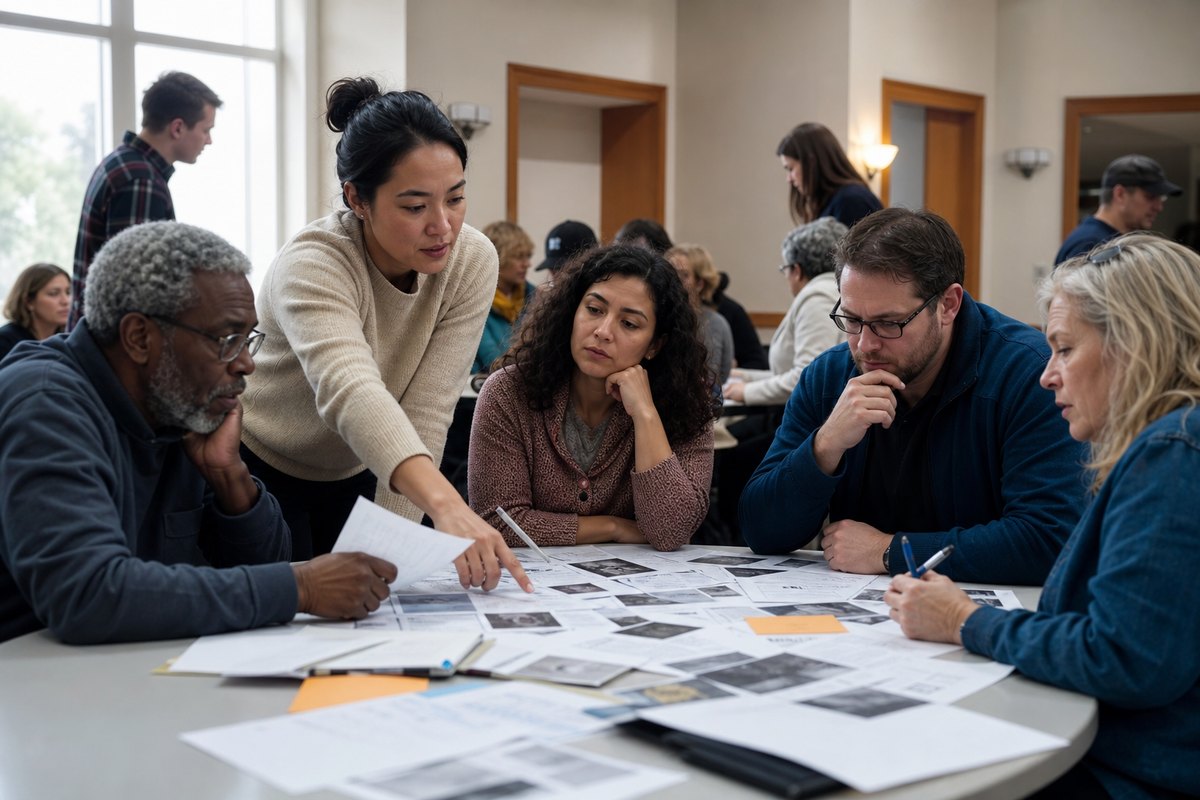
Participating before changes decisions, participating only afterwards decorates them. In dignified work in the automatic era, the consultation gathered opinions without delivering any ability to influence.
A meeting held after the vendor has been contracted, the indicators fixed, and the timetable closed can produce photographs, minutes, and courteous words. It does not, however, produce effective participation. Anyone arriving at that stage can comment only on secondary details or legitimise a direction chosen elsewhere. The timing difference may look small, yet it separates a right to intervene from the ritual of being heard.
Workplace automation makes that distinction particularly visible. A shift allocation system, an assistant for handling enquiries, or a machine that reorganises care does more than accelerate a task. It distributes time, autonomy, information, exposure to risk, and the ability to appeal. If affected people encounter the tool after deployment, their experience enters as incident reports. If they participate beforehand, that experience can change requirements, data, limits, and success criteria.
Participation does not mean that every preference must become a decision or that an organisation gives up coordination. It means that sufficient information, timely engagement, suitable representation, and a reasoned response exist. It also means that something substantive remains open. A dignified consultation may end without accepting a proposal, but it should explain why, record disagreement, and preserve a route for reviewing the outcome when new evidence appears.
Power can be recognised through a simple test: the organisation can ask what the workforce's intervention could change. If the answer is limited to a screen colour, a channel name, or the order of training while productivity, surveillance, staffing, and sanctions remain outside discussion, participation is ornamental. If a contribution can stop an unsafe pilot, extend time, remove a metric, or preserve a human alternative, a genuine capacity to influence exists.
The following three cases are educational composites. They combine plausible situations in industry, public service, and care, but they do not describe events at an identifiable company or replace employment, safety, or legal assessment. Their purpose is to compare two moments of consultation: one arriving afterwards to explain a decision and one opening beforehand to modify it. In each case, the technology matters less than the architecture of authority accompanying it.
Participation before adoption needs information, time, and an open decision#
Early participation begins before drafting procurement specifications or buying a licence. At that stage, the problem should be defined without confusing it with a preferred solution. Reducing waiting, preventing injuries, or improving continuity are objectives; installing a particular algorithm is not. Separating these levels lets workers propose organisational, training, staffing, or maintenance changes that may address the need with fewer data and less dependency.
Early participation begins before drafting procurement specifications or buying a licence.
Information needs to be understandable and sufficient. A sales demonstration is not enough. The system's purpose, affected tasks, collected data, assessment rules, possible recipients, known failures, total cost, and exit conditions are all relevant. Where uncertainty exists, it should be presented as uncertainty. A table separating facts, assumptions, and promises provides a more honest basis than a presentation in which every doubt is recast as resistance.
Time is part of the design too. Participation outside paid hours, with documents delivered the day before, or during the busiest period predictably excludes carers, shift workers, and people needing accessibility support. Paid time is needed for understanding, consultation, and alternatives. Translation, easy-read material, remote participation, and confidential channels are not favours; they correct barriers that would otherwise decide who gets to speak.
Representation requires looking beyond the most visible people. A system may affect permanent and temporary staff, contractors, apprentices, disabled workers, night teams, and people performing invisible coordination in different ways. An average of opinions cannot replace this diversity. Groups with particular exposure should be identified and enabled to contribute without depending on permission from the manager whose performance will be judged by the project's outcome.
Success criteria and harm limits should be agreed before the pilot. Productivity cannot be the only measure if the system also changes rest, intensity, quality, privacy, or access to employment. A baseline should be recorded, outcomes disaggregated, and thresholds set to trigger review or suspension. The person able to stop the system needs a name, authority, budget, and an operational alternative. A pause button with no practical replacement is merely an image of control.
Responses to contributions close the cycle. Every material proposal needs a short trace: accepted, partly accepted, awaiting a test, or rejected, with a reason and owner. Feedback prevents knowledge from disappearing into meeting minutes. It also supports an assessment of participation quality: how many decisions changed, which groups intervened, which disagreements remain, and when they can be reconsidered.
Real consultation continues during use. Automated systems change through updates, new data, local adjustments, and habits nobody anticipated. Initial authorisation should therefore not be treated as permanent. Every material modification needs notice, assessment, and a capacity to respond. Early participation is not a single ceremony but a learning infrastructure accompanying the entire life cycle.
Case one: the shift planner that arrived with the roster closed#
In the first composite case, a factory purchased an automated planner to cover production peaks. Management negotiated price, integration, and launch date with the vendor. Two weeks before deployment, it presented the system to the works council and opened a suggestion box. The algorithm's objective had already been set as minimising hours without production, and it could change shifts with forty-eight hours' notice.
Workers explained that this period would particularly affect single-parent families, people sharing transport, and staff with scheduled treatment. The response stated that the contract did not allow changes to the engine during its first year. Email alerts and a guide for requesting exceptions were added. The consultation collected real needs, but it could only decorate a rule already turned into a technical obligation.
Average coverage improved during the first month. At the same time, informal swaps, absences, and resignations rose among people with the least room for adjustment. Exceptions required disclosure of personal reasons to the immediate supervisor, and handling them counted as a deviation. The system looked efficient because part of its cost moved to family networks, colleagues, and people who left before appearing as a sustained problem.
A review restarted the decision from the problem. A group involving production, prevention, worker representatives, transport, and staff from several shifts was convened. The objective ceased to be maximising availability and became meeting demand without degrading predictability, rest, or equality. Three options were compared: improving voluntary pools, hiring additional staff, and adapting the planner with negotiated constraints. That comparison changed the relationship with the vendor.
The later pilot set a normal fourteen-day notice period, limited late changes, and prohibited penalties for refusals outside declared availability. Preferences were stored as categories without requiring disclosure of diagnoses or family circumstances. Every proposal displayed a reason, allowed a simple correction, and reached an accountable person. Paid time was reserved for representatives and teams to review patterns during the pilot.
Indicators covered staffing, overtime, late changes, reported fatigue, absence, turnover, and differences by contract type. A high-demand week served as a stress test. When the late-change threshold was exceeded, the named owner paused automated allocation and activated the planned human pool. That pause was not treated as pilot failure. It showed that the limit worked.
Early participation did not eliminate the conflict between productive flexibility and predictable lives. It turned the conflict into a visible, negotiable decision. The tool remained in use, but with different objectives, a vendor required to document changes, and quarterly review. Workers did not gain a veto over every shift; they gained the ability to modify the rules distributing the cost. That ability separated consultation from decoration.
Case two: the service assistant that cut time before testing quality#
In the second composite case, a customer service unit introduced a generative assistant that drafted replies. The purchase promised more resolved cases with the same workforce. Before staff used the tool, the organisation reduced the standard time per enquiry and announced the change as an improvement. It then held workshops asking about tone, templates, and the format of suggestions.
Agents noted that some enquiries required checks of contracts, vulnerable circumstances, or local rules. They also warned that a convincing reply could contain an invented condition. Yet an adherence indicator already rewarded acceptance with few edits. The workshop could replace cold phrases and add examples, but it could not revisit allocated time or the metric. Participation polished the voice of a closed decision.
Human work began to disappear from the figures. Agents corrected text, found sources, and reassured confused people, but that effort appeared as delay. Experienced staff detected more failures and received worse adherence results. Recently hired colleagues trusted drafts more readily. The system produced a paradox: professional competence needed to preserve quality became a sign of weak performance.
The second phase was designed with prior participation. Agents, supervision, quality, data protection, accessibility, and worker representation formed a team. Before choosing targets, it classified enquiries by risk and measured actual time without the assistant. Workers identified tasks where a draft could reduce repetition and others where conversation, verification, or empathy should not be compressed.
The new pilot preserved reference times until quality was demonstrated. For high-impact enquiries, the tool had to link the source used or abstain. A button marked doubt, error, or bias without harming individual appraisal and automatically saved the version and context. Text accepted without edits was sampled too, because examining only corrections would have hidden errors that nobody detected.
Outcomes included accuracy, complaints, first-contact resolution, mental workload, corrections, accessibility, and total time, not speed alone. When one category showed repeated errors, the accountable manager could remove it from the assistant without awaiting a general update. Findings were returned every two weeks, and every model change opened a limited test before broader use.
The organisation kept the assistant for well-defined tasks and abandoned automatic time cuts for complex cases. Agents' experience stopped arriving afterwards as resistance or editorial polish; it entered beforehand as design knowledge. A perfect tool was not guaranteed. Something more testable was achieved: no speed gain could become permanent without evidence that it did not depend on invisible corrections or greater risk for a claimant.
Case three: the care robot presented after its route was decided#
In the third composite case, a residential home wanted mobile robots to carry linen, food, and supplies. The project sought to reduce physical loads and release time for care. Management selected a model after a demonstration in an empty corridor and drew routes on floor plans. Once installation was contracted, it informed care assistants, cleaners, kitchen staff, residents, and families in separate sessions.
Care assistants said trolleys crossed paths during washing and shift changes. Cleaners warned about wet floors and fire doors. Several residents explained that the sound alert was difficult to locate and some people might try to help the robot. The vendor offered a different volume, stickers, and friendlier messages. Route, speed, and operating time remained out of reach.
In early trials, the robot reduced some journeys from storage but created new waiting. When it blocked a corridor, staff moved trolleys and accompanied residents to prevent confusing encounters. These tasks were not recorded. A near incident showed that the system poorly recognised a walking frame at an angle. The later explanation insisted that staff needed to adapt, although the real environment had never informed the choice of machine.
The home suspended expansion and reopened the project. A group included residents with different abilities, relatives, care assistants, cleaning, kitchen, maintenance, prevention, and worker representatives. Observation redefined the problem: which loads caused risk, at which times, which journeys consumed time, and which tasks required human presence. An option concealed by the sales demonstration emerged: reorganising storage and deliveries before automating every trip.
A narrower scope was tested, using short routes outside intimate care periods. Residents received accessible explanations and could refuse robot entry in particular zones. Staff gained authority to stop it with a physical control and a procedure that did not affect appraisal. Every blockage, intervention, and displaced task was logged alongside reduced load. Privacy review ensured that sensors could not be repurposed for performance surveillance.
A simulation included a closed door, a spill, a disoriented person, and a network outage. The robot failed safely in three situations and blocked an exit in the fourth. That result prompted a route change and human check, not blame for those who altered the scenario. Manual trolleys and enough staff were retained so work could continue whenever the machine was unavailable.
The final project was smaller than the original purchase and more useful for care. It reduced particular lifts without imposing automated presence in sensitive spaces. Participation by residents and workers changed purpose, routes, timing, data, and continuation criteria. The case showed that consultation afterwards can adjust signals; participation beforehand can decide where technology makes sense and where dignity requires it to stay out.
Four institutional sources and a protocol for demonstrating influence#
The International Labour Organization's guidance on business and occupational safety and health treats active participation by workers and representatives as essential to preventive management and notes the need for time and resources. This supports the view that listening is insufficient when people lack conditions for intervention. Concrete application depends on the law and bargaining arrangements in each setting.
The OECD chapter on social dialogue and artificial intelligence in Employment Outlook 2023 examines how social partners can influence adoption, training, and working conditions. It does not offer a universal recipe or turn statistical association into automatic causation. It provides evidence and questions for designing fairer technological transitions.
The European Agency for Safety and Health at Work's programme on digitalisation brings together research on algorithmic management, automation, and psychosocial risks. Its materials highlight transparency and worker information and consultation. They help assess workload, autonomy, surveillance, and safety, but they do not certify a specific tool by themselves.
Directive 2002/14/EC, available through EUR-Lex, establishes a general framework for informing and consulting employees in the European Union, subject to transposition and scope. It distinguishes providing information from consultation and links the latter with exchange of views and dialogue. Not every decision follows the same process, so competent legal interpretation remains necessary in each case.
A verifiable protocol can be built from these four sources. First, the problem rather than the tool is declared. Information on effects, data, risks, costs, and alternatives then arrives early enough. Affected groups and representatives meet during paid time. Open decisions, success criteria, limits, and pause authority are recorded before contracting. Finally, every contribution receives a traceable response and the pilot retains an equivalent fallback.
The influence record must show more than attendance. It can state which requirement changed, which risk was added, which option was rejected, which protection was strengthened, and which disagreement remains. It should also examine who did not participate and why. If the same roles and shifts always intervene, consultation may reproduce hierarchy even when formally open. Quality is visible in the diversity of knowledge reaching the decision and in the consequence it produces.
A practical test introduces a reasonable contribution before and after contractual closure. If it can alter data, metrics, pace, or scope beforehand but can only modify communication or training afterwards, the organisation has a clear measure of its democratic timetable. A second test asks who can say no, for how long, and with which alternative. A pause that exposes someone to punishment or leaves the service without resources is not real capacity.
Participation before adoption does not guarantee consensus or eliminate mistakes. It reduces the chance that a decision mistakes silence for acceptance and moves knowledge to the place where it can still be useful. In work that does not surrender dignity, automation must be justifiable to those bearing its consequences. Consultation stops being decoration when an ordinary person can identify a risk, propose another route, and verify that the intervention can still change the decision.