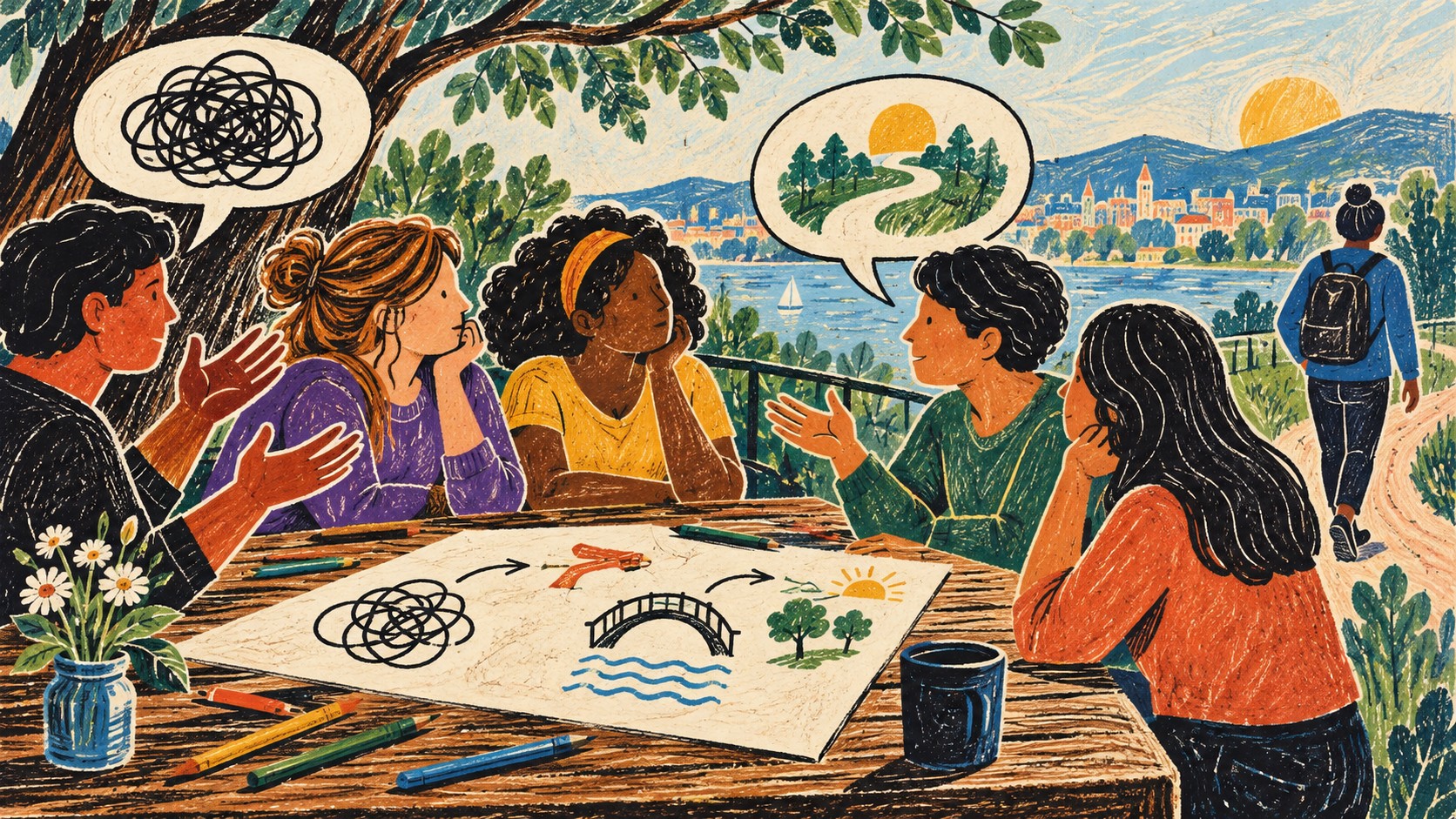
A hurried sentence can reduce a complex experience to a label. In public conversation, care begins by restoring context, not by winning an argument.
The scene that looks small#
a residents meeting muestra cómo a sentence turns one isolated gesture into character. En esa situación, it helps to name what was seen and what remains unknown. For example, someone might say: “We do not know why it happened; let us discuss what affects this moment.”
a residents meeting muestra cómo a sentence turns one isolated gesture into character.
a pharmacy queue muestra cómo a rumour takes the place of available facts. En esa situación, precision makes it possible to question an idea without fixing an identity. Another person might answer: “That word says too little and may cause harm; perhaps it needs changing.”
a messaging group muestra cómo a question arrives as though it were a verdict. En esa situación, a specific question can replace an attribution of motives. Rather than asking for personal explanations, a group can return to the concrete question it must resolve.
a classroom remark muestra cómo an everyday difficulty is compressed into a closed word. En esa situación, it is useful to separate an action s impact from a person s definition. A listener can correct a rumour without becoming a spokesperson for an unknown experience.
a family meal muestra cómo an anecdote is repeated until it resembles biography. En esa situación, it is more honest to admit that information is missing. A brief intervention can recall that one behaviour does not summarise anyone.
a neighbourhood assembly muestra cómo a disagreement is presented as lack of intelligence. En esa situación, context can be requested without turning it into an obligation. When conversation tightens, its effect can be named while leaving reformulation open.
Describe before concluding#
a news thread muestra cómo an absence is interpreted without knowing what happened. En esa situación, conversation gains room when it accepts a simple correction. No moral superiority is needed to ask for more precise language.
a work break muestra cómo a tired tone is read as bad intention. En esa situación, a sentence can be challenged without speaking for someone absent. Correction can be discreet, especially when someone already carries too much attention.
a market conversation muestra cómo a private decision becomes everybody s business. En esa situación, a pause stops the first interpretation becoming a sentence. Sometimes it is enough not to repeat a story that arrived incomplete.
an improvised discussion muestra cómo a doubt changes into a quick accusation. En esa situación, listening becomes more useful when facts and guesses are separated. A respectful question leaves room for nobody to answer.
a busy library muestra cómo a disagreement is used to divide sides. En esa situación, difference does not vanish, but it stops being a personal attack. Disagreement can remain without manufacturing a simple version of the other side.
a bus stop muestra cómo a partial image seems to explain an entire life. En esa situación, a clear boundary can protect someone who does not wish to be exposed. Withdrawing a comment is also responsibility for what was said.
a friends chat muestra cómo a short message receives an intention it cannot prove. En esa situación, shared uncertainty reduces the urge to choose a side. Chosen silence confirms no rumour and authorises no completion.
A correction that asks for no confession#
a community table muestra cómo a small mistake becomes a lasting mark. En esa situación, revising words returns space for thought. Public conversation becomes more liveable when it tolerates not knowing.
a shared corridor muestra cómo reserve is confused with contempt. En esa situación, a group can change course without humiliating anybody. A group can change subject when the cost of continuing falls on one person.
a visit to the square muestra cómo a correction is treated as defeat. En esa situación, attention to detail reduces accumulated harm. Not every clarification has to happen in front of everyone.
a local radio show muestra cómo another person s habit is called a problem without asking. En esa situación, a brief explanation is enough when privacy is not available. A well placed sentence can stop a chain of interpretations.
a community workshop muestra cómo a request for time is treated as indifference. En esa situación, conversation improves when it stops rewarding the sharpest phrase. Care does not ask for perfection; it asks for willingness to revise.
a public lunch muestra cómo a convenient version covers the nuances. En esa situación, a nuance excuses nothing, yet prevents excessive simplification. Active listening does not require private experience to be shared.
Leaving can also be care#
a waiting room muestra cómo a difficult exchange becomes spectacle. En esa situación, responsible curiosity displaces the taste for diagnosis. Caution protects the right to keep part of a story.
a cultural debate muestra cómo a preference is judged as a flaw. En esa situación, caution is not silence; it is care for what is asserted. A concrete criticism is more useful than a broad adjective.
a neighbourhood court muestra cómo an immediate reaction replaces listening. En esa situación, a response can address an idea rather than a reputation. A relationship is safer when nobody must defend their existence.
an open office muestra cómo a striking word displaces precision. En esa situación, repair begins by removing an unnecessary label. An exchange can end when it no longer seeks understanding.
a doorway conversation muestra cómo a second hand story gains authority. En esa situación, a quiet exit keeps energy for other relationships. Calm does not erase disagreement, but it reduces harm.
In shared spaces, speed often rewards the person who offers certainty before the person who names a doubt. Yet a clearly expressed doubt can stop a group from turning incomplete information into a fixed story. It does not solve conflict alone, but it changes the place from which people speak.
It also matters how correction work is distributed. When one person is always expected to explain why a phrase harms them, the exchange stops being equal. An observer can address the language used, ask for a different formulation, or keep a joke from becoming the group s ordinary rule.
Caring for words does not mean banning criticism or demanding artificial agreement. It means making criticism verifiable: identifying an action, describing its effect, and avoiding motives that nobody can check. That distinction offers a fairer basis for continuing the conversation or deciding that stopping is wiser today.
El lenguaje público no puede eliminar todos los desacuerdos ni ofrecer una explicación completa de cada gesto. Sí puede decidir no añadir una etiqueta cuando faltan datos, no reclamar intimidad como precio de la escucha y no prolongar un intercambio que ya causa más daño que comprensión. Quien lea puede probar una frase concreta, corregir una idea con calma o retirarse sin espectáculo; cualquiera de esas opciones puede preservar un espacio común más digno.