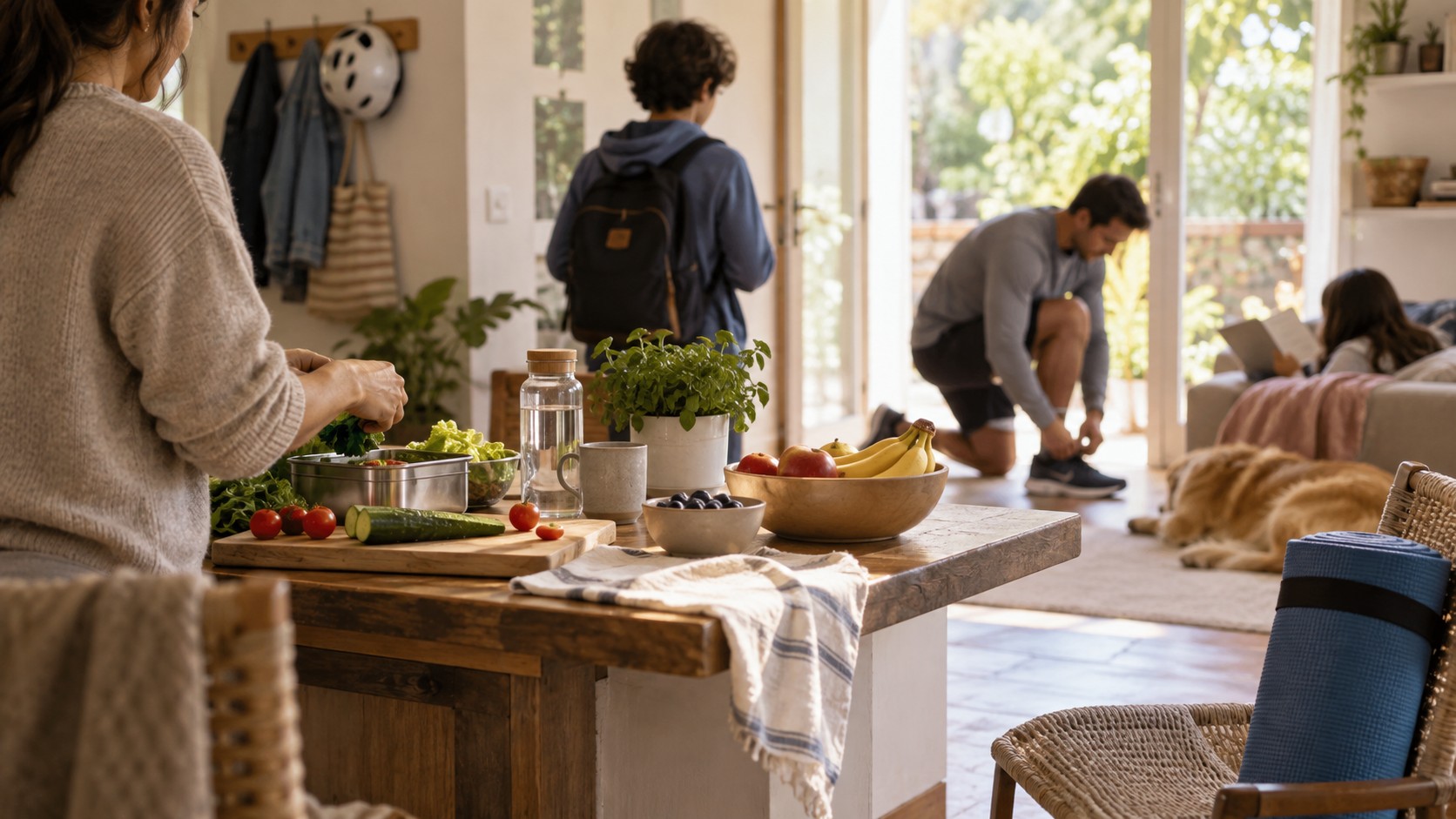
In an imagined scene, a family has a habit of going for a walk after dinner. For several weeks, one person stops joining the walk. Some evenings they say they would rather stay in and read; on others, they want to call a friend or simply be alone. Comments begin at the table: “You always used to come,” “It would do you good to get out,” “You cannot sit around all evening.” None of the remarks is intended to hurt, but together they turn an invitation into an assessment.
The scene does not require anyone to decide whether walking is good, how much rest a person needs, or what explains a change in routine. It asks for attention to an everyday relationship: when a shared habit changes, a family can choose between asking for obedience and trying to understand what space is needed now. That choice does not resolve every uncertainty, but it can keep care from resembling monitoring.
A family habit is not a contract about a body#
Routines help organise life together. They can offer company, shape a schedule, or make a part of the day pleasant. Yet a practice stops being shared when it is used to measure discipline, mood, or personal worth. Not joining a walk does not prove one single cause. It may reflect tiredness, preference, unfinished work, or a wish to be alone. A family does not have to guess which one to be respectful.
Routines help organise life together. They can offer company, shape a schedule, or make a part of the day pleasant.
“We miss you on the walk” communicates affection without making absence a fault. “Would you like us to find another time to be together?” opens an alternative. Both are different from demanding a complete explanation or listing the supposed consequences of not taking part. The difference is that the person's freedom remains intact.
A small scene can reveal a specific need#
A useful conversation does not have to begin with broad labels. It can begin with what happens at the end of a day. Perhaps the person explains that they arrive home saturated with conversation and need twenty quiet minutes. Perhaps they realise they enjoyed walking, but not being asked about food, study, or appearance along the way. Perhaps they do not want to explain anything. Each possibility points to a different need, and none requires someone else to build a hasty theory.
In the scene, someone might ask, “Does the walk feel heavy right now, or is there another part of the evening you would like to organise differently?” The question makes room to discuss a concrete experience rather than an identity. If the answer is that they would rather not talk, that is information too: for now, the relationship needs less insistence.
Reorganising does not mean abandoning a relationship#
When a routine changes, some families fear that accepting the change means giving up care. It does not have to. One person can stay home while another makes tea on their return; the walk can happen once a week; company can be found in another activity chosen together. What matters is that the adjustment is not a test to pass or a concession that will later be collected as a debt.
A small agreement might say, “On Tuesdays we will ask whether you would like to come; if you say no, we will go without insisting.” It can also make clear that the invitation may change again. This kind of clarity reduces repeated arguments and stops every evening becoming a judgment about someone's choice.
Everyday language can remove weight or add it#
Some phrases sound like motivation but add a burden: “It will do you good,” “You have to make an effort,” “You always have an excuse.” They say more about the speaker's interpretation than about what the other person needs. Describing a fact simply and hearing the response protects the relationship better. “You do not feel like going out today; I understand” does not require agreement or complete understanding.
It also matters not to make other people's bodies a family topic. Comparing sizes, stamina, appetites, or abilities can make someone expect to be watched even when no question is asked. Caring co-existence reserves attention for the whole person: their interests, humour, relationships, and decisions, not only for what can be seen from outside.
Help can be offered without directing the answer#
If the change of routine worries the person, they can consider what support they want. Someone close may offer to look for reliable information, find a quieter schedule, or simply listen. The offer does not need to include a solution or a promise of constant follow-up. “If you want to think about this week, I can sit with you for ten minutes” has a clear scope and respects a no.
When questions about physical or mental health arise, it may be appropriate to consult a healthcare professional or relevant service. Family can help with practical matters if requested. It should not interpret signs independently, use concern to impose a routine, or replace professional care with dinner-table opinions.
The end of a day can become calm again#
In the scene, the family decides that the walk will remain an invitation. One person goes out while another stays home without having to justify it. On the return, they share fruit, a song, or a few quiet minutes, according to what feels right. The relationship does not depend on everyone doing the same thing; it depends on no one having to earn the right to be at the table.
There is no formula for every routine. What can support shared life is simpler: observe without turning a scene into a verdict, ask without hiding an order, and accept that an agreement works while it helps. That modesty allows everyday care to be a place to breathe rather than another task to perform. <h2>An invitation can remain without becoming insistence</h2>
A shared routine can remain a possibility rather than a requirement. The following week, a family can again suggest a walk, a film, or time to talk without using the earlier answer as an argument. In that way, today's no is not recorded as permanent distance, and a future yes is not treated as compensation. An invitation remains caring when participation is not turned into proof of affection.