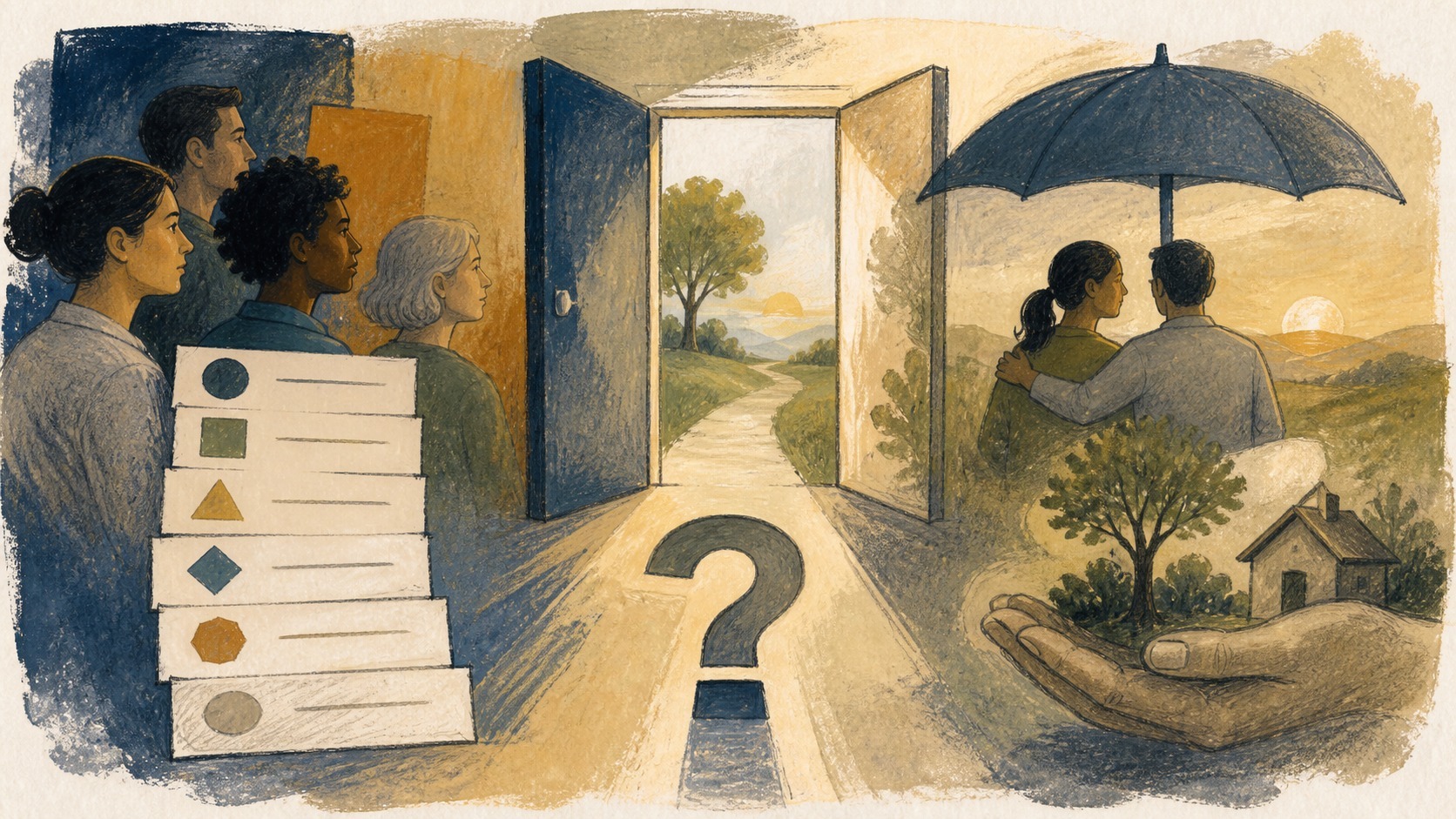
At quarter past nine, the screen in the public advice office had already made a quiet promise: short appointments would go first. Renewing a card, collecting a certificate, or correcting an address carried a predicted duration of ten minutes; requesting a disability adjustment, explaining a recent separation, or rebuilding an incomplete application could take forty. The system did not call anyone “difficult.” It simply sorted a column headed estimated duration. Yet within two weeks, people whose stories would not fit in a form were receiving later slots, postponement messages, and the instruction to come back another day.
Nuria, who staffed the front desk, saw the pattern before the performance dashboard did. A complex appointment returned to the queue when a person could not assemble the documents, explanation, and composure the process required in one morning. The program treated that return as another long request. Straightforward appointments were resolved quickly and improved the daily average; cases requiring listening were left for the point when time had already run out. This was not a spectacular coding failure. It was a priority rule distributing waiting, exhaustion, and the chance of being heard.
The relevant question is not whether sorting appointments saves minutes. It may do so in particular processes. The question is who can change that order once it begins to cause visible harm. A staff survey is not enough if its answer is filed with other suggestions. A vendor explanation is not enough if no one in the office can pause the rule before another person loses a benefit, a medical appointment, or a day’s wages. Having power means being able to interrupt, test a different condition, and require the decision to leave a trace.
Predicted duration is not a neutral measure#
Predicted duration looks like a domestic, almost administrative variable. But it contains assumptions about what counts as work and who can absorb delay. A change of address may be brief for someone with internet access, stable housing, and documents at hand; for a person who has just left shared accommodation, it may involve confusion, missing copies, and fear about disclosing information. The same category does not describe the same effort. When a tool turns those differences into minutes without room for correction, it makes an estimate into a destination.
Predicted duration looks like a domestic, almost administrative variable. But it contains assumptions about what counts as work and who can absorb delay.
That is why three things that are often blended together should be separated. A prediction is a hypothesis about how long an encounter may take. Priority is a decision about who ought to be seen first. Scheduling capacity is a material limit of people, rooms, and shifts. A model may assist with the first; it should not alone decide the second or conceal the third. If there are too few professionals, no formula makes it fair that people needing more time always bear the delay. Naming that limit prevents an organisational shortage from being presented as an unavoidable technical conclusion.
The practical right to pause a rule#
Nuria should not need a friendship with a manager to correct an unfair morning. The system needs an accessible operational pause: a button or clear process allowing staff to suspend automatic ordering for a time window, move a case into a protected appointment, and activate a manual alternative. Pausing does not mean deleting data or stopping service. It means acknowledging that a provisional rule cannot keep producing effects while people establish whether it is harming someone.
That authority needs conditions. Front-line staff, not only technical teams, must know how to use it. There should be a short selectable reason and a free-text note for situations that do not fit a catalogue. It must also prevent retaliation: using a pause under the protocol cannot become a negative productivity marker. If the same pause appears five times for the same reason, the organisation has to review the rule, rather than ask staff to be more patient.
Changing a rule needs boundaries too. It would not be responsible for each person to alter priorities without a shared standard, because that can reproduce invisible arbitrariness. The alternative is public exception conditions: appointments tied to expiring deadlines, risks of harm, accessibility needs, failures by the service itself, and cases where documentation requires explanation. These conditions do not solve everything, but they provide a common language for action and make it possible to check whether they are applied unevenly.
The pause must leave an intelligible trace. The person affected should know that their appointment moved for review, what alternative is offered, and when an answer will arrive. The internal record should retain the rule version, institutional reason for the pause, authorising role, and review result. It need not preserve an entire intimate account or turn the alert into an individual assessment of the person who raised it. It needs enough memory to establish whether a correction happened and whether the failure returned.
A committee that decides, not a consultation ceremony#
Many organisations respond to these problems by creating a listening table. That is a start, but a table with no decision-making capacity can increase frustration: it gathers hard experiences and returns minutes with no consequence. This office’s rule committee needs a written mandate to approve, alter, suspend, or withdraw scheduling criteria. It should meet at a frequency suited to the actual rhythm of harm, and it must be able to call an urgent review when an incident threshold is crossed.
Before approving a change, the committee can require a short note: what problem was observed, which rule version operates today, who is affected, what alternative is proposed, what risk it introduces, what resources it needs, and when it will be reviewed. This is not paperwork intended to delay urgent repair. It prevents a reasonable exception from becoming another opacity. When someone looks at the schedule six months later, they should be able to understand why certain slots were protected and what evidence justified retaining or changing them.
The committee should publish readable decisions: not the sensitive detail of every incident, but criteria, changes, effective dates, and routes for challenge. Publishing does not replace explaining one person’s appointment, but it exposes rules that were never announced and stops knowledge from being scattered through corridors. Useful transparency can say that appointments over thirty minutes have reserved capacity, legal deadlines outrank a prediction, and an estimate can be corrected without penalising the person.
Public criteria that can be contested#
A public criterion is not a list of technical terms or an eighty-page document. It is an explanation that lets people anticipate the path: which factors affect order, which are not used, how an estimated duration is corrected, and what happens if the service lacks enough slots. It should be available online, in the office, and by telephone, in plain language and accessible formats. It also needs a route for requesting an appointment without disclosing more information than necessary in front of a screen or waiting room.
Criteria must allow individual review. Lucia, supporting her brother after an accident, may know that her application requires an hour although the system allotted fifteen minutes. She should be able to request another slot without accounting for her whole life in front of other people. The response needs a deadline and an identifiable responsible role. If refused, it must explain what remedy exists. A public rule that cannot correct the particular case remains a barrier, only now it is printed.
Incidents as evidence of responsibility#
An incident should not vanish into an inbox. Each report needs acknowledgement, minimal classification, a response priority, and a closure explaining what was checked. Classification must not reduce experience to “user error.” It can record an inaccurate estimate, missing accessibility, repeated postponement, unpublished criterion, inappropriate treatment, or technical failure. That makes patterns visible without demanding that each person know the organisation’s vocabulary.
The response must first help the person who reported it. If an appointment has moved three times, repair may be a protected slot, support to gather documents, or an in-person alternative, not a promise that the system will improve later. Collective learning follows: how many reports were resolved, how long the service took, what rule changes were made, and whether they reduced the problem. Counting closed incidents without testing the outcome turns a report into another form of apparent speed.
There must also be an independent route for cases where the office itself does not respond. It might be a guarantees unit, local ombuds service, or review by another team. What matters is access to the rule version and relevant records, with authority to require correction. Without that possibility, the committee supervises itself and the pause depends on the goodwill of people who created the queue.
The next time Nuria sees a person fall to the end of the schedule because they need more help, her intervention should not depend on improvising a favour. She should be able to pause the rule, offer a concrete route, and bring the pattern to a committee capable of changing the timetable. Automation can organise minutes; it cannot by itself decide which lives should pay for its apparent efficiency with hours. The power to decide is demonstrated when a rule can be stopped, contested, and changed before waiting becomes a form of exclusion.