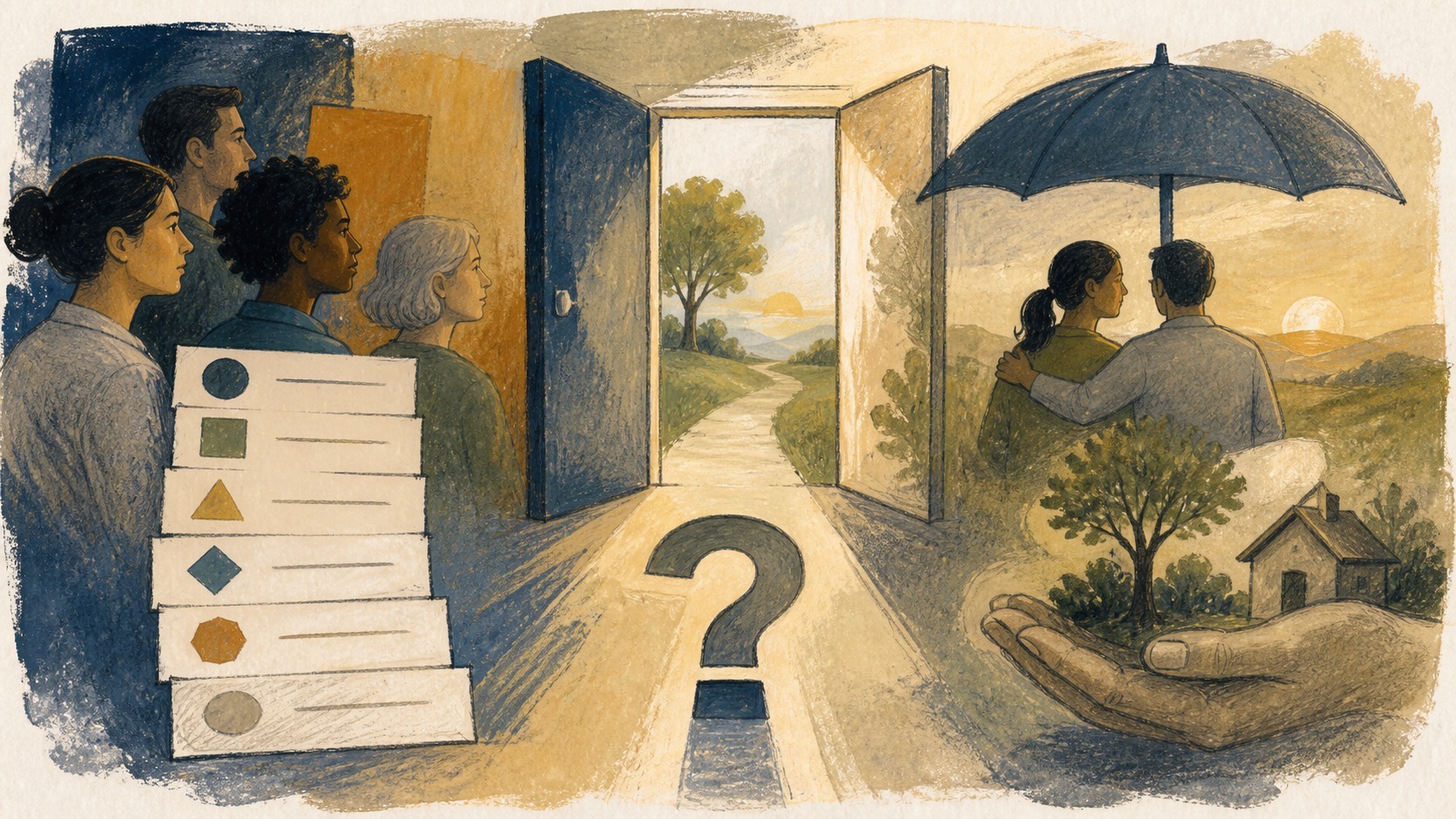
Lucía opened the app before breakfast and found that she had three fewer shifts that week. She had not missed work, delivered orders late, or received a complaint. Yet her score had fallen. Over recent months, she had declined several night routes because she needed to collect her mother from a day center and the person sharing that care could cover only mornings. The screen did not say, “You have been penalized for caring.” It showed a number, a downward arrow, and generic advice: “Improve your availability to access more opportunities.”
The sentence sounds neutral, but it turns a life circumstance into a performance flaw. The app assigns orders and hours through a reputation that nobody can understand or challenge. For Lucía, the consequence is not abstract: fewer shifts mean less income and less ability to organize the month. For the company, the decision appears as an automatic result rather than a choice someone must justify. That distance is dangerous. An algorithm that distributes work also distributes security, time, and the ability to sustain a life outside work.
Dignity does not require that every person always receive the shift they prefer. It requires that a rule affecting income so directly can be understood, questioned, and corrected without forcing someone to reveal intimate details. Automated assignment can help organize a large fleet. It cannot become an excuse for hiding criteria that systematically penalize people with caring responsibilities, a health limitation, or a legitimate scheduling need.
An opaque reputation is not an explanation#
A score gathers different decisions beneath a number that looks objective. It may include punctuality, order acceptance, miles traveled, customer ratings, and night availability. The issue is not only knowing which variables exist. It also matters how they are weighted, which time periods are used, which exceptions are allowed, and what each change produces. If declining a night route reduces the chance of receiving daytime work, a person needs to know before that consequence appears in their pay.
A score gathers different decisions beneath a number that looks objective. It may include punctuality, order acceptance, miles traveled, customer ratings, and night availability.
An actionable explanation does not hand over platform code or an incomprehensible list of coefficients. It says in plain language which factor influenced an assignment, which data were used, how long the effect will last, and what reasonable action the person can take. “You received fewer routes because night refusals reduced your general priority” is not yet a fair answer, but it makes the problem visible. “Your score has changed” gives someone no option except obedience to an unknown rule.
The explanation must arrive at the right time. It is not enough to publish it in a lengthy policy at hiring or hide it behind a data request. It needs to appear when a person loses access to shifts or a rule changes. It also needs to acknowledge uncertainty. If the system cannot explain why it recommended an assignment, that assignment should not by itself decide an income difference that may carry on for weeks.
Availability is not a measure of merit#
Treating total availability as a workplace virtue looks efficient because it is easy to measure. Yet it rewards people who can accept every hour and disadvantages people combining employment with care, study, limited transport, or recovery from illness. Inequality does not disappear because the app does not ask why. It can be reproduced precisely when a seemingly blind criterion penalizes the conditions that make unlimited availability impossible.
In Lucía's case, the system does not need to store her mother's diagnosis or the day center's timetable to avoid harm. It is enough that a protected scheduling preference does not lower general priority. The platform can record that a person is not available at night without turning that boundary into evidence of lower commitment. Asking for private details to prove that care is “valid” shifts an unfair burden: it requires a person to disclose a life in order to receive treatment a better-designed rule could provide by default.
Data minimization is a form of practical justice. A company needs to know when someone can work and what kind of route they can safely accept. It does not need the intimate reason for every limit or a permanent record of it. Separating preference, restriction, and personal explanation stops an app from becoming an archive of vulnerabilities. It also reduces the temptation to use care, health, or family information for other purposes.
Human review needs a deadline and power to change#
A review route cannot be a form that ends in the same automated answer. It must reach a person who can see the rule applied, examine the case, and change an assignment or score when the outcome is unfair. That person needs enough independence not merely to confirm what the system already said. They also need a clear deadline. A review that arrives three weeks later does not repair shifts a courier lost this week.
The request should be possible in one plain sentence: “My schedule restrictions are reducing my shifts unfairly.” It should not require Lucía to write a medical narrative, supply unnecessary documents, or tell several employees who depends on her. If a particular restriction must be checked, the process should ask for the minimum, restrict access, and explain who will see the information. Its purpose is to correct an assignment, not investigate a worker's private life.
Correction cannot become punishment either. If someone asks for review and then receives fewer orders, worse routes, or pressuring messages, the remedy becomes dangerous and nobody will use it. The company must ban retaliation, record subsequent changes in aggregate, and let worker representation audit whether people who complain experience negative consequences. Protecting review matters as much as offering it.
Design rules that do not make people prove harm#
A sound assignment rule begins by separating what organizes the service from what ranks people. It can use declared availability so that it does not offer an incompatible route. It should not translate that availability into a global reputation that affects other shifts. It can balance areas, rest time, and workloads. It should not treat refusals tied to communicated limits as a sign of unreliability.
Before activating a system, a company can test it against scenarios that reveal inequality: a person who does not work nights, another with a temporary limitation, one using public transport, and another who accepts every shift. The question is not who ranks first in the simulation. It is whether a legitimate restriction unjustifiably reduces opportunities in compatible hours. If it does, the rule must change before it affects real income.
Worker representation should participate in that design and have access to aggregate results: distribution of shifts by time band, review rate, score changes, and persistent differences among groups. This is not about classifying people by private life. It is about detecting patterns of harm. When a rule appears neutral but consistently leaves one group with fewer hours, the problem is not individual. It is a property of the system that needs correction.
Make responsibility for assignment visible#
The word “automatic” can dilute responsibility. Yet someone chooses the variables, approves their weights, sets thresholds, and decides whether a recommendation becomes an assigned shift. The company must name the person or team responsible for each of those decisions and publish a way to contact them. Saying “the algorithm did it” does not explain why a worker has lost part of her week.
The rule should be reviewed regularly, not only when a complaint appears. Each month, the team can compare who requested review, how long it took to resolve, which corrections were granted, and whether any schedule boundary is producing indirect effects. A software change, a new area, or a high-demand season can turn a previously acceptable rule into a harmful one. Ongoing review stops a small bias from becoming an invisible habit.
The next step is clear. The platform can remove from the general score refusals that reflect declared availability, explain every change of priority, and offer human review within a short period. It can protect minimal data and prohibit verifiable retaliation. Lucía should not have to tell her mother's story in order to keep shifts she can perform. An organization that assigns work with technology demonstrates dignity when it lets people set limits without paying for them through a secret reputation.