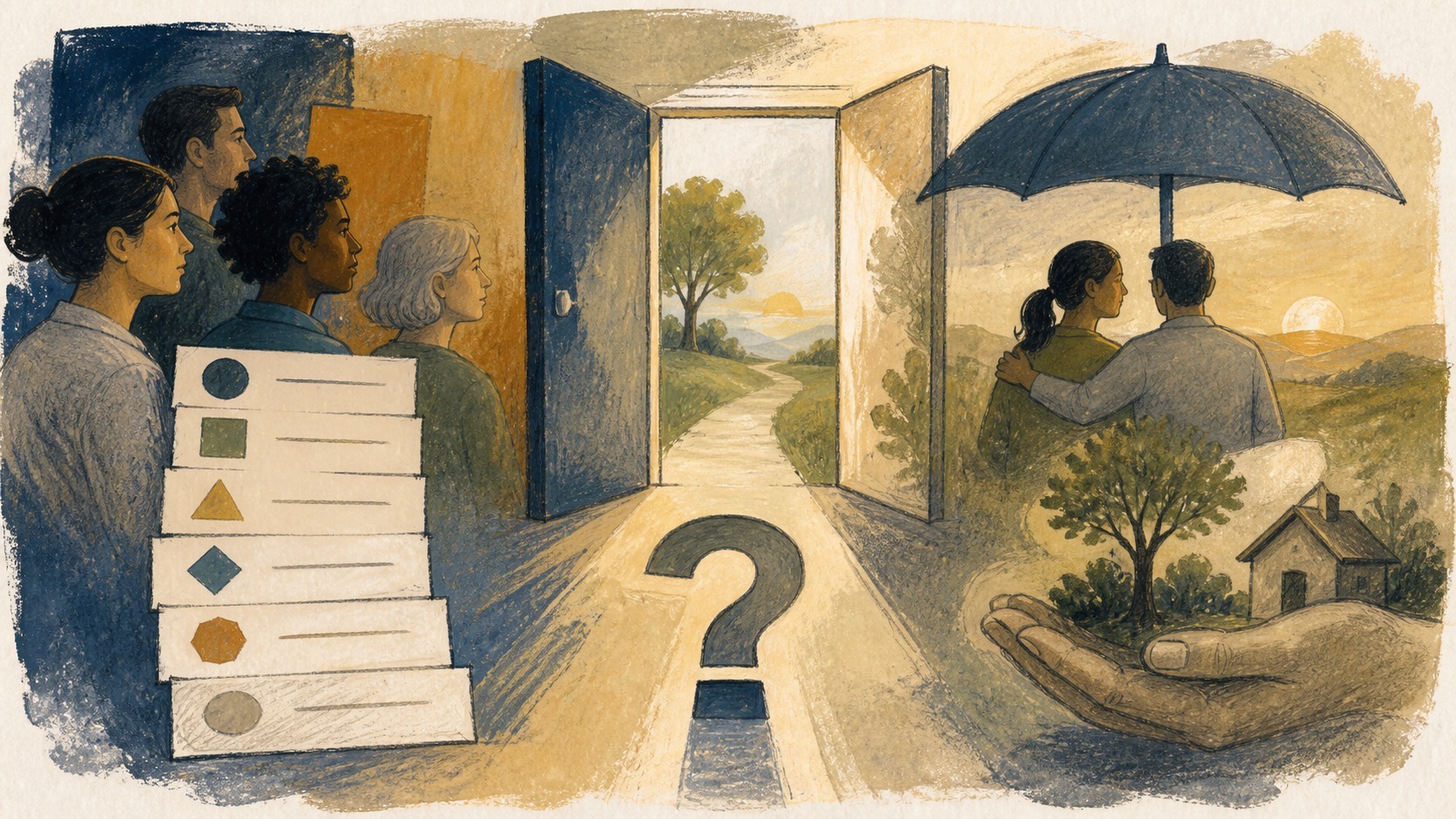
At eight twenty, the company's incident dashboard appeared to be working with enviable calm. Almost every request received an automatic label and moved into a defined queue. The screen celebrated that average classification time had fallen. Inés, hired to cover three months of holidays, saw a different reality in her inbox: the cases that did not fit. A person who had lost access and needed to change language; a charge with two addresses; a delivery linked to a restraining order; a customer whose name appeared in two forms. The system sent these situations to “review.” Inés had no protected minutes to review them and no permission to change a decision affecting another team.
The classifier had not removed the difficult work. It had concentrated it in the role with the least room to refuse it. That concentration is often absent from efficiency reports because the main metric counts processed requests and average route time. An exception takes longer, interrupts other tasks, and requires asking for help; yet when it is diluted among hundreds of quick decisions, it barely changes the average. For Inés, the exception is not a small statistical deviation. It is the part of the day that turns a temporary assignment into a chain of urgent situations without authority.
An average can hide an unequal line#
Classifier efficiency is usually presented as a technical question: accuracy rate, automation achieved, waiting time reduced. These are useful measures, but they are incomplete if they do not ask who handles what the model fails to recognize. Two systems can have the same average time and distribute the burden in radically different ways. In one, doubtful cases rotate among experienced people with protected schedules and the power to correct. In the other, they land with a temporary worker while final decisions remain with supervisors who are only available during particular hours.
Classifier efficiency is usually presented as a technical question: accuracy rate, automation achieved, waiting time reduced.
To see the difference, the organization must measure by person rather than by queue alone. Every week it should know how many exceptions each role receives, how much time they take, how many require transfer to another unit, how many return because no response arrived, and what consequence follows when they are delayed. It also matters to distinguish a genuinely complex incident from one blocked by the design itself. If Inés cannot correct a clearly wrong field, approve a small refund, or request additional information safely, many minutes come not from the case's complexity but from a rule that has stripped away her ability to resolve it.
This measurement needs care. It must not become another ranking that punishes whoever receives the most difficult cases. The purpose is not to prove that someone is slow. It is to find where the cost of ambiguity is deposited. A useful record groups exception types, notes waiting time imposed by authorizations, and records whether the person could close the case or had to transfer it. Read closely, it may reveal that an apparently minor category—changes to contact details—creates an entire afternoon of calls because the system treats every update made from a shared phone as suspicious.
Time to repair must exist before the error#
When an exception arrives, the usual response is to ask for “agility.” The person receiving it is expected to resolve it quickly, remain courteous, and keep the queue from growing. That is not a repair plan; it is a demand for individual effort. Repair requires time planned into the shift. If the classifier sends thirty ambiguous cases to one person, their schedule must recognize that work as surely as it recognizes a meeting or a standard service task. Otherwise the company presents as savings the invisible hours someone else takes from breaks, training, or ordinary requests.
At Inés's center, one practical change would be to reserve review blocks and assign cover when an agreed volume is exceeded. It is not enough to say that the supervisor is “available.” The process must name who takes cases during an absence, how long a person may wait at most, and which tasks can be postponed without penalizing the person handling the exception. These choices may sound administrative, but they determine whether a bad classification becomes a brief inconvenience or a harm that lasts for days.
Authority matters as much as time. A person cannot repair harm if they can only describe it. Inés should be able to correct plainly erroneous data, override a low-risk label, activate a human-support route, and grant compensation within a clear limit. For higher-impact decisions, she needs escalation with a named owner, a deadline, and a binding response. Authority does not mean leaving her alone with sensitive situations. It means the system must distinguish what can be resolved close to the case from what needs further deliberation. Escalation without a deadline is a polite way of abandoning someone in the queue.
Redistribution is not moving blame around#
If the data show that exceptions fall on a temporary contract, the answer is not to train that person to endure them better. The distribution must be reviewed first. The organization can establish rotation across teams, a specialist duty for sensitive categories, and a rule preventing one person from receiving a disproportionate share of unresolved cases. Rotation needs paid training and access to the information required to act. Sending a case to another desk without context only lengthens the route and forces a customer to repeat a story they have already told.
Redistribution also requires examining incentives. If the main team is judged by closing many easy cases, it has a reason to keep ambiguities off its dashboard. If the review team is penalized for every extra minute, it will tend to close cases with insufficient information. The organization can adopt a shared measure: the outcome of an exception is part of the quality of the entire route, not the problem of a separate office. Then the people who design rules, configure the classifier, and answer affected people all have a reason to prevent the problem, resolve it quickly, and leave a verifiable improvement.
A monthly case session can turn repeated failures into design changes. There is no need to read every incident. It is enough to select patterns: requests involving compound names, shelter addresses, tasks completed by carers, orders combining a return and a repair. Inés and the other people working the queue should be able to explain what happened without risking a session being used to assess their performance. The result should be a list of changes with an owner and date: a rule adjusted, a field enabled, a message rewritten, a category removed from automation.
A harm threshold changes the conversation#
Every automated process needs a point at which it is no longer acceptable to proceed as though failure were normal. That threshold cannot be only a drop in the accuracy rate. It must include human signals: one person accumulates more than an agreed number of exceptions in a shift; a case waits beyond a defined deadline; a category concerns safety, health, housing, or income; a correction repeats after it has been documented. When the threshold is crossed, the classifier pauses for that category or sends it directly to a human route until the cause is investigated.
The pause must protect rather than punish. If the system stops, Inés cannot be blamed for the temporary increase in work, and the team must not improvise how to handle what remains. The plan should state which resources activate, who tells users about the change, and how evidence is preserved so the model can be corrected. A well-designed pause shows that the organization understands the difference between tolerating an imperfection and accepting repeated harm because aggregate numbers remain favorable.
At the end of the week, the best indicator will not be that the dashboard has returned to green. It will be whether the organization can answer a more specific question: what happened to the cases that did not fit, and who had real power to repair them? If Inés still receives every ambiguity without time or decision-making power, the classifier has merely exported its limit to the most fragile contract. If the burden is measured, shared, repaired with authority, and able to stop the system when it causes harm, automation no longer uses exceptions as a dumping ground. That is the condition worth writing down before the next rule goes live.