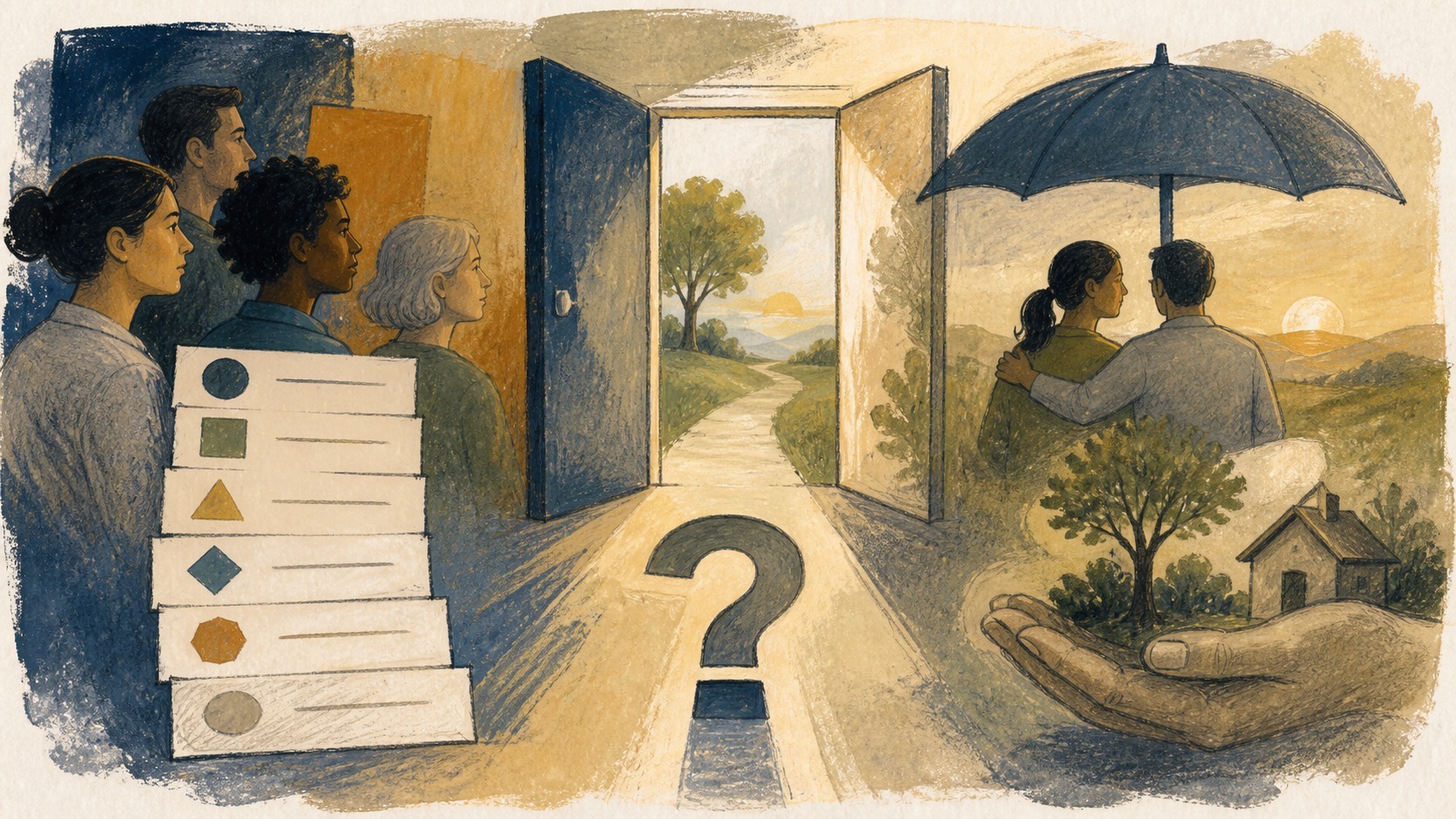
On a Tuesday afternoon, a family arrived at the neighborhood association for the first time. Their child would not let go of her father's hand, their form was half completed, and they carried questions they did not yet know how to ask. At the reception table, a sign displayed a QR code: “Write here and you will receive all the information.” Someone suggested that a bot should handle that first message from the following week onward. It sounded sensible: immediate replies, coverage outside office hours, orderly records. Yet two volunteers pointed out what the benefits list missed. That first conversation was not simply a way of delivering instructions. It was the moment when a family learned whether they could speak slowly, whether an awkward need had a place there, and whether anyone would remember what they had shared.
This is not an argument for treating human service as a noble relic opposed to a cold machine. Some repetitive tasks are worth simplifying, and many people appreciate being able to check a detail after hours. The problem begins when we call an operation “welcome” even though it only sorts requests. A community can decide not to automate certain moments because their value is relational. That is not a rejection of progress. It is a choice about what kind of relationship the group wants to offer and what responsibility it refuses to hide behind an interface.
What happens before a person asks the question#
People arriving for the first time rarely present a neat request. A parent may ask about the cost of an activity while actually testing whether they can mention financial difficulty without being exposed. They may ask about a timetable while trying to find out whether their child will be supported when they freeze or struggle. They may write in short sentences because they do not command the local language, feel embarrassed about asking for help, or have been let down by institutions before. A bot can recognize words, display a link, and log an issue. What it should not pretend is that it has understood the full meaning of a pause, a hesitation, or an indirect request.
People arriving for the first time rarely present a neat request. A parent may ask about the cost of an activity while actually testing whether they can mention financial difficulty without being exposed.
Listening does not mean guessing someone else's life. It means leaving room for them to clarify, correct, or simply say, “I do not know where to start.” That possibility needs time, tone, and permission to depart from a script. In a welcome offered in person, by phone, or on video, the person receiving the message can ask whether the family would rather continue another day, explain which information is not needed yet, or find someone who knows a particular resource. Quality is not about resolving everything in five minutes. It is about ensuring that a family does not have to translate a concern into a sentence that fits a menu.
There is an asymmetry here as well. The association knows its procedures, limits, and acronyms; the family does not. When first contact is designed only to save internal time, the burden of learning the system falls on people who have just arrived. That burden is particularly unfair where children are involved, after a recent move, during grief, with a disability, amid precarious paperwork, or without reliable digital access. An organization cannot measure its efficiency while ignoring the effort it pushes onto its own doorstep.
Separate administrative help from an arrival conversation#
The alternative is not to ban all automation. It is useful to sort tasks by the kind of harm an inadequate response could cause. A system can send the address, confirm that an application has arrived, remind someone about a missing document, or explain where public rules can be found. It can do this when the message clearly says that it is automated and makes a human route visible. In that territory, the tool reduces waiting without deciding what a person needs.
First welcome belongs in another category whenever it requires interpreting context, building trust, or making a consequential decision. A bot should not assess whether a family can receive support, respond to a disclosure of violence, handle a health-related need, explain an exclusion, or guide someone through a conflict. Nor should it collect sensitive information at the outset “just in case.” When an answer goes wrong in these situations, it does not merely produce a badly classified record. It may cause someone to leave and never return.
A simple rule can make the boundary discussable: if a reasonable person might feel ignored, singled out, or pushed to reveal more than necessary by an automated answer, that interaction should reach a human first. The rule does not require a team to be available twenty-four hours a day. It requires honesty about timing. “We have received your message; a member of the team will respond by six tomorrow” may be more caring than a performance of closeness that will never take responsibility for the reply.
Decide with the people who carry the welcome#
A short session can turn scattered impressions into working criteria. The group can draw the journey from first contact to the first activity and mark where intimate information, language barriers, urgency, cost questions, or admission decisions appear. It can then sort each step into public information that may be automated, information that needs supervision, and conversation that must remain human. The result need not be a solemn policy document. It can be a one-page map that any volunteer checks before replying.
This exercise also exposes a practical requirement: a human welcome needs support. It is not enough to say that the bot will not replace anyone if the same two people remain available without training, cover, or access to the information they need. The community must agree realistic shifts, a support person for complex cases, and a safe way to hand a conversation over without forcing a family to repeat its story. Keeping human contact requires organization, not romantic language.
Build a boundary people can understand#
The boundary must include data as well. First contact is not an opportunity to collect a person's entire life. A form can ask only for a contact name, a preferred way to be reached, and a general reason for getting in touch; details can wait for a conversation where they are relevant. If a platform stores messages, the community must know who can access them, how long they remain, and how they are deleted. Asking for less at the beginning protects both the family and the person providing help.
An exit from the automated route is equally important. Every message should contain an easy path to a person: a phone number, an in-person time, a monitored email address, or the option to write “I want to speak to someone.” It should not be hidden behind five buttons. The human alternative must work for people who cannot use a digital channel, do not know the terminology, or need a slower conversation.
Test without making the test an abandonment#
Before introducing a bot, a community can run a limited trial with low-risk uses. For a month, let it answer only three common questions, and ensure that every message expressly invites the reader to contact the team. At the end, do not merely count how many messages it resolved. Review how many people asked for human help, where the system misunderstood, which questions arrived repeatedly, and whether anyone gave up before making contact. A speed metric without those stories may be celebrating the barrier the tool created.
Choosing not to automate first welcome may reveal that the real problem was not slowness but a lack of resources or a poorly explained route. A bot cannot fix an impossible schedule or compensate for an exhausted volunteer network on its own. Sometimes the responsible decision is to simplify forms, publish clearer information, and set aside one weekly hour for new arrivals. That is less spectacular than installing a tool, but it may answer the need that prompted the proposal far better.
The promise a community can make#
A family does not need an association to promise perfect availability. It needs to know that, when something matters, it will find a named person with clear limits and the ability to ask another person for help. That commitment can welcome technology around it: reminders, calendars, reviewed translations, confirmations, and appointment planning. But it does not mistake those supports for the relationship that lets someone begin to belong.
The next step can be very concrete. At the next meeting, choose three recent first-arrival messages and ask which part was administrative, which part needed listening, and which answer would have been harmful if it had been automated. Write down one limit, one human channel, and one response time. Then test the agreement for four weeks and revisit it with people who arrived during that period. When a community can explain where it stops automating and why, it is not becoming less modern. It is making the care it intends to sustain visible.