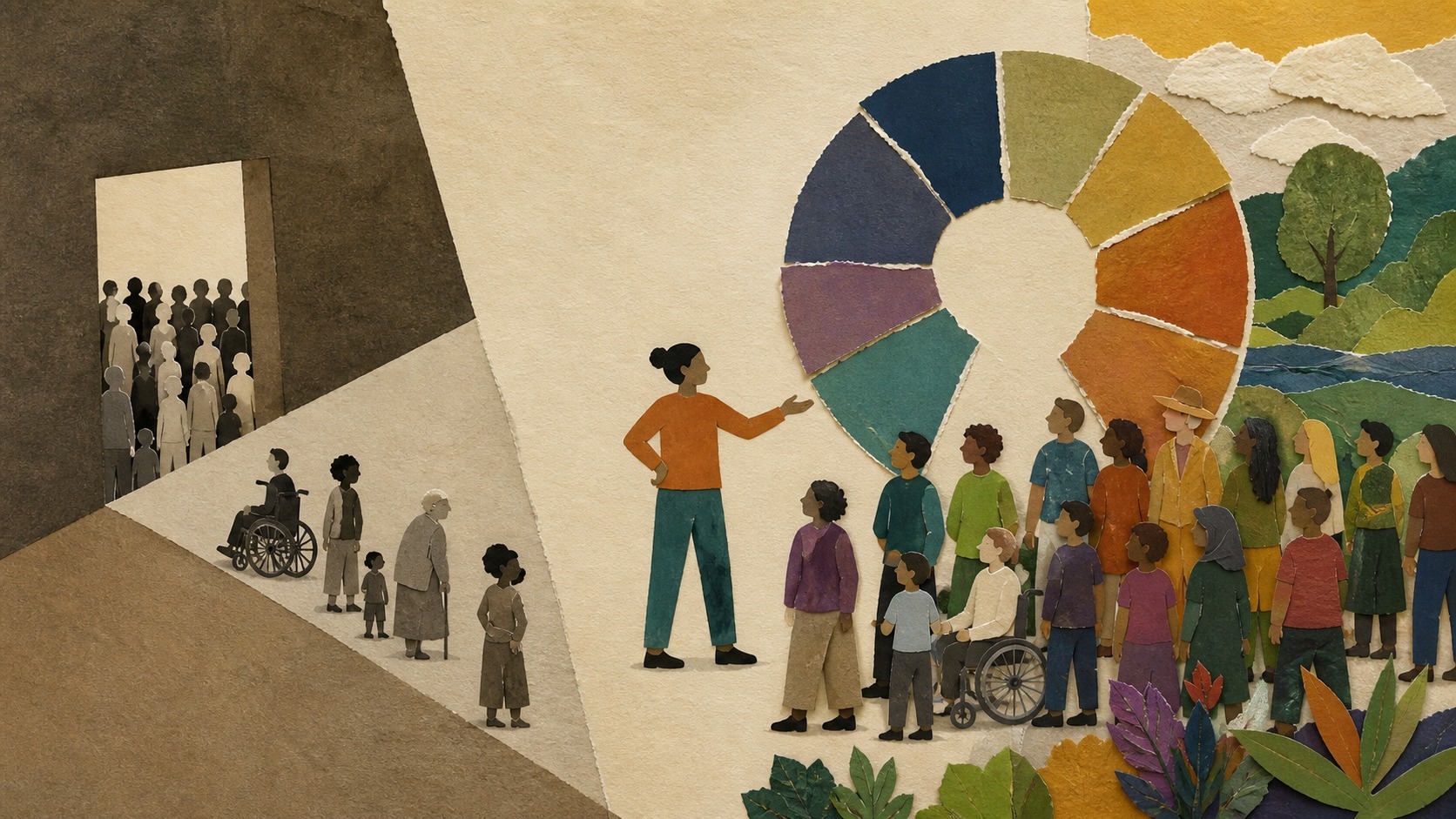
On Monday morning, Nora walked into class, looked at the digital challenge board, and saw that she had fallen three places. On Friday she had spent time with Leo, not handing him the answer to a division problem but asking him to draw it, test it, and explain what was not fitting together. Over the weekend he completed two more activities and collected individual points. Nora did not regret helping him; explaining an idea helped her think as well. What troubled her was the rule she had learned without anyone stating it aloud: time spent with another learner cost a visible position, while moving quickly alone was rewarded on the screen everyone saw.
This is not a story about selfish children or an evil app. It is a more specific design problem. A challenge can make two worthwhile actions compete with each other. When the interface rewards accumulated speed and displays it as a public ranking, mutual help acquires a measurable cost. A poster asking students to collaborate cannot repair that contradiction. The relevant question is what choice the system makes sensible, what work it leaves unrecognised, and what atmosphere it creates every time the leaderboard refreshes.
A place on the board is not a summary of learning#
Rankings are attractive because they make activity easy to see. A teacher gets a quick overview, some students get a clear target, and repetitive practice can feel more lively. Yet one number combines very different conditions: reading speed, reliable internet, prior familiarity with the interface, time available after school, and sometimes support at home. Treating that bundle as a transparent measure of learning confuses a trace of use with understanding.
Rankings are attractive because they make activity easy to see. A teacher gets a quick overview, some students get a clear target, and repetitive practice can feel more lively.
Public display adds a particular pressure. Comparison no longer stays inside each student's own record; it becomes the shared scenery of the room. A student near the top may feel obliged to defend that place. A student near the bottom may avoid admitting confusion in order not to confirm a reputation for slowness. In between, offering a hint or asking for one can look strategic. The person who explains risks losing an advantage; the person who receives help may worry about appearing dependent. A conversation that could improve an idea becomes a quiet calculation about status.
The design also reshapes adult attention. When the dashboard is treated as the main sign of progress, a teacher can end up spending energy on the exceptions it produces: an activity that failed to save, an attempt that was locked, a shared device that registered the wrong account. Those matters deserve attention, but they can crowd out richer questions. Who reformulated a useful question? Which group noticed that a source was weak? Who found a way to explain an idea to somebody who was excluded from the discussion? Accurate click counts do not automatically provide good observation of learning.
Helping is intellectual work#
During a science activity, Marta did not solve Leo's task for him. She asked him to sketch the path of the water, look again at the glass on the table, and write down what had changed. In explaining those prompts, Marta had to organise her own reasoning. Leo could test an idea without having to defend himself in front of the whole class. That matters because help is not always a transfer of answers. It is often the work of creating conditions in which someone else can think more clearly.
If the system records that exchange only as an unproductive pause between two tasks, it is teaching that the exchange does not matter. The remedy is not to attach a coin to every helpful gesture or monitor every conversation. That would invite performances of helpfulness for credit. A better approach is to collect small, qualitative evidence. A pair might note what question was raised, which explanation changed after talking, and what still needs checking. A group might show two routes to an answer and explain which one made the idea easier to grasp.
Such evidence is not a contest in kindness. It helps make the process visible. It can reveal that a student repeats a procedure without understanding it, that explanation work is always falling to the same person, or that a quiet student has an unusually effective way of representing an idea. It can also protect privacy. Collaboration does not require a learner to announce that reading is difficult, that an instruction was confusing, or that extra time is needed. Voluntary peer support, anonymous question boxes, rotating roles, and private conversations with the teacher can all preserve dignity while opening routes to help.
Challenge without turning classmates into rivals#
Removing a permanent leaderboard does not mean removing challenge, goals, or feedback. A challenge can remain lively when it changes the question guiding the activity. Instead of asking, “Who finished first?”, it can ask, “Which strategy worked, why, and for whom?” Rather than showing one list of names, a board can make shared milestones visible: formulating a strong question, comparing two sources, returning to an error, explaining a decision, or finding a way for every person in a group to take part.
Visibility should be negotiated, not imposed. Some goals can belong to the whole class, such as documenting meaningful questions or ensuring that every group compares a source. Others are better kept personal and agreed with the teacher: asking for clarification before getting stuck, organising the steps of a problem, or rebuilding confidence in reading. Technology can return a learner's own route without turning it into a public notice. In that form, data offer orientation rather than assigning social worth.
It also helps to separate practice from demonstration. During practice, repetition, error, and requests for support should carry little risk. Later, an individual or team can choose evidence that explains what was learned. This separation stops an early mistake from remaining on the screen for a week as a label. It also makes room for progress that is not linear. A learner may make a significant leap after finding the right question, not after completing the highest number of tasks.
A school does not need to redesign an entire platform at once. It can trial one four-week unit with a clear rule: do not project individual positions, and collect a short weekly reflection on help, difficulty, and strategy. Before starting, the adults and students can agree what they will notice: how many questions circulate, who stops participating, whether peer pairings become more varied, how easily someone returns after a block, and what self-assessments say about explanation. The purpose is not to score children on whether they are collaborative enough. It is to find out whether the environment lets them collaborate without paying a social penalty.
Listen for effects that the report cannot see#
People who encounter the board every day can identify consequences that a vendor report cannot predict. They can say which feature encourages them, which one makes them anxious, and when points push them towards a quick answer instead of a difficult question. Listening does not mean placing the full burden of design on children. It means taking their experience seriously: the joke that follows a low rank, the classmate who stops explaining, the worry of someone who cannot get online at home to catch up.
Families and support staff can add context without having to disclose it publicly. A learner may share a device, care for a sibling, or need more time to process text. These conditions should not become explanations displayed on a board. They should challenge the assumption that a visible pace equals merit. Inclusion begins when nobody has to expose a private circumstance in order to prove that a rule is unfair.
That conversation can lead to checkable commitments: individual rankings are not projected; practice points do not determine grades; help is described through reflection rather than a counter; any student can request a private progress view; and staff review the challenge on an agreed date. These are not decorative settings. They define the relationship technology builds in class.
Return to the next question#
The real test will come when Leo is stuck again. If Nora can sit beside him without feeling she is giving up a position, if he can say, “I do not understand this step,” without the room turning that into a label, and if the teacher gains a useful clue about how to support them, then the challenge is serving learning. If the design continues to reward solitary acceleration alone, no slogan about collaboration will change daily behaviour.
The first step can be modest. Review one screen and ask what it shows everyone, what it calculates, what action it recognises, and what experience it makes invisible. Then test a limited change and listen again. Designing digital education is not a choice between enthusiasm and prohibition. It is a decision about the relationships a small rule creates. When the board stops setting potential learning partners against one another, the challenge can recover its purpose: giving people reasons to investigate, explain, and improve together.