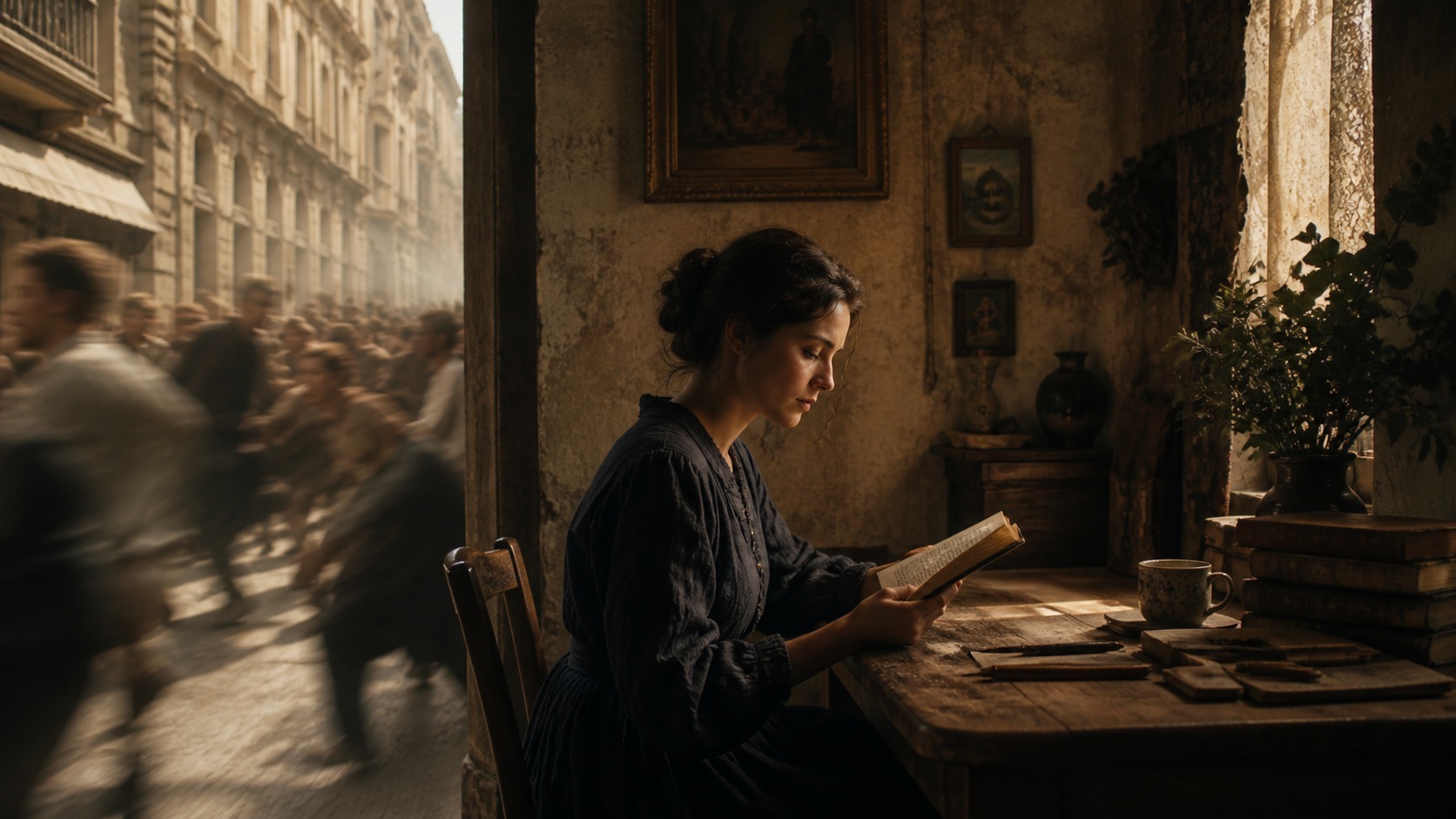
The room goes dark before the group has quite finished entering. A night-time city appears on a curved wall; the floor trembles with the passing of a train and, suddenly, a sequence of flashes fills the whole visual field. Marta, who booked tickets to accompany her nephew, looks for an exit. She cannot find one. He is trying to follow the story in his headphones, but there are no captions and the installation's sound swallows his aunt's explanations. Nearby, another visitor stops: she has been standing for an hour, does not know where a bench is, and fears losing the thread if she steps away.
None of these people has asked for a privilege. They have asked to take part without having to guess the route, endure stimuli that hurt them, or choose between resting and understanding. Accessibility in an immersive exhibition is not a label added at the end beside the ticket desk. It is the way a team decides which experience counts as normal and who can experience it in full. Designing from different bodies, senses, and rhythms does not lower artistic ambition. It makes that ambition more exact.
The issue does not begin on opening day#
Many institutions discover accessibility too late. A few hours before opening, someone asks whether the film has captions. A hurried transcript is commissioned, a movable chair is set aside, and a short warning about intense lights is added. These gestures are better than indifference, but they arrive after the decisions that truly shape a visit have been fixed: the length of each room, the single possible direction of travel, the audio mix, the height of the text, the requirement to use a personal phone, or the lack of a quiet exit.
Many institutions discover accessibility too late. A few hours before opening, someone asks whether the film has captions.
That delay creates an expensive fiction. It suggests that there is a main experience, plus a set of adaptations for people who do not fit it. In practice, well-designed alternatives help visitors who may not identify as disabled, too. Someone who does not speak the narration's language can follow captions. A person arriving after a day of caring work may welcome a seat and a way to rejoin the story. A family with a baby, a visitor with migraine, or a teenager overwhelmed by crowds may need to regulate intensity without giving up the content.
Captions are not text pasted at the edge of a screen#
Captions are often the first visible requirement and are therefore treated as a mechanical task. Yet an immersive exhibition raises decisions that an ordinary film does not solve. If voices come from several directions, how does a visitor know who is speaking? If a sound work tells us something that does not appear in the image, how is that information conveyed without forcing someone to stare at one corner? If text sits over a projection whose colours keep changing, does it still have contrast? If someone enters halfway through a sequence, can they find their bearings without waiting twenty minutes for it to begin again?
A good captioning system communicates dialogue, narration, relevant sounds, and changes of speaker at a readable pace. It may appear on a stable side screen, on a loaned tablet, or in a version chosen before entry. What matters is that it does not depend on a personal phone, an unreliable connection, or type too small to read. It should be tested at the real viewing distance, under the room's actual lighting, and when people are standing in front of it. The team should also ensure that it does not create a strange hierarchy: captions should not be the reward for taking a secondary route that requires leaving the work.
Rest is part of the dramaturgy#
A bench placed at random does not solve a demanding visit. Resting requires knowing where it is possible to pause, how much remains, and what will be missed by taking a break. In an exhibition built around continuity, leaving a room can feel like giving up the work. That is why rest needs an intended function: a place from which some content remains available, a summary that makes re-entry possible, a clear time marker, or an equivalent shorter route.
Imagine the exhibition as a journey through five stations. In the second, visitors cross a sound corridor; in the third, imagery accelerates; in the fourth, they are invited to answer a question. Before beginning, an accessible design offers a simple map showing the intensity of each station and two complete routes: one continuous, another with pauses. Near the third station is a quiet area with seats and steady light, where people can hear a recap of what has come before and decide when to return. It is not a punishment room or an infirmary. It is a legitimate part of the script.
Finding your way means being able to decide#
Immersion is sometimes confused with total disorientation. A work can certainly play with surprise, scale, or the temporary loss of reference points. The problem arises when confusion stops being an aesthetic choice and becomes a practical barrier. If a visitor cannot see an exit, does not know where the next scene starts, or has no way to ask for help without pushing through other people, they lose the ability to regulate their experience.
Orientation can be discreet and still suit the atmosphere. A pre-visit map in plain language and high contrast can identify doors, ramps, toilets, quiet zones, and return points. A tactile cue or a constant sound reference can help someone recognise direction without filling the room with signs. On arrival, front-of-house staff can explain that there is an immediate exit, where it is, and how to return afterward. For some visitors, knowing that option exists is exactly what makes entry possible.
A flash-free alternative must be equivalent#
Warnings about flashing lights are necessary, but they do not release the design from responsibility. Saying “contains flashes” informs a person; it does not offer participation. An equivalent alternative provides access to the same story, the same materials, and the same possibility of discussion without exposing someone to a stimulus that may cause pain, disorientation, or a seizure.
Equivalent does not mean identical in every technical device. A room can offer a version with gentle transitions, lower volume, and stable light. An audiovisual work can have an alternative edit that preserves the narrative without flicker. An installation can programme low-stimulation sessions without advertising them as an embarrassing favour. The key is that a visitor does not receive a thin synopsis while other people experience the complete work. If the final discussion depends on a decision that appears only in the high-intensity version, the alternative is not enough.
Testing early changes the relationship with visitors#
The most valuable measure happens before the final projector is bought. A museum, cultural centre, or festival can invite diverse participants to testing sessions and pay for their time as expert knowledge, not as a symbolic gesture. The invitation should say what will be tested, what support is available, and which decisions remain open. Afterwards, the team needs to document more than an observation — “the exit was hard to find.” It needs to record the barrier, its impact, the working hypothesis, and the proposed change.
A simple log can have four columns: point in the route, barrier observed, consequence, and owner with a date. At the first test, for example, two people did not understand where the narrative began because they entered through a side door. Both left early. The response is not to blame them for arriving late; it is to test a repeatable visual and sonic welcome at every entrance. In another session, a visitor could use captions but had nowhere to sit while reading them. The solution must test captioning and rest together, because barriers rarely arrive alone.
The best immersion does not demand endurance#
An intense experience can be memorable without making endurance a condition of entry. When captions, pauses, orientation, and flash-free alternatives are considered from the start, the exhibition says something consistent with its own promise: the public matters as a real presence, not as an imagined outline.
The next practical step is to review one scene before it is locked. Bring together the person writing the script, the person designing the space, the person producing sound, and the person welcoming visitors. Ask what information is lost if someone cannot hear, cannot stand, needs to leave for a minute, or avoids flashes. Choose an equivalent alternative for each situation and test it with people unfamiliar with the work. If the route still makes sense at different paces, immersion has not been diluted. It has become inhabitable.