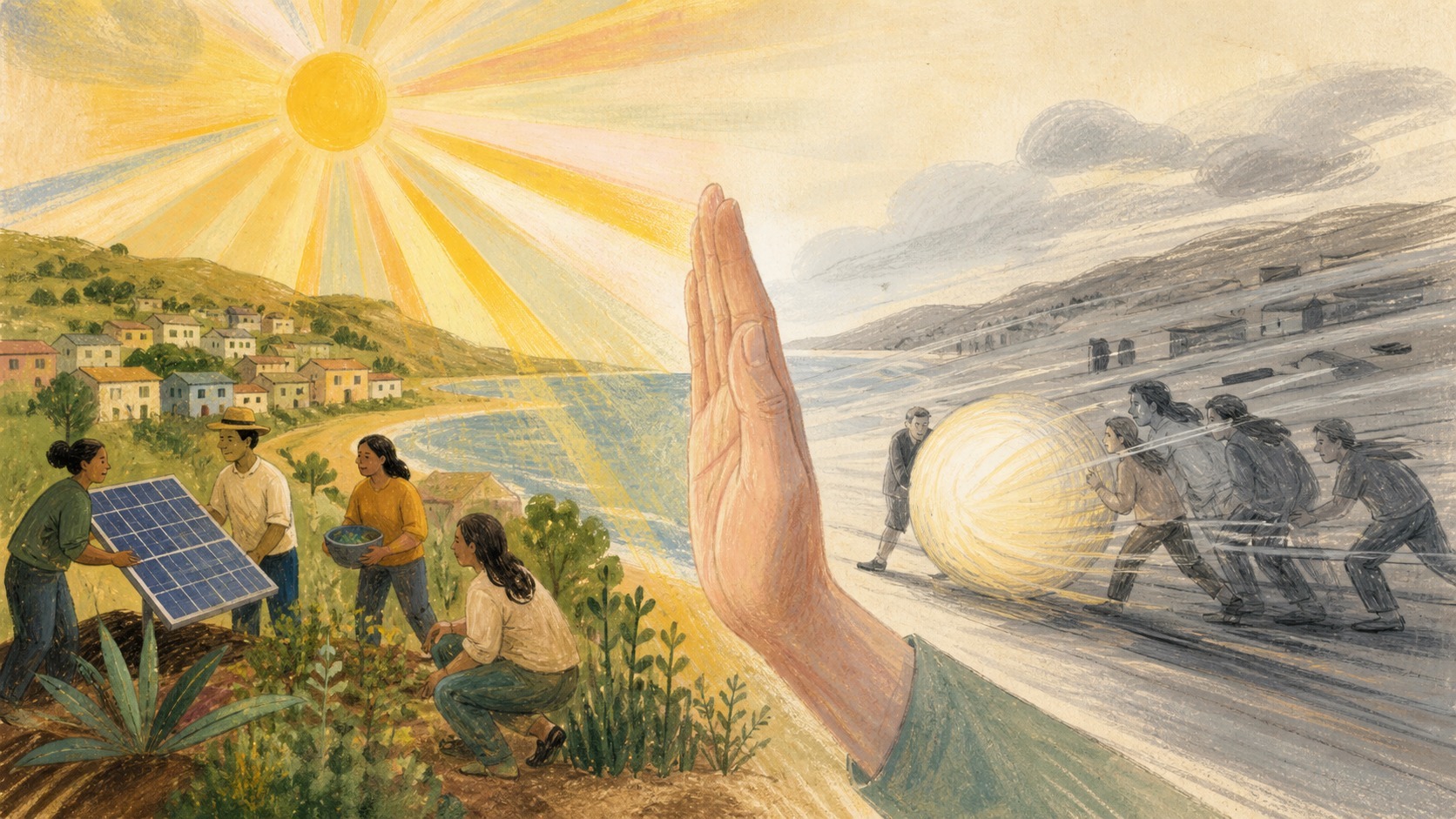
Participating and deliberating without polarising does not require identical views. It requires conditions in which people can hear facts, state disagreement and agree on a next step without accepting it through fear.
Step one: define the decision and its boundary#
A sign of progress is not the disappearance of disagreement; it is a discussion that leaves a checkable record. Before judging a meeting as good or bad, ask whether the question was understood, whether facts were separated from opinions, and whether a dissenting person could explain their reason without ridicule. Record the information that was missing and who can provide it. This observation turns a quick impression into collective learning and prevents a group from mistaking silence for agreement.
A sign of progress is not the disappearance of disagreement; it is a discussion that leaves a checkable record.
Use four simple indicators: diversity of voices, quality of sources, clarity of the decision, and safety of the exchange. They need no elaborate score. Record who participated, which document supported the measure, who owns the next step, and whether there were interruptions, insults, or disclosure of personal data. UNESCO and the Council of Europe describe critical, inclusive citizenship; in practice, it is visible when rules allow people to change their minds without losing dignity.
Step two: make the exchange safe#
Pause and seek institutional mediation when there are threats, repeated harassment, discrimination, disclosure of personal information, or a power relationship that prevents free speech. The Spanish Data Protection Agency advises limiting shared data and protecting children information in particular. UNICEF stresses that participation must be safe and genuinely influential. Seeking support does not invalidate deliberation: it protects people so disagreement does not turn into harm.
Step three: ask a shared question#
Choose one concrete matter: improving a playground, setting a timetable or reviewing a rule. Replace “who is right?” with “which decision is needed, what information is missing, and who is affected?” Record the purpose, deadline and boundaries: no insults, threats or disclosure of personal data. The Council of Europe links democratic participation with equal voice; a useful conversation makes room before it asks for agreement.
Step four: organise evidence, experience and proposals#
Prepare three visible columns. Facts include schedules, budgets, rules and checkable information; experiences include the effect a person describes; proposals include measures that can be tested. This stops lived experience being treated as a statistic and a rumour being treated as evidence. UNESCO promotes global citizenship grounded in critical thinking and respect; checking a source is not the same as dismissing a speaker.
Case one: neighbours argue about noise#
An association received complaints about a concert. Some residents wanted a ban while others said the neighbourhood should not give way. The facilitator first asked for facts: timing, permits and affected areas. Then she gathered needs: rest, cultural connection and predictability. The agreement was to test an earlier time, give advance notice and provide an incident contact. Labels became a reviewable experiment rather than an identity battle.
Design turns and rules that protect people#
Use short contributions, a speaking order and a summary rule: before replying, each person can restate the previous idea so its author recognises it. Offer written notes to people who cannot speak publicly. UNICEF says participation should be safe, inclusive and genuinely influential; explain what will be decided in the meeting and what will be reviewed later. Facilitation does not control opinion. It prevents volume from replacing an argument.
Case two: a class debates a school measure#
A secondary school discussed restricting phones. Some students feared unfair punishment and staff needed concentration. Instead of voting at once, the group mapped moments: arrival, break, emergency and learning activity. It tested a voluntary phone box, family contact routes and an incident review without names for two weeks. WHO notes that participatory settings support wellbeing when people can influence decisions. The resulting rule was clearer and less punitive.
Use sources without wielding authority as a weapon#
Share institutional links and say what question they clarify. A municipality may explain a bylaw; the Spanish data-protection authority may explain privacy; a public-health guide may explain risk; and an international organisation may explain rights. Also say what each source does not answer. If a misleading message appears, correct the claim rather than attacking the person. UNESCO media literacy asks who published, on which evidence and when it was updated.
Case three: families discuss photographs#
After an activity, someone posted childrenʼs images in a chat. Some families wanted memories and others requested immediate removal. The group stopped forwarding, consulted the AEPD guidance and split two decisions: remove current images and agree specific permissions for future ones. One person confirmed the removal privately and another prepared a simple form. Repair was quicker because winning the argument was no longer the goal.
Step five: test, review and adjust#
A proposal should name an owner, date, resources and review signal. Instead of “we will communicate better,” write “for one month there will be two turns, a neutral summary and a private channel; on day 30 we will review attendance, incidents and comments.” Do not measure only attendance. Ask whether rules were understood, whether someone was excluded and whether disagreement could be voiced without retaliation.
When to pause and seek support#
Where harassment, threats, discrimination or risk appear, deliberation should not continue as routine conversation. Pause, protect information and involve leadership, mediation, social services or emergency resources as appropriate. Responsible participation never requires a person to debate their own dignity. Keep a minimal memory of agreements and learning, not intimate stories.
A practice worth repeating#
Before the next meeting, share the aim, available information, rules and decision route. During it, listen, distinguish the layers and turn a proposal into a test. Afterwards, communicate what was agreed and what remains open. Use the Council of Europe, UNESCO, UNICEF, WHO and AEPD as quality frames; no source replaces care for particular people. The aim is not to remove conflict but to move through it without turning another person into an enemy.
Prepare a conversation that can continue#
Before inviting people, share a short sheet with the question, available information and the decision that can actually be made. State what will not be decided yet. Ask every participant to bring one need, one question and one testable proposal. Preparation reduces the advantage of the fastest speaker and gives people with less time, experience or confidence a common starting point. Keep an accessible channel for advance contributions and explain how they will enter the record.
Facilitation does not replace collective responsibility. It keeps the question visible, shares speaking time, stops attacks and checks that an intervention has been understood before it is answered. A one-minute opening round, a clarification round and a proposal round can help. When a disputed claim appears, record what source could support it and who will find it. The aim is not to win a debate but to leave a traceable decision.
Use evidence without turning it into a weapon#
Share the relevant rule, budget, technical report or record, and distinguish complete evidence from provisional information. The OECD encourages people to assess information quality and its limits, so ask about date, origin, method and likely gaps. If a figure is unavailable, list it as an open question instead of filling the space with a convenient assumption.
Personal stories are evidence of impact even when they cannot alone determine a policy. Hearing that someone cannot sleep, travel or access a service reveals questions that figures may miss. Agreement improves when the group chooses an indicator: incidents, waiting time, attendance, cost or perceived safety. Review it on an agreed date and be ready to change the measure when it does not work.
Three cases for practising without escalation#
At a school, families and teachers disagreed about phones. Rather than argue about generations, they mapped arrival, break, class and departure. They checked the school rule, spoke with pupils and tested a voluntary storage point and emergency protocol for six weeks. The review reduced interruptions and showed that some families needed another contact route. The response was to adjust the protocol, not name winners.
In a cooperative, two shifts argued about invisible work. The meeting began with a two-week record rather than blame. They validated tasks, time, risk and training needs, then agreed on rotation, hour compensation and a named contact. A month later the record showed where inequality remained and the group changed the design. Transparency turned a broad accusation into practical work.
In a town, young people and shopkeepers clashed over a square. The council arranged observation walks at different times, published legal limits and requested proposals with approximate costs. Movable seating, lighting and activity times were tested. Evaluation collected complaints, use and cleaning data. A monthly table stopped one isolated incident from defining the whole relationship.
Protect people who disagree#
Safe deliberation includes ways to speak without revealing sensitive information. Make clear that screenshots, recordings and names will not be shared without consent. If a threat or harassment occurs, stop the session and use the institution's protocol; do not ask the affected person to manage harm alone. Spain's data-protection authority notes that data minimisation is practical care: collect only what is necessary to decide.
Watch for less visible inequalities too. Timing, language, transport, childcare and digital access decide who can attend. Offer predictable invitations, clear materials, interpretation or support where feasible, and records that explain decisions in plain language. The Council of Europe and UNESCO place inclusion and dignity at the centre of democratic citizenship; applying that principle means designing a conversation that more people can sustain.
Close with small, reviewable commitments#
End with five elements: a provisional decision, an owner, resources, an indicator and a review date. Read the record aloud and ask whether it fairly describes both disagreement and agreement. Publish a version without personal data and leave a route for factual corrections. Where there is no agreement, record the alternatives and the criterion that still prevents a choice; a clear pause is better than false consensus.
Practice becomes durable through short cycles. Test a limited measure, observe effects, listen to people who are worse off and adjust. Notice progress: a careful restatement, a corrected source or a sincere apology are civic skills. Participating and deliberating without polarising does not remove conflict; it turns conflict into learning, rights protection and decisions that can still be explained tomorrow.
Build a weekly learning routine#
After every session, spend ten quiet minutes reviewing it. What helped people understand another position? Which source still needs checking? Who could not take part, and what barrier prevented it? Turn the answers into a short list of changes for the next meeting. Share that list early so people can correct interpretations before they become rumours or fixed labels.
Once each quarter, review the conversation rules as well. Do the speaking turns still work? Is more reading time, a hybrid format or accessibility support needed? Measure more than whether an agreement was reached. Ask whether the decision was understandable, whether commitments were completed and whether minority views could describe their experience without punishment. That discipline makes participation a collective capacity rather than an exceptional event.